SEO Tools for Agencies · Updated 5 November 2026
SEO Tool Free Trials Compared
Compare the trial length, card rules, limits and end-of-trial behavior for Ahrefs, Semrush, SE Ranking, Moz and Surfer.
- 18 min read
- SEO tool free trials compared
- Verified against vendor pricing
The short answer
SE Ranking has the longest published timed test at 14 days and does not require a card. Semrush, Moz and Surfer publish seven-day trials, but Semrush disables exports and Moz and Surfer require card details. Ahrefs has no timed trial, but its free account is permanent and does not require a card.
| If you need | Reach for |
|---|---|
| The longest timed test without a card | SE Ranking (opens in a new tab) |
| A full-suite trial with a clear export warning | Semrush (opens in a new tab) |
| A permanent no-card alternative to a timed trial | Ahrefs Free (opens in a new tab) |
| A Medium-level SEO suite trial | Moz Pro (opens in a new tab) |
| A Pro-level content and AI test | Surfer (opens in a new tab) |
Get started with the tools in this guide
Where a vendor offers a free plan or a free trial, it is stated below, so you can try the tool before you pay for it.
-
See Semrush pricing (opens in a new tab)
Semrush
-
Start a free Moz Pro trial (opens in a new tab)
Moz Pro
Free trial, plus a free community account for limited research
-
See Ahrefs pricing (opens in a new tab)
Ahrefs
-
Start a free SE Ranking trial (opens in a new tab)
SE Ranking
14-day free trial, no card required
-
Start free with Surfer (opens in a new tab)
Surfer
Free plan available
These links go to the vendor's own site. We may earn a commission if you sign up, at no extra cost to you. How we fund the site. Every figure in this guide was read from the vendor's pricing page on the date stamped above, so confirm the number before you commit.
- Timed trials compared
- 4
- Longest published trial
- 14 days
- No-card timed trial
- SE Ranking
- Permanent free accounts
- 2
Overview
SEO tool free trials compared is a trial-mechanics question before it is a software question. SE Ranking is the strongest first test for an agency that wants the longest published window without entering card details. Semrush is the runner-up for a team that needs to test a broad suite, but its trial export restriction changes what can be proven before payment.
A trial is a fixed research window. The agency needs to know whether the product answers its own recurring questions, not whether a dashboard looks polished on the first visit. That means recording the number of days, the card rule, the account or plan that opens, the limits that remain in force, and the event that follows the final day.
This page compares Ahrefs, Semrush, SE Ranking, Moz Pro and Surfer using official vendor pages read on 5 November 2026. It does not rank monthly price tiers. The decision here is whether the available window is long enough, open enough and exportable enough for a responsible agency evaluation.
An agency should also separate a free account from a free trial. A free account may be permanent but deliberately narrow. A trial may expose more features for a few days and then turn into a paid subscription. Treating both as “free” hides the most important risk: the time available to make a decision and the action required to prevent a charge.
What we compared
The read date matters because vendors can change trial rules without changing the product name. “Try for free” is not enough evidence of a duration. “Start for free” can describe a paid plan with a checkout path. Where an official page did not state a trial length or end state, this article says so rather than filling the gap with a common industry pattern.
SE Ranking: the cleanest no-card test
Best no-card trial SE Ranking 14 days with starter usage published in the pricing FAQ, read 5 November 2026
SE Ranking is the clearest starting point when the agency wants a real timed trial without a payment-card commitment. The official pricing page publishes a free 14-day trial and places “No credit card required” beside the start button. That gives a team a longer window than the seven-day offers from Semrush, Moz and Surfer, while removing the immediate auto-charge concern that comes with a card-required trial.
The 14 days are not an unlimited copy of every paid quota. SE Ranking says the trial is fully functional with starter usage. The published limits are up to 10 projects, 750 tracked keywords per day, 20 AI prompts per day, and AI competitive research for up to three domains with unlimited reports. The wording matters. A team should use these numbers as the test boundary rather than assume the Core or Growth allowances appear during the trial.
Those limits are useful for an agency evaluation because they cover more than a one-page demonstration. Ten projects can represent a small sample of client sites or internal test cases. The 750 tracked keywords per day provide room to build a representative rank-tracking set, but the trial still needs a controlled list. Twenty AI prompts per day can test a defined set of client and competitor questions, but not an unlimited exploration habit.
SE Ranking’s page does not publish an automatic end-of-trial rule on the checked page. It does publish cancellation and upgrade information, but it does not say that the 14-day trial automatically charges a selected plan, downgrades to a free account, deletes data or extends. That is a meaningful difference from the conversion language published by Semrush, Moz and Surfer. The agency should not infer the missing rule. It should check the account notice or ask support before the window ends.
The SE Ranking review covers the platform beyond the trial window. For the mechanics of a trial, its main advantage is simple: the duration and no-card requirement are both stated clearly, and the trial quotas are concrete enough to plan around.
Semrush: broad access, but no trial exports
Best broad-suite trial Semrush 7 days with most core features, but exports are disabled during the trial
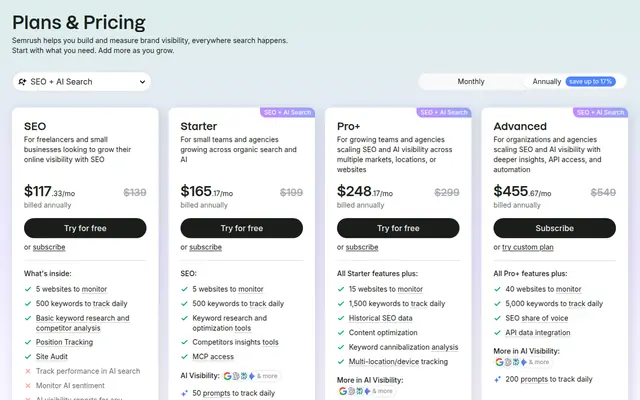
Semrush gives the agency a seven-day trial and a separate permanent Free account. The trial landing page describes seven-day access to its marketing toolkits, while the subscriptions help page says most Semrush toolkits include a seven-day trial. The official free-account article says card details are required to start the trial, even though the $0 Free account needs no payment information.
The trial is designed for breadth. The official trial page lists SEO, AI visibility, content, traffic and market, advertising, local, social and AI PR toolkit routes. The subscriptions page says trials provide access to most core features. An agency can therefore use the window to check whether the platform supports its research, technical audit, visibility and content questions in one place.
The major withholding is exports. Semrush says trial exports are disabled, including when export functionality would normally be included in the paid plan. This turns the trial into an evaluation of the interface, data, filters, reports and workflow, but not necessarily a complete test of client delivery. A team that needs to send CSVs, PDFs or other extracted evidence should mark that as unresolved rather than treating a successful on-screen inspection as proof of fit.
Semrush also publishes eligibility conditions. Each toolkit trial can be activated once per account. The SEO and Traffic & Market toolkits are exceptions to the general trial policy when an account has had a previous trial or paid subscription for those toolkits. A team should therefore use the account that will own the eventual work, not a disposable account that creates uncertainty about eligibility or retained projects.
At the end, the official subscriptions page is explicit: after the seven-day trial, the account converts to the selected plan unless cancelled. If the team continues, it is billed at the standard rate. Cancellation during the trial is free. The card requirement means the calendar reminder is not optional, particularly when the person who starts the trial is not the person who controls billing.
The Semrush pricing explanation goes deeper on paid-plan structure. For the trial decision, Semrush is a good fit when the team wants to see many workflows quickly and can tolerate a card requirement and an export restriction.
Ahrefs: no timed trial, permanent limited access
Best permanent free access Ahrefs Free No timed trial, no card, and limited access that remains active
Ahrefs takes a different route. Its official pricing page says it does not offer free trials, while the Ahrefs Free page describes a free-forever account and explicitly says it is not a trial. There is no seven-day or fourteen-day countdown to manage. There is also no credit card requirement for the free account.
The trade-off is that the account is limited rather than temporarily full. Ahrefs says verified websites are unlimited. Site Explorer for verified websites shows up to 1,000 backlinks and keywords at once. Site Audit gives 5,000 crawl credits per month per project. Web Analytics supports up to 1 million events per project. Social Media Manager offers unlimited channels and posts in beta, and AI Content Helper includes one free document per month. The SEO Toolbar does not require verification.
The end state is also different. The Ahrefs Free account stays active. The pricing page says that when a paid subscription ends, the account switches to Ahrefs Free with limited Site Explorer and Site Audit access. That is a downgrade to a permanent limited account, not an automatic renewal of the free account into a paid plan.
The Ahrefs review covers the paid platform and seat costs. For a trial comparison, Ahrefs is the choice for an agency that values no card, no expiry and a controlled free baseline more than a short period of full access.
Moz Pro: a Medium monthly trial with automatic renewal
Best for a defined Medium-level test Moz Pro 7 days, card required, and automatic paid renewal unless cancelled
Moz Pro publishes a seven-day free trial on its official trial page. The help page adds the detail that matters operationally: the trial is available for the Medium monthly subscription. It is not a free choice of every plan or billing cadence. An agency comparing a different level should not assume the trial reproduces that plan.
A valid credit card is required to start. Moz says the card is not charged during the free trial period, although a temporary authorization of up to $1 may appear and be instantly voided. The help page also says the card is used so the membership can roll into a paid subscription if the account remains open. This is a card-required trial even though the initial seven days are free.
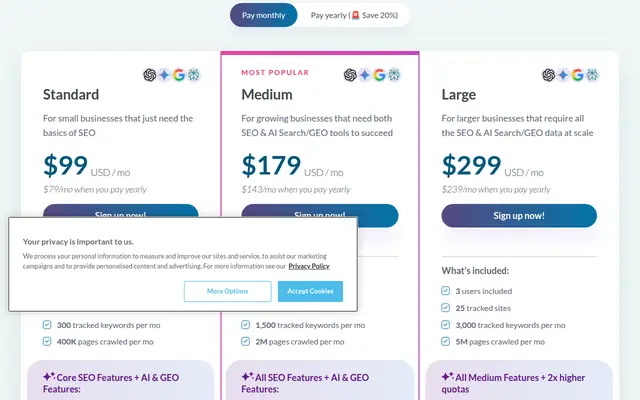
The included scope is more specific than the pricing button suggests. Moz says the trial provides the SEO suite, including Link Explorer, Keyword Explorer, Rankings, Page Optimization and more. The Medium-level description says an agency can set up 10 Campaigns, track 10 sites and three competitors in each Campaign, and use research tools including Keyword Explorer and Link Explorer.
Moz also sets a sharp boundary around changes. The help page says upgrading to a higher level or buying add-ons ends the trial immediately and starts the paid subscription. The trial is not a sandbox in which the agency can freely add every capability without changing the billing state. A billing owner should review any upgrade prompt before clicking it.
The end-of-trial rule is unambiguous. Moz automatically renews the trial as a paid subscription unless the agency cancels. The card is charged monthly thereafter. Moz recommends cancelling at least 24 hours before the end date, and the account keeps access through the rest of the trial. The trial end date appears in the account’s Subscriptions section, and Moz says an email reminder is sent one day before the end.
Moz also mentions a free Community account with limited access to MozBar, Keyword Explorer and Link Explorer. The pricing page does not give a single quota table for that free account. It is therefore not an equivalent free plan to the Medium Pro trial, and a team should not assume that cancelling a Pro trial creates the same feature set as the trial.
The Moz Pro review covers paid pricing and limits. The trial decision is narrower: Moz provides a structured Medium-level evaluation, but the card, billing cadence and automatic renewal need to be treated as part of the product mechanics.
Surfer: seven days of Pro access, then a charge
Best content workflow trial Surfer 7 days of Pro access with AI visibility, writing and audit features
Surfer’s official help article says the trial lasts seven days and provides full access to the Pro plan. The pricing page shows several paid routes, but the trial help page is the source for the mechanics. A new account chooses a subscription plan and enters billing details at checkout before the trial begins.
The trial includes full AI Visibility coverage, Content Audit and Smart Recommendations, Keyword Research, AI writing and one-click automations, real-time AI SEO guidelines and MCP access. That is a meaningful content and AI workflow test rather than a small sample of a single editor. It allows an agency to see whether its brief-to-draft-to-optimisation process fits the product.
The trial is for new accounts. Surfer says that if the card was previously registered on a Surfer account, the new account may not be eligible. That rule matters when an agency assigns the trial to a contractor, former employee or second workspace. The team should confirm ownership and eligibility before building a test plan around the window.
Surfer’s card rule is direct. The help page says that after seven days the chosen subscription begins and the card is charged for the first billing period. The trial does not cancel automatically. If the agency cancels, access continues until the trial ends, then the account expires and stored data becomes inaccessible. That last point makes export or evidence capture especially important before cancellation.
Surfer does not publish a permanent $0 plan on the checked pricing page. Discovery is displayed as a paid plan with 120 documents and 10 tracked pages, not as a free operating tier. A “Start for Free” button therefore should not be interpreted as a permanent free plan. It is a path into the trial or checkout flow.
The Surfer SEO review covers the broader product. For the trial decision, Surfer is a good test when content production and AI visibility are central, but the agency must use the seven days to capture the evidence it needs before the account expires or converts.
SEO tool free trials compared
The table below compares only trial mechanics and free access. It does not rank monthly plans. Every row was checked against the official pages listed in the sources section on 5 November 2026.
| Vendor | Trial or free access | Card | What the window includes | What it withholds or does next |
|---|---|---|---|---|
| SE Ranking | 14-day free trial | No card required | Up to 10 projects, 750 tracked keywords per day, 20 AI prompts per day, AI research for 3 domains, unlimited reports | Starter usage rather than full paid quotas; end-of-trial conversion rule not published on the checked page |
| Semrush | 7-day trial plus a separate Free account | Card required for trial; no card for Free | Most core toolkit features; SEO, AI visibility and other toolkit routes | Exports disabled during trial; converts to selected plan unless cancelled |
| Ahrefs | No timed trial; Ahrefs Free is permanent | No card | Verified-site access, 5,000 audit credits per month per project, 1,000 Site Explorer rows at once, 1 free AI Content Helper document per month | Limited rather than full access; stays free and does not auto-convert |
| Moz Pro | 7-day trial for Medium monthly | Card required | Medium access, 10 Campaigns, 10 sites and 3 competitors per Campaign, research tools | Other levels and billing cadences excluded; auto-renews as paid unless cancelled |
| Surfer | 7-day trial with Pro access | Card and billing details required | Full Pro access, AI Visibility, Content Audit, Keyword Research, AI writing, guidelines and MCP | New accounts only; auto-converts and charges unless cancelled; cancelled trial expires and stored data becomes inaccessible |
Free plans versus trials, vendor by vendor
The free plan is the control condition for a trial decision. It answers the question, “What can the agency keep using if it buys nothing?” It is not a substitute for the trial and should be assessed separately.
Ahrefs Free is permanent and limited
Ahrefs publishes the clearest permanent free account in this group. It has no expiry, no card and no hidden charge according to the official free page. Verified websites are unlimited, but the useful data is bounded: up to 5,000 Site Audit crawl credits per month per project, up to 1,000 backlinks and keywords visible at once in Site Explorer, and up to 1 million Web Analytics events per project. AI Content Helper includes one free document per month.
Semrush Free is a small inspection account
Semrush Free is permanent and no-card. The pricing page lists one demo project, 10 reports per day, basic onboarding and AI Visibility features. The official free-account article adds examples of 10 queries per day in several tools, 100 Site Audit pages and 10 tracked keywords.
SE Ranking does not publish a permanent free plan
SE Ranking’s checked pricing page does not publish a permanent $0 plan. Its free access route is the 14-day trial. The agency should therefore save the findings it is allowed to retain and confirm the end-state rule before the trial closes. The no-card rule reduces billing risk, but it does not remove the need to document the work.
Moz Community access is not Moz Pro
Moz’s pricing page mentions a free Community account with limited MozBar, Keyword Explorer and Link Explorer access. It does not publish a single quota table for that account on the checked page. The Medium monthly Pro trial is a different offer with 10 Campaigns, tracked sites and research access, and it requires a valid card.
Surfer shows paid Discovery, not a free plan
Surfer does not publish a permanent $0 plan on the checked pricing page. Discovery is the lowest displayed paid option, with 120 documents, 10 tracked pages, AI SEO Optimization Guidelines, Surfy and Humanizer. Those limits should not be labelled as a free plan simply because the call to action says “Start for Free.”
How to use a fixed trial window well
A trial should answer a decision, not generate a tour. Start by writing five questions the agency repeats for clients. Examples include: can the platform audit a representative site within the quota, can it find the same competitor evidence the team already uses, can it track the required keywords, can a second person reproduce the work, and can the output be delivered in the required format?
Assign each question to a day. The first day is for account setup, domain verification and baseline captures. The next two days are for the core research workflows. The middle of the window is for repetition across a second site or project. The penultimate day is for collaboration, reporting and export checks. The final day is for a written decision and a cancellation or continuation check.
Record what the trial prevents. Semrush’s disabled exports, Moz’s Medium-only monthly route, SE Ranking’s starter quotas and Surfer’s post-cancellation expiry are not footnotes. They determine whether a team can prove the product works for the handoff, billing and retention requirements that follow a recommendation.
The SEO tool hidden fees guide is useful after the trial because seats, exports, add-ons and credits can change the paid workflow. The SEO software cost for agencies guide covers the separate monthly budget question. This page should remain focused on whether the trial gives enough evidence to reach that later decision.
Common trial traps for agencies
The first trap is confusing a button with a plan. “Start for Free” can open a trial, a paid checkout with a free period or a paid entry tier. Surfer’s Discovery plan demonstrates why the wording needs a second check. The pricing page shows a paid option, while the help page defines the seven-day Pro trial.
The third trap is treating no card as no risk. SE Ranking does not require a card, but the exact end-of-trial behavior was not published on the checked page. A team can still lose access to trial data or miss the point at which it must choose a paid plan. No-card means lower charge risk, not automatic data retention.
Who should not buy this category on a trial
A team should stay with a permanent free account when its current need is occasional inspection of one or two properties and it does not need full exports, broad quotas or scheduled delivery. Ahrefs Free and Semrush Free can support limited ongoing checks. The free account is a sensible stopping point when a timed trial would only repeat work the agency does not yet have.
A team should avoid starting a card-required trial while the billing owner is unavailable. Moz and Surfer publish automatic paid conversion, and Semrush converts to the selected plan unless cancelled. Starting the clock without a cancellation owner turns an evaluation into an avoidable billing event.
Our verdict
SE Ranking is the best first trial for most small agencies because it publishes a 14-day window, requires no card and states its starter limits: 10 projects, 750 tracked keywords per day, 20 AI prompts per day and three domains for AI competitive research, read 5 November 2026. Its main unresolved point is what happens at the exact end of the trial, which the checked pricing page does not state.
Semrush is the better second choice when breadth matters more than export testing. Its seven-day trial covers most core features, but exports are disabled and the account converts to the selected plan unless cancelled. That makes it a strong product-fit test and an incomplete client-delivery test.
Ahrefs is the safest long-term free starting point because it has no timed trial and no card. Its free account is limited, but it stays active. Moz is a defined Medium monthly test with clear automatic renewal rules, while Surfer is the strongest content-focused trial when the team can use seven days of full Pro access and capture its evidence before cancellation or conversion.
The phrase SEO tool free trials compared should lead to a calendar and a test brief, not a feature race. Choose the window that matches the agency’s decision, record the limits that can invalidate the test, and cancel or continue deliberately. For the wider platform choice, use the SEO tools hub and the SEO tools with no contract guide, then review the site’s methodology before treating a trial result as a buying recommendation.
Frequently asked questions
What are the best SEO tool free trials compared for a small agency?
SE Ranking is the strongest first test because its official page publishes a 14-day trial with no card required. Semrush, Moz and Surfer publish seven-day trials, while Ahrefs offers no timed trial and instead provides a permanent limited free account. The best choice depends on whether the agency needs a longer no-card window, broad suite access, or a full content workflow test.
Which SEO tool trial lasts the longest?
SE Ranking publishes the longest timed trial in this comparison at 14 days. Its trial includes starter usage of up to 10 projects, 750 tracked keywords per day, 20 AI prompts per day and AI research for three domains. No longer timed trial was published on the official pages checked on 5 November 2026.
Which SEO tool trial does not require a credit card?
SE Ranking says no credit card is required for its 14-day trial. Ahrefs also requires no card, but it does not offer a timed full-product trial, only permanent limited free access. Semrush Free requires no card, but Semrush says card details are required for its seven-day trial.
Do Semrush trials allow exports?
No. Semrush says exports are disabled during trials, even when the paid plan normally includes export functionality. The trial can still test research, audits, dashboards and workflows, but an agency should not treat it as proof that client-ready data delivery works until it verifies the paid state.
What happens after a Moz Pro free trial?
Moz Pro’s seven-day trial automatically renews as a paid Medium monthly subscription unless it is cancelled. A valid card is required at signup, and Moz says the card is charged monthly after the trial. Cancelling at least 24 hours before the end date avoids the charge while retaining access through the rest of the trial.
Does Surfer have a permanent free plan?
No permanent $0 plan is published on the checked Surfer pricing page. Surfer publishes a seven-day Pro trial, and its lowest displayed Discovery option is a paid plan with 120 documents and 10 tracked pages. After a cancelled trial ends, Surfer says the account expires and stored data becomes inaccessible.
Is Ahrefs Free the same as an Ahrefs trial?
No. Ahrefs says Ahrefs Free is not a trial and has no expiry date or card requirement. It provides limited, permanent access, including 5,000 Site Audit crawl credits per month per project, up to 1,000 Site Explorer backlinks and keywords at once, and one free AI Content Helper document per month.
Does SE Ranking automatically charge at the end of its trial?
The checked SE Ranking pricing page does not publish an automatic end-of-trial charge, downgrade, deletion or extension rule. It does publish the 14-day length, no-card requirement and starter limits. The agency should check the account notice or confirm the end state with SE Ranking before the last day rather than assume what happens.
What should an agency test during an SEO software trial?
It should test the exact jobs it repeats for clients: site audit, keyword and competitor research, rank tracking, collaboration, reporting and export. The team should use representative data, record each quota and note what the trial withholds. The final decision should state whether the product answered the agency’s questions inside the published window, not whether the interface looked impressive.
Can a free plan replace an SEO software trial?
Sometimes, but only for a narrow workflow. Ahrefs Free and Semrush Free are permanent and useful for limited inspection, while Moz’s Community account and Surfer’s paid Discovery option are not equivalents to their Pro trials. A free account can show whether the basic research is relevant, but it may not test the paid quotas, exports, seats or client delivery that an agency actually needs.
Official trial and pricing pages
Trial facts and limits were read on 5 November 2026 from the Ahrefs pricing page, Ahrefs Free page, Semrush pricing page, Semrush trial page, Semrush subscriptions help, SE Ranking pricing page, Moz Pro pricing page, Moz Pro trial page, Moz Pro trial help, Surfer pricing page and Surfer trial help. Vendor trial rules and limits can change, so the date beside each fact is part of this comparison.
A trial is only useful when it answers the agency’s own questions inside the vendor’s stated window. The result should be a documented go, no-go or paid follow-up decision, with no assumption that a free button means permanent access or that an unlisted end state will resolve itself.
Get started with the tools in this guide
-
See Semrush pricing (opens in a new tab)
Semrush
-
Start a free Moz Pro trial (opens in a new tab)
Moz Pro
Free trial, plus a free community account for limited research
-
See Ahrefs pricing (opens in a new tab)
Ahrefs
-
Start a free SE Ranking trial (opens in a new tab)
SE Ranking
14-day free trial, no card required
-
Start free with Surfer (opens in a new tab)
Surfer
Free plan available
These links go to the vendor's own site. We may earn a commission if you sign up, at no extra cost to you. How we fund the site. Every figure in this guide was read from the vendor's pricing page on the date stamped above, so confirm the number before you commit.
Related guides
-
 Best value
SEO Tools for Small Agencies
Is Semrush Worth It for a Small Agency?
The cost maths for Semrush in a small agency, including the website cap on the entry plan that decides which tier you actually need.
-
 Head to head
SEO Tools for Small Agencies
Semrush vs Moz for Consultants
Semrush and Moz compared on verified pricing, included seats and website limits, and the seat maths that decides it for a small consultancy.
-
SEO Tools for Small Agencies
Best SEO Tool for Small Agencies
A cost-per-client comparison of Semrush, Ahrefs and Moz Pro for small agencies, including project caps, keyword limits, annual discounts and extra seats.