SEO Tools for Small Agencies
Surfer SEO Review for Small Agencies
Surfer SEO review for small agencies with verified 2026 pricing, document, page-tracking and seat limits per plan, and how it fits a five-client book.
Updated Verified against vendor pricing 14 October 2026
The short answer
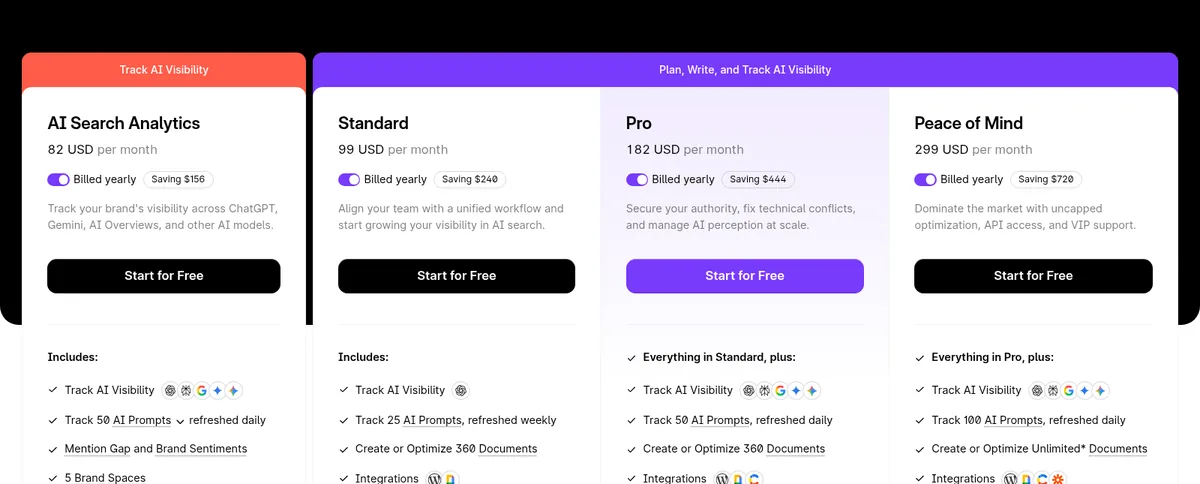
Surfer costs $49 per month on Discovery billed yearly, $99 on Standard and $182 on Pro. Standard publishes 360 documents, 50 tracked pages and 3 team seats, while Pro moves to 200 tracked pages and 5 seats. Surfer was acquired by Positive Group in October 2025 and now trades as Positive Surfer, an AI visibility platform.
| If you need | Choose |
|---|---|
| The cheapest way to test the tool | Discovery at $49 per month billed yearly |
| AI visibility tracking without content production | AI Search Analytics at $82 per month |
| The plan most small agencies should buy | Standard at $99 per month, with 360 documents and 50 tracked pages |
| More page tracking and five seats | Pro at $182 per month, with 200 tracked pages |
| Uncapped documents and API access | Peace of Mind at $299 per month |
| Custom limits, SSO and white-label | Enterprise, quoted on request |
Check current pricing at the source
Every figure in this guide was read from the vendor's own pricing page on the date stamped above. Vendors change plans without notice, so confirm the number before you commit.
- Standard (yearly)
- $99/mo
- Standard pages tracked
- 50
- Standard team seats
- 3
- Pro (yearly)
- $182/mo
Overview
Surfer's centre of gravity has moved, and that changes who should buy it. The company was acquired by Positive Group in October 2025 and now trades as Positive Surfer, positioning itself as an AI visibility platform rather than a content optimisation tool. Its own announcement describes the transition as a rebuild rather than a relaunch. The pricing ladder reflects that: the cheapest content plan is no longer the entry point, and a dedicated AI visibility plan now sits beside it at $82 per month.
For a small agency, the practical question is unchanged. Surfer publishes a fixed subscription rather than a per-seat charge, its plans differ mainly in document allowance, page tracking and team seats, and the decision is whether those numbers match the client book and the number of people who need access.
This Surfer SEO review is for small agencies, consultancies and in-house content teams. Every price and limit below was read from Surfer's own pricing page on 2026-10-14, rendered directly, including its full plan comparison table. Comparison figures for Semrush, Ahrefs and SE Ranking come from those vendors' pages and are reused from our existing guides rather than re-derived here.
For the wider category, see the SEO Tools for Small Agencies hub, Best SEO tool for small agencies, SE Ranking review, Semrush alternatives and Ahrefs alternatives.
What Surfer is now
Surfer began as a content optimisation tool built around a content score, and that function remains. The platform scores a draft against the pages already ranking for a target term, recommends terms and structure, and provides a writing assistant. It also publishes a content audit that monitors performance and flags ranking drops, a topical map for planning clusters, and a plagiarism checker.
What the Positive era has added is an AI visibility layer. Surfer tracks whether a brand is mentioned across ChatGPT, Perplexity, Google AI Mode, Google AI Overview and Google Gemini, measures mention gaps and brand sentiment, and reports a visibility score. It also publishes MCP support, which lets an AI agent work with the platform directly.
The company is registered as Surfer Sp. z o.o. in Wrocław, Poland. Its pricing page states that the platform is trusted by more than 150,000 creators, SEO specialists, agencies and teams, which is a vendor claim rather than an independently verified figure.
Surfer SEO pricing
Surfer publishes five self-serve plans and a custom enterprise tier. Every price on the page is shown as the monthly figure when billed yearly, and each plan carries a stated annual saving against monthly billing. Surfer does not publish a monthly-billing price in this view, so no monthly-billing comparison is made below and no monthly figure is derived.
| Plan | Monthly, billed yearly | Annual saving stated | Documents | Pages tracked | Team seats |
|---|---|---|---|---|---|
| Discovery | $49 | $120 | 120 | 10 | 1 |
| AI Search Analytics | $82 | $156 | Not stated | Not stated | 5 |
| Standard | $99 | $240 | 360 | 50 | 3 |
| Pro | $182 | $444 | 360 | 200 | 5 |
| Peace of Mind | $299 | $720 | Unlimited | 500 | 10 |
| Enterprise | Custom | Custom | Custom | Custom | Custom |
Two features of this ladder matter more than the headline prices.
First, the document allowance does not increase between Standard and Pro. Both publish 360 documents and the same content features. The $83 monthly step from Standard to Pro buys page tracking, which rises from 50 to 200, and two extra seats, from three to five, along with brand workspaces rising from one to five. An agency that writes a fixed volume is paying for tracking and access, not for capacity.
Second, the AI prompt allowances differ by refresh rate, not just by number. Standard tracks 25 AI prompts refreshed weekly and across ChatGPT only. Pro tracks 50 prompts refreshed daily across all five models. Peace of Mind tracks 100 on the same daily, all-model basis. An agency that wants to report AI visibility to a client needs at least Pro, because a weekly refresh through one model is not enough to show movement.
The three plans that fit most small agencies
Best for testing the tool Surfer Discovery at $49/month billed yearly
Best for an agency selling content Surfer Standard at $99/month billed yearly
Best for agencies reporting AI visibility Surfer Pro at $182/month billed yearly
What each plan is actually for
Discovery at $49 is a genuine entry point rather than a trial. It covers 120 documents, tracks 10 pages, includes the AI SEO optimisation guidelines, and gives access to Surfy, the writing assistant, plus the humaniser. One person testing whether Surfer's approach suits the agency's writing can work inside it.
AI Search Analytics at $82 is a different product. It carries no content production allowance at all. What it adds is visibility tracking across all five AI models, 50 prompts refreshed daily, mention gap and brand sentiment reporting, five brand workspaces, brand knowledge and MCP. It is the plan for an agency already producing content elsewhere and wanting to monitor how brands appear inside AI answers.
Standard at $99 is the plan most small agencies will want. It adds the full content workflow on top of visibility tracking: 360 documents, 50 tracked pages, three team seats, one-click content optimisation, team collaboration, the plagiarism checker, rank drop detection, WordPress and Google Docs integrations, and brand knowledge. Its constraint is the AI layer, which runs on 25 prompts refreshed weekly and across ChatGPT alone.
Pro at $182 is the step for agencies doing client reporting. It moves page tracking to 200 and seats to five, raises brand workspaces to five, lifts the AI layer to 50 prompts refreshed daily across all five models, and adds one-click internal linking, content ideas and coverage gap analysis, templates and custom voices, and a cannibalization report.
Peace of Mind at $299 removes the document ceiling under a fair usage policy, tracks 500 pages, seats ten people, tracks 100 prompts daily, adds advanced SERP analysis, personalized onboarding and a dedicated success manager, and names API access. It is priced for a larger team, and the fair usage qualifier on unlimited documents is worth reading before relying on the word unlimited.
Cost per client in the five-client scenario
Surfer is a flat subscription, so the per-client figure is simply the plan price divided by five client websites. The scenario is the same one used across this site: five clients, one website each, one operator, billed yearly, no add-ons.
| Plan | Monthly total | Per client monthly |
|---|---|---|
| Discovery | $49.00 | $9.80 |
| AI Search Analytics | $82.00 | $16.40 |
| Standard | $99.00 | $19.80 |
| Pro | $182.00 | $36.40 |
| Peace of Mind | $299.00 | $59.80 |
The comparison that matters is with the per-project tools. SE Ranking Core publishes 10 projects for $103.20 per month on annual billing, or $20.64 per client across five clients, and includes rank tracking, audits and backlink research. Surfer Standard sits at $19.80 per client on the same basis but is a content optimisation platform, not a rank tracker, so it answers a different question.
That makes the budget decision in this category a sequencing question rather than a price question. An agency tracking rankings, monitoring backlinks and auditing sites needs a platform like SE Ranking, Semrush or Ahrefs first. Surfer earns its place once content production is a recurring service and the quality of each draft has to be defensible. The full arithmetic across the category is in our SEO software cost guide.
Where Surfer is strong
The content workflow is the most complete in this price band. A draft can be scored against the pages already ranking, optimised in one click, checked for plagiarism, linked internally with one click, and then monitored for ranking drops after publication. For an agency selling content as a service, that chain is the product.
The seat allowance is generous for the price. Standard includes three seats and Pro includes five, at a flat subscription rather than a per-seat charge. Across a small team that is materially cheaper than platforms that bill each user.
The integrations are the ones agencies actually use. WordPress and Google Docs are on Standard, and Pro adds Contentful and Zapier. An agency publishing client content does not have to change its tooling to adopt Surfer.
MCP support is present across the ladder. Surfer publishes MCP on every plan, which matters if the agency wants an AI agent to work with the platform rather than only a human operator.
Where Surfer falls short
Document capacity is flat between Standard and Pro. Paying 84 per cent more for the same 360 documents is a real objection, and the step only makes sense if page tracking, seats and the AI refresh rate are the reasons.
The AI visibility layer is limited on the tier most agencies buy. Weekly refresh across ChatGPT alone, on 25 prompts, is not enough for client reporting. The honest position is that the AI features agencies are most curious about require Pro or the separate AI Search Analytics plan.
Page tracking starts low. Discovery tracks 10 pages and Standard tracks 50. An agency with five client sites and a content programme will pass 50 tracked pages quickly, which pushes it toward Pro.
Monthly billing is not published in the pricing view. Every figure on the page is the yearly-billed monthly price, and the stated saving varies by plan from $120 to $720 a year. An agency that wants the flexibility of monthly billing has to establish that figure through the vendor, and we do not derive it.
Peace of Mind's unlimited documents carry a fair usage qualifier, which the page states explicitly. Treat the word as bounded.
How it compares with the alternatives
Against Semrush, covered in our Semrush alternatives guide, the difference is scope rather than quality. Semrush is a full search platform at $139 per month monthly, publishing five websites, 500 keywords a day and AI visibility prompts. Surfer Standard is $99 per month billed yearly and is narrower, focused on producing and optimising content rather than tracking a whole account.
Against Ahrefs, compared with Semrush in our Ahrefs vs Semrush guide, the split is similar. Ahrefs Lite is $129 monthly for five projects and 750 tracked keywords, and it is a research and backlink platform. Surfer does not attempt to replace it.
Against SE Ranking, reviewed in our SE Ranking review, the overlap is thinnest. SE Ranking Core is $129 monthly or $103.20 on annual billing for 10 projects, 2,000 daily keywords and 100 AI prompts, and it covers rank tracking, audits and backlinks. It does not include a content optimiser of Surfer's kind.
The pattern is consistent. Surfer is a specialist tool that earns its subscription when content production is sold as a service, and it is a poor substitute for a general SEO platform.
Our verdict
Buy Standard at $99 per month billed yearly if the agency sells content. It publishes 360 documents, 50 tracked pages, three seats and the full content workflow, including the audit and the plagiarism checker, at $19.80 per client across five clients. It is the best value on the ladder for that purpose.
Move to Pro at $182 only when client reporting justifies it. The step buys 200 tracked pages, five seats, five brand workspaces and a daily AI prompt refresh across all five models. If the agency is reporting AI visibility to clients, Pro is the honest minimum, because Standard's weekly refresh through one model cannot show movement.
Do not buy AI Search Analytics expecting to produce content. It carries no document allowance. It is the right plan only for an agency that produces content elsewhere and wants to monitor AI answers.
Test on Discovery before committing to a year. At $49 per month billed yearly with 120 documents, it is cheap enough to establish whether the content score approach suits how the agency writes, and it avoids paying Standard prices for a workflow nobody adopts.
Do not treat Surfer as a rank tracker, and do not buy it before the tracking platform. The agency needs something to measure the account before it needs something to optimise the drafts.
The figures behind this review are recorded in our pricing research, and the verification standard is in the methodology.
Frequently asked questions
How much does Surfer cost?
Surfer publishes five self-serve plans, all quoted as the monthly price when billed yearly. Discovery is $49, AI Search Analytics is $82, Standard is $99, Pro is $182 and Peace of Mind is $299. Each carries a stated annual saving, from $120 on Discovery to $720 on Peace of Mind. Surfer does not publish a monthly-billing price in its pricing view, so we do not quote one.
Is Surfer SEO worth it for a small agency?
It is worth it when the agency sells content as a service. Standard at $99 per month billed yearly publishes 360 documents, 50 tracked pages, three team seats, one-click optimisation, a plagiarism checker, internal linking and a content audit, which is $19.80 per client across five clients. It is not a substitute for a rank tracking platform, so it belongs alongside one rather than instead of one.
What is the difference between Surfer Standard and Pro?
Both publish 360 documents and the same core content features. Pro costs $83 more per month and moves page tracking from 50 to 200, team seats from three to five, and brand workspaces from one to five. It also raises the AI layer from 25 prompts refreshed weekly across ChatGPT to 50 prompts refreshed daily across all five models, and adds templates, custom voices and a cannibalization report.
Does Surfer charge per seat?
No. Surfer publishes a flat subscription with a fixed seat allowance per plan rather than a per-user price. Discovery includes 1 seat, Standard includes 3, Pro includes 5, Peace of Mind includes 10 and AI Search Analytics includes 5. An agency does not pay more when an existing team member starts using the tool, but it cannot exceed the seat count without changing plan.
What are Surfer's document limits?
Discovery covers 120 documents, Standard and Pro both cover 360, and Peace of Mind publishes unlimited documents under a fair usage policy that the vendor states explicitly. AI Search Analytics carries no document allowance because it is a visibility monitoring plan rather than a content production plan.
How many pages can Surfer track?
Discovery tracks 10 pages, Standard tracks 50, Pro tracks 200 and Peace of Mind tracks 500. Page tracking is the main feature that separates Standard from Pro, and it is the limit most likely to push a five-client agency to the higher tier.
Does Surfer track AI visibility?
Yes. AI visibility tracking is present across the ladder, but the allowance differs sharply. Discovery tracks no AI prompts, AI Search Analytics tracks 50 prompts refreshed daily, Standard tracks 25 prompts refreshed weekly and across ChatGPT only, Pro tracks 50 prompts refreshed daily across all five models, and Peace of Mind tracks 100 prompts on the same basis. The models covered are ChatGPT, Perplexity, Google AI Mode, Google AI Overview and Google Gemini.
Who owns Surfer?
Surfer was acquired by Positive Group in October 2025 and now trades as Positive Surfer. The vendor describes the change as a rebuild rather than a rebrand, and the pricing ladder reflects it, with a dedicated AI visibility plan now sitting beside the content plans. The company is registered as Surfer Sp. z o.o. in Wrocław, Poland.
What payment methods does Surfer accept?
Surfer states that it accepts credit and debit cards, and bank transfer for yearly subscriptions only. PayPal is not supported. That matters for agencies outside the card-friendly markets, and it is worth confirming against the vendor's billing documentation before committing to an annual plan, which is charged for the full year upfront.