SEO Tools
Semrush vs Moz for Consultants
Semrush and Moz compared on verified pricing, included user seats and website limits. The seat maths decides it for most small consultancies.
Updated Verified against vendor pricing 10 October 2026
The short answer
Moz is cheaper for a solo consultant, because its Standard plan costs $79 a month on annual billing against Semrush at $117.33. Semrush is better value for a team, because Moz includes only one to three seats and charges $49 a month for each extra one.
| If you need | Choose |
|---|---|
| The cheapest entry price | Moz Starter at $49 a month |
| One or two users on a tight budget | Moz Standard |
| Three or more users | Semrush, because Moz charges $49 per extra seat |
| More than five websites | Semrush Pro+ |
| AI search visibility tracking | Semrush |
| Simpler, cheaper rank tracking | Moz |
- Cheapest paid plan
- $49/month
- Semrush SEO plan
- $117.33/month
- Moz extra user seat
- $49/month
Overview: semrush vs moz for consultants
For most small consultancies, Moz is the winner on price and Semrush is the runner-up on cost, although Semrush becomes the better choice when AI search visibility or a larger tracked portfolio matters. In this semrush vs moz comparison, the practical answer is not just the headline subscription: it is the combination of seats, tracked websites, keyword capacity, billing term, and the work your team actually needs to do.
Semrush and Moz are SEO platforms for keyword research, rank tracking, site work, and competitive analysis. They suit consultants and small agencies that need repeatable research across client properties rather than a one-off browser tool. The decision is especially relevant when you are choosing SEO tools for consultants and paying from a small operating budget.
This guide starts with the verified price and plan scope, then explains the user-seat maths, portfolio limits, billing traps, free options, and situations where neither subscription is sensible. For more comparisons, use the SEO tools hub. If your next question is whether the higher Semrush bill can pay back for a small agency, see Is Semrush worth it for a small agency?.
What we compared
We compared the published monthly price on annual billing with the monthly-billing price, included seats, tracked websites, keyword allowances where the pricing page specifies them, and the practical cost of adding people. We also considered the free options and trials because a small consultancy may be better served by testing or combining free tools before committing.
Every price and limit in this article was checked against the vendor's own pricing page on 2026-10-10, the date in the front matter. Annual prices are shown as a monthly equivalent where the vendor publishes that figure. A feature is only treated as a buying reason when it is established by the verified notes or by the existing comparison, rather than assumed from a familiar product label.
Semrush
Best for AI visibility and larger portfolios Semrush more capacity, higher entry price
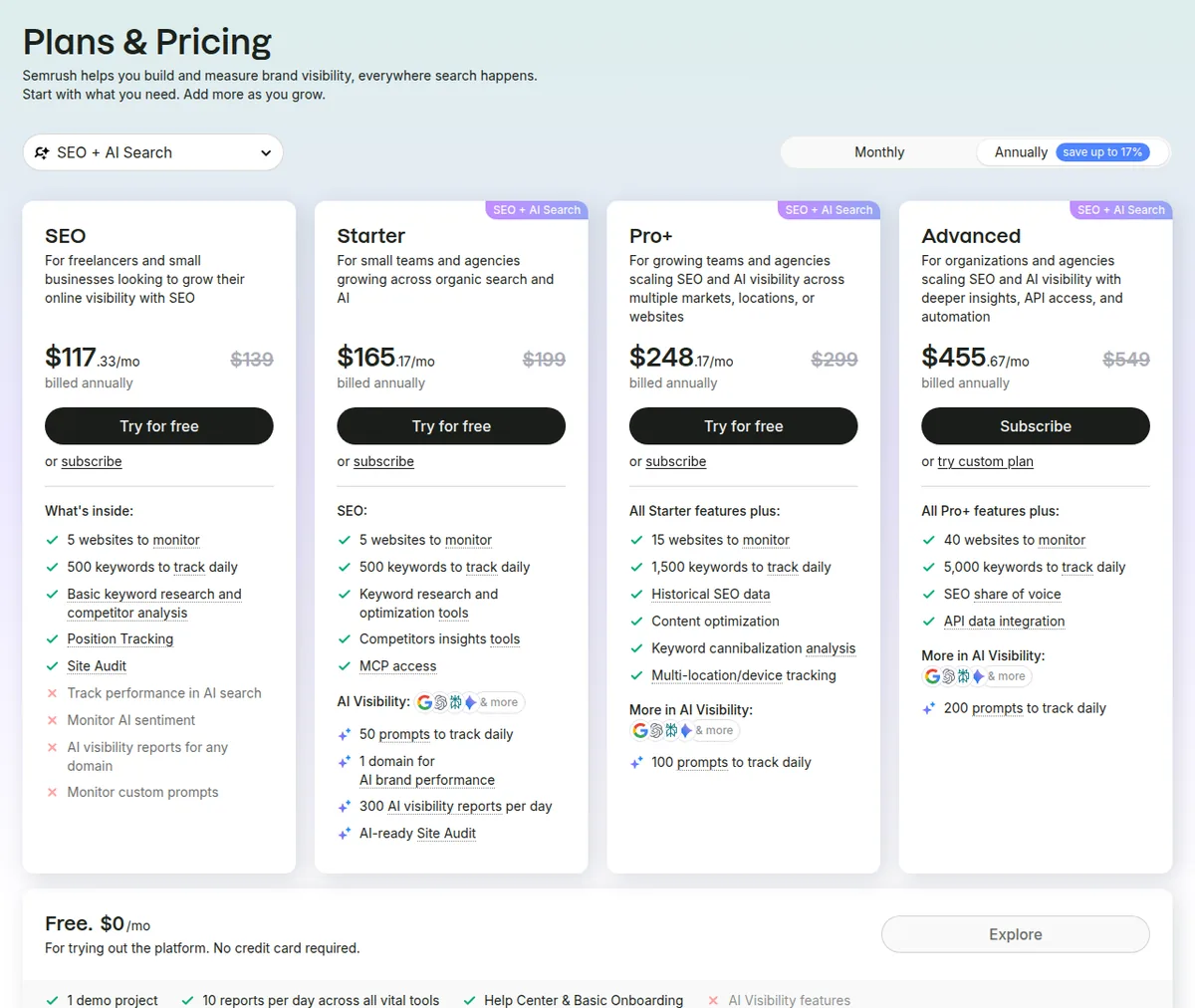
Semrush is the stronger fit when the consultancy needs more than a basic rank-tracking subscription. Its published SEO plan includes five websites and 500 keywords per day at $117.33 a month on annual billing, or $139 month to month. That is a materially higher starting bill than Moz Starter, so the extra capacity needs to be useful rather than merely available.
Semrush Free costs $0 and provides one demo project plus 10 reports per day across tools, making it a useful way to test light research before starting a paid trial or plan.
The paid ladder is clear enough to map against portfolio size:
- SEO: $117.33 a month on annual billing or $139 monthly, with five websites and 500 keywords per day.
- Starter: $165.17 a month annually or $199 monthly, with five websites, 500 keywords, AI visibility with 50 prompts per day, and MCP access.
- Pro+: $248.17 a month annually or $299 monthly, with 15 websites and 1,500 keywords per day.
- Advanced: $455.67 a month annually or $549 monthly, with 40 websites, 5,000 keywords per day, and API access.
The important distinction is between the SEO plan and Starter. Five websites are present at both levels, but the verified notes attach AI visibility and its 50 prompts per day to Starter. Moving up should therefore be tied to that need, not to a vague expectation that a more expensive label automatically improves every workflow.
Semrush includes one user on the listed plans. Additional users start at $45 per month, and the vendor also lists Base Report at $10 per month and Pro Report at $20 per month as add-ons. Those extras are why the base price should never be copied directly into a team proposal without a seat check.
A named cost scenario makes the difference concrete: a five-person consultancy on Semrush SEO pays $297.33 per month on the verified annual-equivalent pricing, calculated as $117.33 plus four additional users at $45. This is not a claim that every additional-user quote will be identical beyond the published starting price. It is the scenario using the verified "from $45" figure and the existing article's calculation, so treat it as a planning floor rather than a bespoke quote.
Semrush also has a seven-day free trial. That short window is most useful when you arrive with a defined client list and a few real questions to test. Record which reports, sites, and team members you actually need before the trial ends, then compare the resulting plan with Moz rather than judging the interface in isolation.
Moz Pro
Best for solo consultants and simpler budgets Moz Pro lower entry cost and clear annual saving
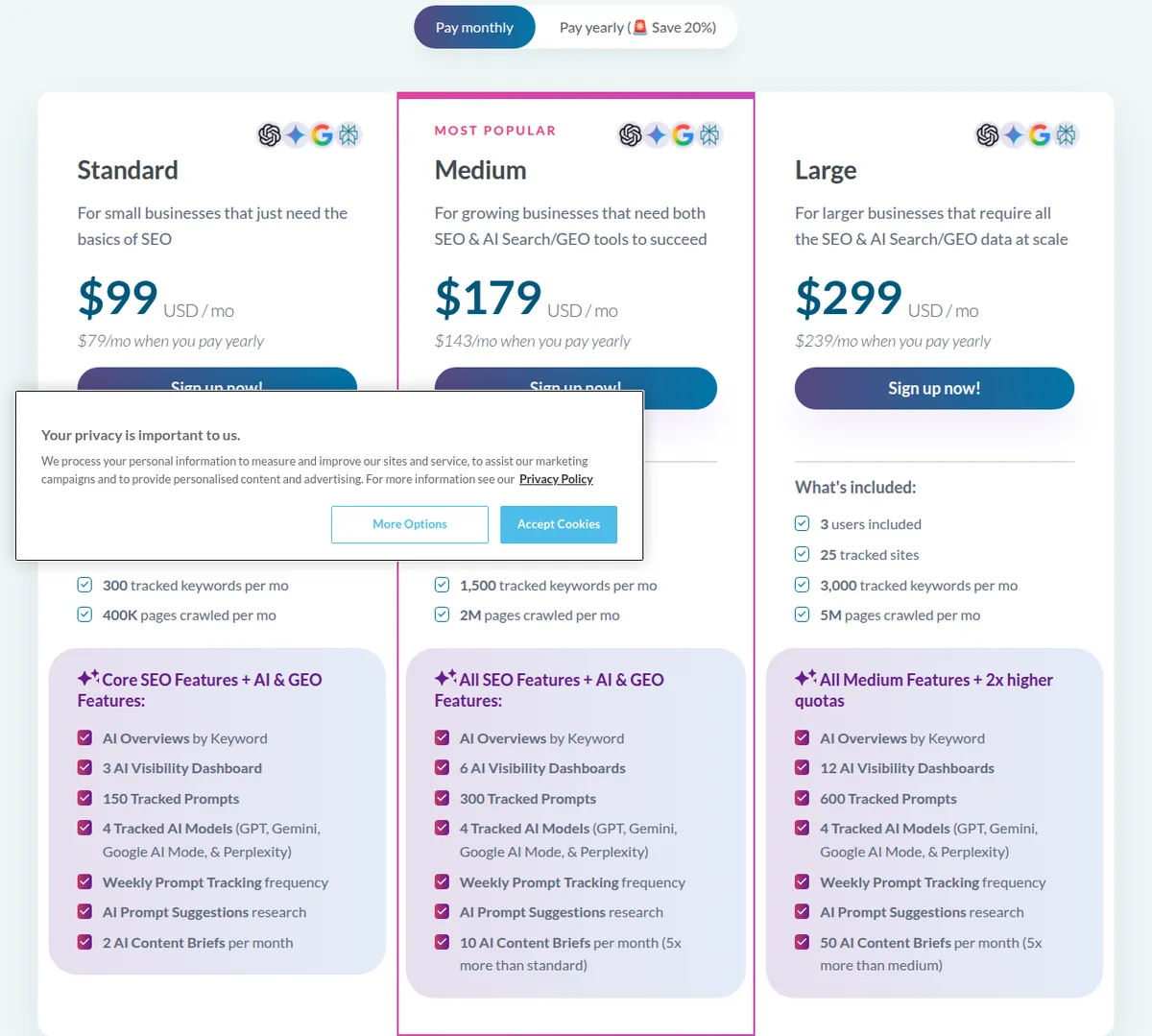
Moz Pro is the better fit for a consultant who wants a lower paid starting point or who works alone. Moz Starter costs $49 per month for one site. Standard costs $79 a month on annual billing or $99 monthly, includes one user, three sites, and 300 keywords. That makes Moz Pro especially attractive when three or fewer client properties cover the current workload.
The higher tiers trade a bigger portfolio for a bigger subscription:
- Starter: $49 a month for one site.
- Standard: $79 a month annually or $99 monthly, with one user, three sites, and 300 keywords.
- Medium: $143 a month annually or $179 monthly, with two users, 10 sites, and 1,500 keywords.
- Large: $239 a month annually or $299 monthly, with three users, 25 sites, and 3,000 keywords.
Moz's published seat counts make its plan selection unusually important. Medium includes two users and Large includes three, but a larger consultancy does not receive unlimited access simply by choosing a higher website tier. Additional user seats cost $49 per month each on any plan level, including Starter, Standard, Medium, and Large.
The named cost scenario is straightforward: a five-person consultancy on Moz Standard pays $275 per month on annual billing, calculated as $79 plus four additional seats at $49. That is higher than the solo headline price, yet it remains close to the comparable Semrush SEO team calculation. If five people need access every day, compare the final seat-inclusive totals rather than the $49 entry point.
Moz offers a free trial on Medium and provides free standalone Domain Analysis, Keyword Explorer, and Link Explorer tools. Those options are useful when you have occasional research needs or want to validate the workflow before paying. They do not turn the paid plans into an unlimited free service, so keep a record of which client deliverables require a subscription.
Semrush vs Moz pricing comparison
The table below puts the verified list prices side by side. Annual figures are the monthly equivalents published for annual billing; monthly figures are the month-to-month prices.
Table: Semrush and Moz published monthly pricing and included capacity
| Plan | Annual price per month | Monthly price | Included seats | Websites |
|---|---|---|---|---|
| Moz Starter | $49 | $49 | 1 | 1 |
| Moz Standard | $79 | $99 | 1 | 3 |
| Moz Medium | $143 | $179 | 2 | 10 |
| Moz Large | $239 | $299 | 3 | 25 |
| Semrush SEO | $117.33 | $139 | 1 | 5 |
| Semrush Starter | $165.17 | $199 | 1 | 5 |
| Semrush Pro+ | $248.17 | $299 | 1 | 15 |
| Semrush Advanced | $455.67 | $549 | 1 | 40 |
Moz applies a 20 per cent discount for annual billing. Semrush applies roughly 17 per cent. Both figures are from the vendors' own pricing pages.
The closest comparisons are not always the rows with matching names. Moz Standard is the low-cost solo comparison to Semrush SEO, while Moz Medium is closer to a 10-site portfolio and Semrush Pro+ is the 15-site step. A buyer should choose the row that fits the work, then inspect seats and billing, rather than treating the two ladders as equivalent packages.
The seat and billing traps
The first trap is confusing the plan price with the team price. Moz Standard includes one user, Medium includes two, and Large includes three. Semrush's listed plans include one user, with additional users starting at $45 per month. The included seat cap is therefore part of the product decision, not an administrative detail.
The second trap is assuming that a bigger website allowance solves collaboration. It does not. A solo consultant with 10 sites may be well served by Moz Medium at $143 annually, while a three-person team may need to budget for an extra Moz seat even if it stays on that tier. Semrush's Pro+ plan raises the website allowance to 15, but its one included user still leaves team cost to calculate.
The third trap is comparing annual and monthly figures inconsistently. Moz Standard is $79 a month on annual billing and $99 monthly. Semrush SEO is $117.33 annually and $139 monthly. If you cancel or change direction before the annual commitment makes sense, the lower displayed monthly equivalent may not represent the cash-flow choice you actually want. Put both billing options in the proposal and state which one you are using.
The fourth trap is reading a website number as a client number. One client can have more than one property, staging environment, or domain to track, while several small retainers may share a single property. The published limits are websites, not a promise about how many clients your workflow can support. Count the properties your team will actively monitor before selecting a tier.
The fifth trap is mixing keyword allowances with websites. Semrush SEO lists 500 keywords per day and Pro+ lists 1,500 per day. Moz Standard lists 300 keywords, Medium 1,500, and Large 3,000. These are different kinds of capacity and should be matched to how often you run research, not used as a simple one-to-one score.
There is also a reporting-cost trap. Semrush lists Base Report at $10 per month and Pro Report at $20 per month, in addition to its user add-on starting at $45. The verified notes do not establish an equivalent Moz reporting overage rule, so this article does not invent one. Ask for the exact included report allowance and any add-on requirement before treating either headline total as your complete operating cost.
For a quick team check, use the following annual-equivalent scenarios from the verified figures:
| Team size | Moz Standard | Semrush SEO |
|---|---|---|
| One user | $79 | $117.33 |
| Three users | $177 | $207.33 |
| Five users | $275 | $297.33 |
Who should not buy either tool
Do not buy either subscription just because an SEO platform appears on a competitor's stack. If you only need occasional domain, keyword, or link research, Moz's free standalone tools may be enough. If you are still validating an offer and have no recurring client reporting workflow, the Semrush Free option, with one demo project and 10 reports per day, may be a better starting point than a paid seat.
Stay on a free option when your work fits its limits and your clients do not require recurring monitoring. A free tier is not a failure if it covers the current job. Revisit the decision when you can name the sites, users, keywords, or reports that are blocked by the free workflow.
Do not choose Semrush Starter solely for the word "AI." Its verified advantage is specifically AI visibility with 50 prompts per day, so pay for it only when that work is part of a deliverable or a decision you need to make. Likewise, do not choose Moz Large simply because 25 sites sounds comfortable if you do not need that portfolio capacity.
Small agencies should also keep the rest of the stack in proportion. An SEO subscription does not replace client management, delivery tracking, or sales follow-up. If you are reviewing the wider software setup for a design-led practice, compare it with the best CRM for design studios rather than asking an SEO tool to solve a CRM problem.
Our verdict
Choose Moz Pro when you are a solo consultant, a two-person practice, or a price-sensitive team managing up to 10 sites without a need for Semrush's verified AI visibility feature. Moz Starter is the lowest paid entry at $49, and Standard is $79 a month on annual billing with one user, three sites, and 300 keywords.
Choose Semrush when AI visibility with 50 prompts per day matters, when five websites on the entry SEO plan better match your portfolio, or when the 15-site and 40-site tiers are more relevant than Moz's lower entry price. Budget for users from the beginning: a five-person team is $297.33 on Semrush SEO versus $275 on Moz Standard using the verified annual-equivalent scenarios.
The direct answer to semrush vs moz for consultants is conditional but practical: Moz is the default recommendation for a solo buyer; Semrush is the better specialist choice when its additional capacity is part of the service you sell. Before paying, write down the sites, people, keyword work, reports, and billing term you need. If that list does not justify a paid plan, buy nothing yet.
Frequently asked questions
Is semrush vs moz a better choice for a solo consultant?
Moz is usually the better solo choice because Moz Starter is $49 a month and Moz Standard is $79 a month on annual billing. Semrush SEO starts at $117.33 a month on annual billing, so a solo consultant should choose it only when its additional capacity or AI visibility work has a clear purpose.
What does Semrush cost compared with Moz?
Semrush SEO costs $117.33 a month on annual billing or $139 monthly. Moz Standard costs $79 a month annually or $99 monthly, while Moz Starter costs $49 a month for one site. The right cost comparison changes when you add users or need a larger website portfolio.
How much do extra user seats cost on each platform?
Moz charges $49 per month for each additional user seat on any plan level. Semrush lists additional users from $45 per month. A five-person team therefore needs four paid additions after the included user on either of the example plans.
Which platform has the lower annual price for three to ten websites?
Moz Standard covers three sites at $79 a month annually, and Moz Medium covers 10 sites at $143. Semrush SEO covers five sites at $117.33, while Semrush Pro+ covers 15 at $248.17. Moz is lower on these annual-equivalent rows when the website allowance fits and AI visibility is not a requirement.
Does Semrush have a free plan or trial?
Semrush has a $0 Free option with one demo project and 10 reports per day across tools, plus a seven-day free trial. The free option is best for light research or initial evaluation. A consultancy should test its real reporting and site workflow before deciding whether the paid plan is justified.
Does Moz have free tools or a free trial?
Moz offers a free trial on its Medium plan and free standalone Domain Analysis, Keyword Explorer, and Link Explorer tools. Those options can cover occasional research without a full subscription. They do not change the published paid-plan seat and website limits.
Is Semrush Starter worth paying for if I already have Moz?
It can be worth considering when AI visibility with 50 prompts per day or MCP access is part of the work you sell. It is not an automatic upgrade for every consultant, because Semrush Starter costs $165.17 a month on annual billing and still includes one user and five websites. Compare the specific deliverable against the extra monthly cost before switching.
Which plan should a small agency choose first?
Start with the smallest plan that covers the sites and people you can name today, then use a trial or free option to test the workflow. Moz Standard is the lower-cost starting point for one user and three sites, while Semrush SEO is the better starting point when five sites or the Semrush workflow is necessary. Recalculate before renewal if your client list, team, or reporting load changes.