SEO Tools for Small Agencies · Updated 28 October 2026
Semrush Pricing: What Each Tier Costs
Semrush pricing explained by tier, with verified monthly costs, annual figures, seats, report add-ons and the Free plan.
- 14 min read
- semrush pricing
- Verified against vendor pricing
The short answer
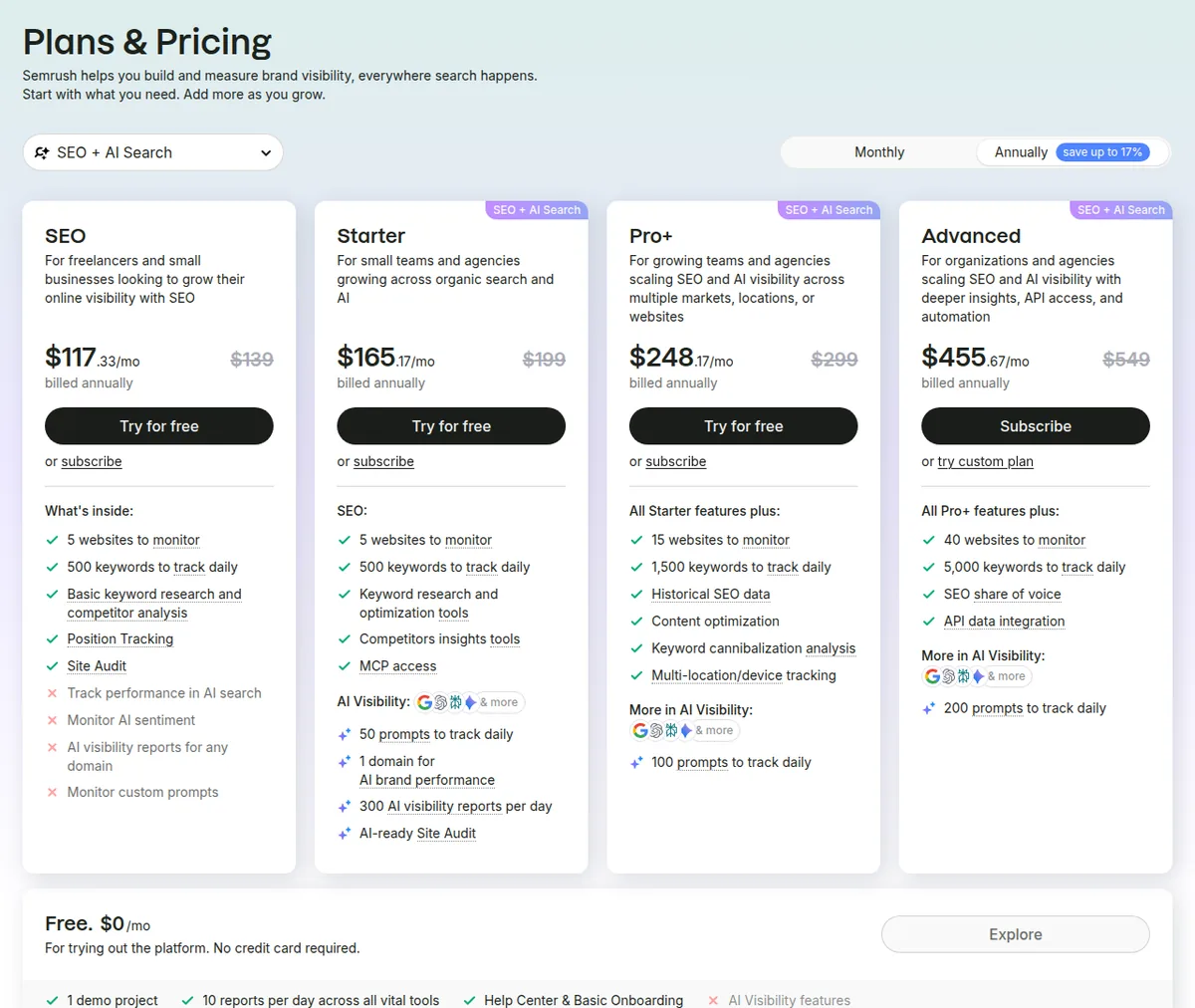
Semrush SEO is the clearest starting point at $139 monthly or $117.33 billed annually, while Starter is the better fit when keyword research, MCP access and deeper AI visibility work matter. Advanced is now quote-only, so its price cannot be compared with the published tiers.
| If you need | Choose |
|---|---|
| A paid starting point for five websites | Semrush SEO (opens in a new tab) |
| Keyword research, optimisation and MCP access | Semrush Starter (opens in a new tab) |
| Historical data and content optimisation for 15 websites | Semrush Pro+ (opens in a new tab) |
| Share of voice, API integration and team users | Semrush Advanced, request a demo (opens in a new tab) |
| A no-cost way to test core access | Semrush Free (opens in a new tab) |
Get started with the tools in this guide
These links go to the vendor's own site. We may earn a commission if you sign up, at no extra cost to you. How we fund the site. Every figure in this guide was read from the vendor's pricing page on the date stamped above, so confirm the number before you commit.
- Cheapest paid tier
- $139
- Annual saving
- Up to 17%
- Additional user
- From $45 monthly
- Published plans
- 5
Overview
Semrush SEO is the best starting point for most small agencies that have up to five websites to manage and need a defined monthly bill. It costs $139 per month, or $117.33 when billed annually, and includes 500 keywords per day. Semrush Starter is the runner-up for a team that needs keyword research and optimisation tools, competitor insight tools, MCP access and expanded AI visibility work, at $199 monthly or $165.17 annually. Semrush pricing becomes a capacity and workflow decision once extra users, reports or higher-level data are added.
This guide is for agencies and consultancies with two to 20 people that have already decided to use Semrush. It explains the Free, SEO, Starter, Pro+, Advanced and Enterprise routes without treating them as interchangeable. The focus is the real bill: what each tier is for, what is included, which limits change, and what happens when a second person or a reporting add-on is needed. For the wider category, start with the SEO Tools for Small Agencies hub, then compare the best SEO software for consultants or the wider SEO software cost for agencies guide.
How we chose
This is a tier-ladder explainer rather than a feature ranking. The comparison records the monthly figure, the monthly equivalent when billed annually, website allowance and keyword allowance for every published route. It then separates features that move a buyer from one tier to the next, including AI visibility, historical data, content optimisation, API access, team users and reporting.
Every price and plan limit in this guide was checked against Semrush's own pricing page on 28 October 2026, re-checked on the day this review was last updated. Where the page says Custom, the article says Custom. Where the verified record does not state a fixed included-user count, this guide does not invent one. That evidence rule is also explained in the methodology, which is useful when an older comparison page gives a different number.
Annual billing saves up to 17 per cent, as stated on the pricing page. The annual figures below are the displayed monthly equivalents for annual billing, not a claim that the annual amount can be paid one month at a time. A small agency should compare the payment commitment as well as the monthly-looking figure.
Semrush pricing: every plan explained
Best starting point for five websites Semrush SEO $139 monthly or $117.33 billed annually
Semrush SEO is the cleanest fit for a small agency that needs paid access, five websites and 500 keywords per day without immediately moving into a broader research package. It includes Position Tracking, Site Audit, AI search performance tracking, AI sentiment, AI visibility reports for any domain and custom prompt monitoring. Those inclusions make it more than a bare rank-tracking entry point, but the plan is still easy to budget because the published price is fixed.
SEO is less suitable when keyword research and optimisation tools are central to the workflow, when competitor insight tools are required, or when the team needs the higher website and keyword limits of Pro+. It is also not the correct choice for a team that requires Advanced's SEO share of voice, advanced API data integration, team users or reporting. Those are upgrade signals, not reasons to assume that SEO includes them.
What the Semrush Free plan includes
Semrush Free costs $0 and gives an agency one demo project. It includes 10 reports per day across all vital tools, Help Center and basic onboarding, and AI Visibility features. No credit card is required. The Free route is therefore a real way to inspect access and start a small test, but it is not a substitute for a paid client workflow with a five-website requirement.
The one-demo-project limit should shape the test. A solo consultant can use it to understand the interface and decide whether the reporting and visibility workflow is relevant. A small agency should not read the free access as evidence that a multi-client operation will fit. The published Free allowance is deliberately narrow, and the article does not infer extra projects, extra users or a larger report allowance. There is also a seven-day free trial, and it can be cancelled anytime. The trial is separate from the $0 Free tier in the pricing ladder. A buyer should record which route is being tested, because a short trial and an ongoing Free account answer different questions: one tests paid workflow access, while the other provides limited continuing access.
Best for research and AI visibility expansion Semrush Starter $199 monthly or $165.17 billed annually
Starter is the step up for a team that has outgrown the SEO feature boundary rather than the five-website boundary. It adds keyword research and optimisation tools, competitor insight tools and MCP access. It also includes 50 prompts tracked daily, one domain for AI brand performance and 300 AI visibility reports per day. The published capacity remains five websites and 500 keywords per day, so the extra $60 monthly over SEO should be justified by these added workflows.
Northstar Content Studio is a useful cost scenario. It has five people, five client websites and one operator today, so Starter begins at $199 monthly. The second person adds an additional user starting at $45 per month, and the Pro Report add-on adds $20 per month. Northstar's corrected monthly total is therefore $264, calculated as $199 plus $45 plus $20. The report line is not hidden inside the plan price, and the extra seat is not free merely because the team is small.
Starter suits a team that can name the added workflow it needs. It is not the natural answer for historical SEO data, content optimisation, keyword cannibalisation analysis or multi-location and multi-device tracking, which are listed under Pro+. It also does not provide the Advanced additions described below. The correct decision is to compare the required workflow with the added $60 monthly, then add seats and reporting to the same worksheet.
Best for historical data and content operations Semrush Pro+ $299 monthly or $248.17 billed annually
Pro+ is the plan for a larger or more mature SEO operation. It covers 15 websites and 1,500 keywords per day, then adds historical SEO data, content optimisation, keyword cannibalisation analysis, multi-location and multi-device tracking, and 100 prompts tracked daily. The website and keyword increases matter for agencies managing more than five client properties, while the feature additions matter for teams that need to compare historical performance or coordinate content work.
Consider Harbour Metrics, a 12-person agency with 12 client websites and a content team. Pro+ starts at $299 monthly, and an additional user starts at $45 monthly when another named user is needed. A Pro Report adds $20 monthly, producing a corrected total of $364 monthly before any other add-on. The calculation is $299 plus $45 plus $20. It demonstrates the same rule as the Starter example: a plan comparison should end with the operational bill, not stop at the card price.
Pro+ is the upper published fixed-price tier in this guide. It is not the right answer when the agency specifically needs SEO share of voice, advanced API data integration, team users, reporting or unlimited prompts tracked daily. Those are Advanced signals, and Advanced does not have a published dollar amount.
For quote-led enterprise controls Semrush Advanced Custom, request a demo
Advanced is now quote-only. The pricing page publishes Custom and a request-demo button, not a monthly price or annual monthly equivalent. It lists 40+ websites and 5,000+ keywords per day, and adds SEO share of voice, advanced API data integration, team users, reporting and unlimited prompts tracked daily. No Advanced figure should appear in a buying spreadsheet until Semrush supplies the quote.
Advanced can fit a team with 40 or more websites, 5,000 or more keywords per day and a need for the listed controls. It can also be relevant when a consultancy needs unlimited prompts tracked daily. It is not a routine upgrade for a small two-person firm just because it has a larger headline capacity. Enterprise is a separate route, quoted separately, with unlimited projects and custom limits.
Semrush plans compared
The table uses the published plan figures. Advanced is shown as Custom because the page publishes no price, while Enterprise is included as a separate quoted route rather than treated as a sixth fixed tier.
| Plan | Monthly | Billed annually | Websites | Keywords per day |
|---|---|---|---|---|
| Free | $0 | $0 | 1 demo project | 10 reports per day across tools |
| SEO | $139 | $117.33 | 5 | 500 |
| Starter | $199 | $165.17 | 5 | 500 |
| Pro+ | $299 | $248.17 | 15 | 1,500 |
| Advanced | Custom, request demo | Custom | 40+ | 5,000+ |
The table answers the first budget question, but not the whole buying decision. SEO and Starter have the same published website and keyword allowances, so their difference is the work each one adds. Pro+ raises both capacity measures and introduces historical and content-oriented features. Advanced changes the commercial conversation entirely because the price is supplied by quote. If Semrush turns out not to be the fit, the same verified method is applied to the alternatives in the Ahrefs review, the SE Ranking review and the Moz Pro review.
Semrush Traffic Cost: what the metric means, and what it is not
A large share of the searches that begin with Semrush pricing are not about the subscription at all. They are about Traffic Cost, a metric that sits inside the platform, and the two numbers are easy to confuse because both are expressed as money.
Semrush defines the metric in its own glossary. Traffic Cost, found in Domain Analytics, is "how much an advertiser would have to spend on average per month in Google Ads to receive all the traffic the source received from organic search for all of the keywords and positions listed in the report." The same glossary gives a shorter variant, SE Traffic Price, defined as the "estimated monthly price for an Ad campaign for the same amount of organic traffic as shown in the Domain's report."
Three things follow from that wording, and each one prevents a mistake.
Traffic Cost is a valuation, not a bill. Semrush states that the figure is provided "to give you a baseline estimation of how valuable a domain's keyword portfolio is." Nobody is charged it. It does not appear on a Semrush invoice and it is not a plan tier.
It is an estimate built from a proprietary method. Semrush says the number combines several inputs including CPC, search volume and competition level. Treat it as an order-of-magnitude reading of a keyword portfolio, not as a rate card.
It answers a different question from the plan price. The plan price is what the agency pays Semrush. Traffic Cost is what the agency's client would have had to spend on Google Ads to buy the same organic visibility. A client-facing report can use the second number to show value. A budget spreadsheet needs the first.
The confusion is worth naming directly, because it changes the answer a buyer expects. "Semrush traffic cost" in a search box is usually a question about the metric. "Semrush cost" is a question about the subscription. This page covers the subscription, and the section above covers the metric, so both readings are answered on one page.
The seat and billing traps
The first trap is assuming that a plan price covers every person in a 2 to 20-person agency. Semrush lists Additional Users starting at $45 per month. The verified pricing record does not state a fixed included-user count for the paid plans, so a spreadsheet should not assume that all staff can log in under the headline amount. Identify the people who need named access, then add the published additional-user line where it applies.
The second trap is adding a seat but forgetting reporting. Semrush lists Lead Generation at $90 per month, Base Report at $10 per month and Pro Report at $20 per month. These are separate add-ons. An account that needs client-ready reporting should show the report choice as its own line, because a $10 Base Report and a $20 Pro Report produce different corrected totals even before a seat is added.
The third trap is treating the annual figure as a casual monthly subscription. SEO displays $117.33 billed annually, Starter $165.17, and Pro+ $248.17. The page states that annual billing saves up to 17 per cent. That makes the annual route attractive once client demand is stable, but the team should confirm the payment timing and budget the annual commitment rather than multiply the monthly-looking number by an assumed payment schedule.
The fourth trap is using website count as the only upgrade test. SEO and Starter both publish five websites and 500 keywords per day. Starter's case rests on keyword research and optimisation tools, competitor insight tools, MCP access, 50 prompts tracked daily, one domain for AI brand performance and 300 AI visibility reports per day. Pro+ changes the website and keyword ceiling, but also adds historical data, content optimisation, cannibalisation analysis and multi-location and multi-device tracking.
Finally, do not treat a seven-day free trial as proof of the long-term bill. It can be cancelled anytime, while Free is a $0 route with one demo project and 10 reports per day across tools. The Semrush hidden fees guide is useful for a second pass over seats and add-ons, and the Semrush alternatives guide helps when the corrected total no longer fits the agency's budget.
Who should not buy this
A one-client consultant should not start with a paid tier simply because Semrush has a broad feature ladder. Semrush Free gives one demo project, 10 reports per day across tools, basic onboarding and AI Visibility features at $0, with no credit card required. That may be enough to decide whether the workflow belongs in the operating stack before a recurring bill begins.
A five-website agency should not choose Starter by default. SEO has the same published website and keyword allowances, so Starter's extra cost needs a real reason, such as keyword research and optimisation, competitor insight, MCP access or its stated AI visibility allowances. If none of those matters, the upgrade is difficult to defend.
Do not put a guessed Advanced price into a procurement document. Request a demo and treat the result as a quote. If the needed route is unlimited projects and custom limits, Enterprise is the relevant quoted conversation, not a made-up extension of the Advanced figure.
Our verdict
For most small agencies starting with Semrush, SEO is the best default at $139 monthly or $117.33 billed annually. It fits five websites and 500 keywords per day, and its Position Tracking, Site Audit, AI search performance tracking, AI sentiment, AI visibility reports and custom prompt monitoring provide a defined paid starting point.
Starter is the runner-up when the team genuinely needs keyword research and optimisation tools, competitor insight tools, MCP access or its expanded AI visibility allowances. Choose Pro+ when 15 websites, 1,500 keywords per day, historical data, content optimisation or multi-location work make the upgrade concrete. Treat Advanced as quote-only, and do not rely on older articles that give it a fixed price. Before signing, add the people and reports required, then check the final bill against the Semrush versus Moz comparison for consultants.
Frequently asked questions
What does Semrush traffic cost mean?
Traffic Cost is a Semrush metric, not a Semrush price. Semrush defines it as how much an advertiser would have to spend on average per month in Google Ads to receive all the traffic a source received from organic search for the keywords and positions listed in the report. It is an estimate of what a domain's keyword portfolio would cost to buy through paid search, and it is not charged to anyone.
Is Semrush traffic cost the same as the Semrush subscription price?
No, and the two are frequently mixed up. The subscription price is what the agency pays Semrush each month: $139 monthly for SEO, $199 for Starter and $299 for Pro+ on current monthly billing. Traffic Cost is a valuation of a domain's organic visibility expressed as an equivalent advertising spend. One is a cost the agency pays, the other is a value the agency can show a client.
What is the cheapest Semrush pricing tier?
Semrush Free is the cheapest route at $0 and includes one demo project plus 10 reports per day across tools. The cheapest published paid tier is SEO at $139 monthly or $117.33 billed annually. Those figures describe the base route before an additional user or report add-on is added.
How much does Semrush cost per month?
The published monthly prices are $0 for Free, $139 for SEO, $199 for Starter and $299 for Pro+. Advanced is Custom and requires a demo, so no monthly figure can be quoted. Enterprise is quoted separately with unlimited projects and custom limits.
What does the Semrush Free plan include?
The Free plan includes one demo project, 10 reports per day across all vital tools, Help Center and basic onboarding, and AI Visibility features. It costs $0 and does not require a credit card. The published limits do not support assuming multiple projects or a larger report allowance.
What are Semrush additional users charged at?
Additional Users start at $45 per month. The verified pricing record does not state a fixed included-user count for the paid plans, so a small agency should confirm how many people can access the account before adding the $45 line. A second user should be budgeted separately when the team needs a named login.
Is Semrush Starter worth the extra cost over SEO?
Starter costs $199 monthly compared with SEO at $139, and both publish five websites and 500 keywords per day. The extra $60 is justified only when keyword research and optimisation tools, competitor insight tools, MCP access or Starter's AI visibility allowances match the workflow. Otherwise, SEO is the more direct starting point.
Does annual Semrush billing save money?
Yes. Semrush states that annual billing saves up to 17 per cent. The displayed annual monthly equivalents are $117.33 for SEO, $165.17 for Starter and $248.17 for Pro+, so the team should compare those figures with the payment commitment before choosing a billing term.
Is Semrush Advanced still a fixed-price plan?
No. Advanced is now published as Custom with a request-demo button, not a dollar amount. It lists 40+ websites, 5,000+ keywords per day, SEO share of voice, advanced API data integration, team users, reporting and unlimited prompts tracked daily, but the buyer needs a quote for the actual price.
What do Semrush report add-ons cost?
Semrush lists Base Report at $10 per month, Pro Report at $20 per month and Lead Generation at $90 per month. These are separate from the plan price and should be added to the monthly worksheet. For example, Starter at $199 plus an additional user from $45 and Pro Report at $20 produces a corrected total of $264 monthly.
The seven-day trial is the part most people hit first, and whether it needs a card is covered in SEO tool free trials compared.
Get started with the tools in this guide
These links go to the vendor's own site. We may earn a commission if you sign up, at no extra cost to you. How we fund the site. Every figure in this guide was read from the vendor's pricing page on the date stamped above, so confirm the number before you commit.
Related guides
-
 Best value
SEO Tools for Small Agencies
Is Semrush Worth It for a Small Agency?
The cost maths for Semrush in a small agency, including the website cap on the entry plan that decides which tier you actually need.
-
 Head to head
SEO Tools for Small Agencies
Semrush vs Moz for Consultants
Semrush and Moz compared on verified pricing, included seats and website limits, and the seat maths that decides it for a small consultancy.
-
SEO Tools for Small Agencies
Best SEO Tool for Small Agencies
A cost-per-client comparison of Semrush, Ahrefs and Moz Pro for small agencies, including project caps, keyword limits, annual discounts and extra seats.