SEO Tools for Small Agencies
Semrush Alternatives for Small Agencies
Compare Moz Pro and Ahrefs with Semrush on verified entry pricing, seats, limits, switching costs and free routes.
Updated Verified against vendor pricing 11 October 2026
The short answer
Moz Pro Standard is the cheapest practical Semrush alternative at $79 per month on annual billing, while Ahrefs Lite is $108 per month displayed annually. Semrush remains the better buy when its higher site, keyword or AI visibility capacity is part of the paid service.
| If you need | Choose |
|---|---|
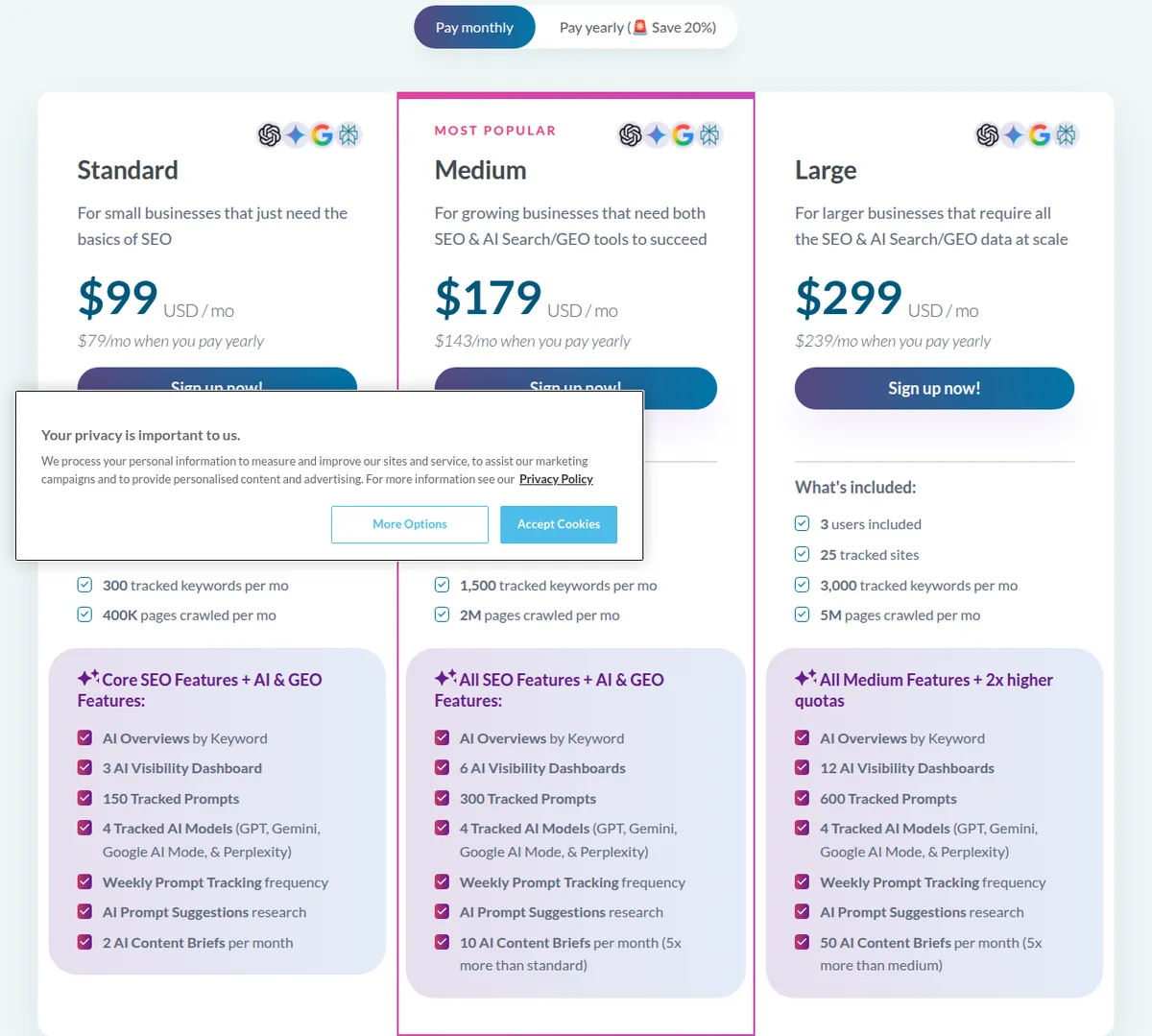
| The lowest practical paid entry | Moz Pro Standard at $79/month yearly (opens in a new tab) |
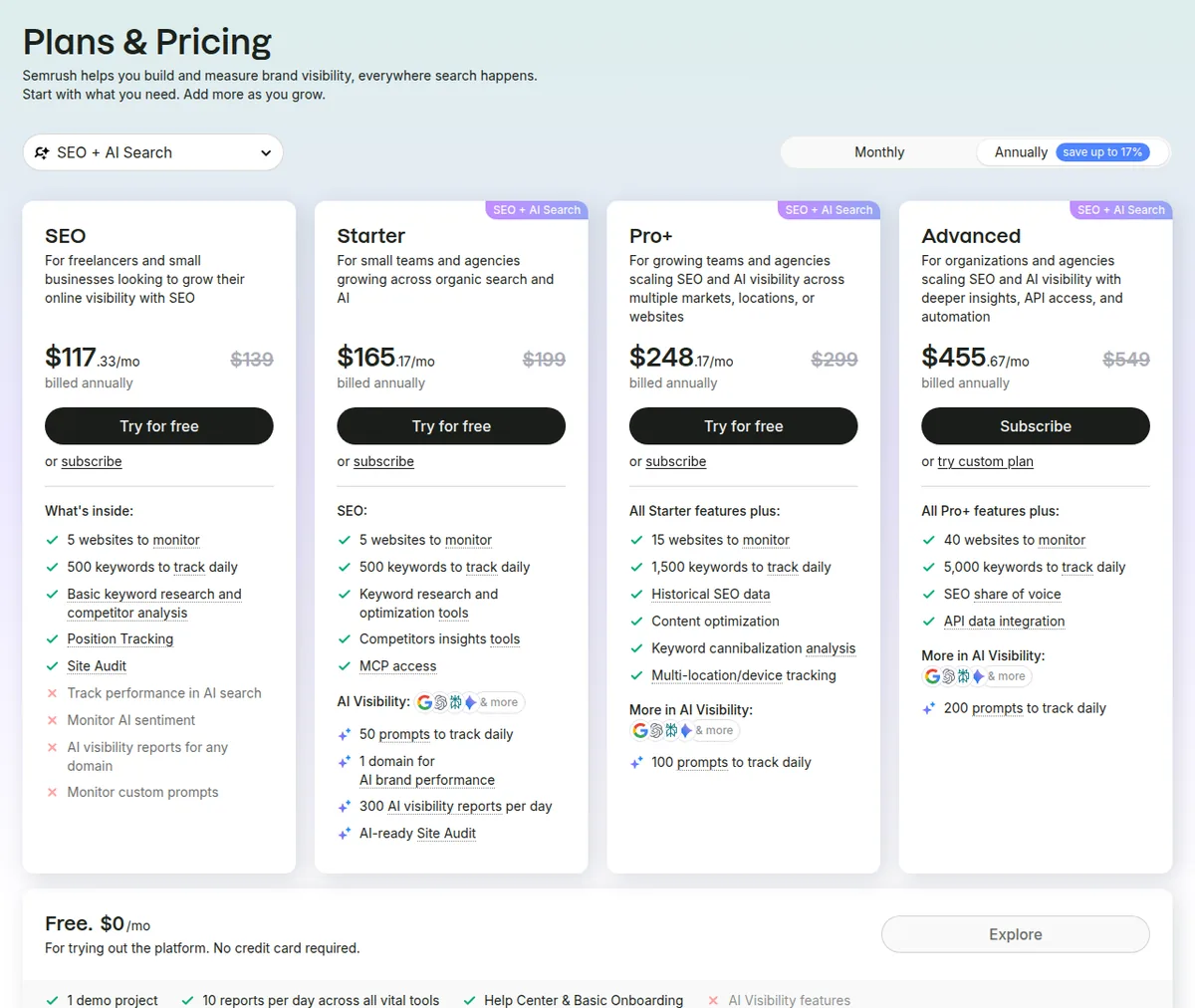
| Five sites and 500 keywords/day | Semrush SEO at $117.33/month yearly (opens in a new tab) |
| Ahrefs data with annual billing | Ahrefs Lite at $108/month displayed annually (opens in a new tab) |
| AI visibility and MCP access | Semrush Starter at $165.17/month yearly (opens in a new tab) |
| Occasional research without a full suite | Ahrefs Free or Moz's free standalone tools (opens in a new tab) |
| A five-person team | Model seats before choosing a plan |
Check current pricing at the source
- Check current Semrush pricing (opens in a new tab)
- Check current Moz Pro pricing (opens in a new tab)
- Check current Ahrefs pricing (opens in a new tab)
Every figure in this guide was read from the vendor's own pricing page on the date stamped above. Vendors change plans without notice, so confirm the number before you commit.
- Moz Standard annual
- $948/year
- Ahrefs Lite annual
- $1,290/year
- Semrush SEO annual
- $1,407.96/year
- Tools compared
- 3
Overview: Semrush alternatives
For a small agency leaving Semrush, Moz Pro Standard is the best value destination and Ahrefs Lite is the runner-up. Moz costs $79 per month yearly, versus $117.33 for Semrush SEO and $108 displayed annually for Ahrefs Lite. Semrush is still worth the premium when its five websites, daily keywords, AI visibility or MCP access supports paid work.
These Semrush alternatives suit small agencies doing recurring SEO delivery. Count properties, keyword units, users, billing commitment and historical records before switching.
The decisive comparison uses annual billing. Semrush SEO is $117.33 monthly annually, or $1,407.96 yearly; Starter is $165.17, or $1,982.04. Moz Standard is $79, or $948 yearly. Ahrefs Lite is displayed as $108 annually, with a stated $1,290 annual charge. Moz saves $459.96 against Semrush SEO, and Ahrefs saves $117.96.
This guide explains the capacity and seat trade-offs, then gives a migration checklist. Start with the SEO Tools for Small Agencies hub.
How we chose
The comparison tests annual cost, capacity, users, seat pricing, billing terms and switching data. Semrush daily reports, Moz tracked keywords and Ahrefs project, keyword and crawl allowances are different units.
Every price and stated limit was checked against the vendor's own pricing page on 11 October 2026, the date in the front matter. Annual figures use the vendor's displayed monthly equivalent where applicable, with annual totals calculated from the published amount. Semrush's additional-user line is a starting figure, so its team totals are planning floors.
Semrush
Best for capacity and AI visibility Semrush SEO at $117.33/month annually
Semrush suits an agency with recurring work that wants a broad SEO workflow in one subscription. SEO costs $117.33 annually or $139 monthly, with five websites and 500 keywords per day, explaining its premium over Moz Standard.
Starter is not merely a cheaper name for the same entry point. It costs $165.17 per month on annual billing or $199 monthly, still lists five websites and 500 keywords, and adds AI visibility with 50 prompts per day plus MCP access. That is a reason to stay with Semrush only when those capabilities belong in a defined client service. Paying for Starter because it sounds more complete is not a switching strategy.
Pro+ is $248.17 annually or $299 monthly, with 15 websites and 1,500 keywords per day. Advanced is $455.67 or $549, with 40 websites, 5,000 keywords per day and API access. Additional users start from $45 monthly; Base Report is $10 and Pro Report $20.
A two-person Northstar Search team on SEO pays a planning floor of $162.33 monthly, or $1,947.96 yearly, after one user from $45. Five people require four, making $297.33 monthly or $3,567.96 yearly, before report add-ons. Starter would be $210.17 and $345.17 monthly for those teams.
Semrush's weakness is the commitment before a small team has a large portfolio. SEO and Starter both show five websites, and a client with several properties can consume that allowance quickly. A team needing more than five should price Pro+ rather than assume a small overage is available.
Semrush Free is a genuine $0 evaluation route with one demo project and 10 reports per day across the tools. A seven-day free trial is also listed. Those options can validate a workflow, but neither should be presented as a free multi-client delivery plan.
Moz Pro
Best for lower entry cost Moz Pro from $79/month annually
Moz Pro is the strongest Semrush alternative when an agency fits its tiers. Standard costs $99 monthly or $79 yearly, with one user, three sites and 300 keywords. Medium is $179 or $143 yearly, with two users, 10 sites and 1,500 keywords. Large is $299 or $239 yearly, with three users, 25 sites and 3,000 keywords. Extra seats cost $49 monthly.
A two-person Cedar Digital team with three sites can use Standard plus one seat for $128 monthly, or $1,536 yearly. If it needs Medium's 10 sites and 1,500 keywords, both users are included and the total is $143 monthly, or $1,716 yearly. The cheaper bill has the smaller allowance.
For five-person Cedar Digital, Large includes three users, so two seats make $337 monthly or $4,044 yearly. That exceeds Semrush SEO's five-person floor despite Moz's lower solo entry price.
Moz's strengths are visible plan boundaries and a lower solo commitment. Its weaknesses are Standard's three-site ceiling and the recurring seat charge. Moz also lists a free trial on Medium and free standalone Domain Analysis, Keyword Explorer and Link Explorer tools, but these do not create a free Moz Pro plan with paid allowances.
Ahrefs
Best for a larger research allowance Ahrefs from $108/month annually
Ahrefs is worth inspecting for a published annual price and larger entry allowance than Moz Standard. Lite is $129 monthly or $1,290 yearly displayed as $108 monthly, with one user, 750 tracked keywords, 100,000 crawl credits monthly, 2,500 report rows and five unverified-ownership projects. Verified-ownership projects are unlimited on the full plan.
Lite permits two additional users at $40 monthly, with annual seats shown at $400. Two-person Fieldline Advisory therefore pays $1,690 yearly. Five people require Standard at $249 monthly or $2,490 yearly displayed as $208 monthly; four annual seats make $4,890 yearly, or $407.50 monthly averaged.
Standard lists 20 unverified-ownership projects, unlimited verified projects, 2,000 tracked keywords, 500,000 crawl credits monthly and 30,000 report rows. Advanced is $449 monthly or $4,490 yearly displayed as $374, with 5,000 keywords, 1,500,000 crawl credits and up to 10 additional users. Enterprise is $1,499 monthly or $14,990 yearly, with an annual commitment.
Ahrefs Free has limited Site Explorer and Site Audit access, with no published numeric limits. Starter is $29 monthly, but its annual price and numeric limits are not published, so it is not an apples-to-apples annual comparison with Lite.
Ahrefs' weakness is the price jump once a team exceeds Lite's two additional users. It can be cheaper than Semrush for a solo or two-person workload, but the five-person Standard scenario is far above Semrush SEO's planning floor. The published seat allowance belongs in the budget.
Semrush alternatives compared
Annual entry pricing and published capacity, before extra seats
| Tool and plan | Annual price shown | Annual total | Published capacity | Included users |
|---|---|---|---|---|
| Semrush SEO | $117.33/month | $1,407.96/year | 5 websites, 500 keywords/day | 1 |
| Semrush Starter | $165.17/month | $1,982.04/year | 5 websites, 500 keywords | 1 |
| Moz Pro Standard | $79/month | $948/year | 3 sites, 300 keywords | 1 |
| Ahrefs Lite | $108/month displayed | $1,290/year | 5 unverified projects, 750 keywords | 1 |
| Ahrefs Standard | $208/month displayed | $2,490/year | 20 unverified projects, 2,000 keywords | 1 |
The entry-level cost reality is clearest when the annual totals sit beside the units. Moz Standard saves $459.96 per year against Semrush SEO, but it offers three sites rather than five and 300 tracked keywords rather than Semrush's 500 keywords per day. Ahrefs Lite saves $117.96 per year against Semrush SEO, while publishing 750 tracked keywords, 100,000 crawl credits per month and five unverified-ownership projects. Those are different measurement systems, so the apparent saving does not prove equal coverage.
Semrush Starter complicates the comparison. It is $574.08 per year more than Semrush SEO and keeps the same five websites and 500-keyword figure in the verified notes, but adds AI visibility with 50 prompts per day and MCP access. If the team does not use those additions, Moz Standard is $1,034.04 per year cheaper than Starter and Ahrefs Lite is $692.04 cheaper. If the agency sells AI visibility reporting, those alternatives may not be true replacements for the workflow.
This is where moz vs semrush and Ahrefs vs semrush become capacity decisions. A three-site, one-user operation can save with Moz Standard, while a five-site operation may need Semrush SEO or Moz Medium. Ahrefs Lite undercuts Semrush SEO, but its keyword, crawl and project units must answer the same client questions.
A practical migration plan
Before cancelling Semrush, make a dated export pack for every active client. Include keyword positions, rank-tracking history, backlink data, keyword lists, audit issue lists, competitor snapshots, client reports and project settings. Label each file with the client, domain, date, search market and handover owner.
Historical rank tracking and backlink data are the two records teams most often lose. A new tool starts a fresh series rather than recreating the old baseline, so preserve dated rank files and backlink exports before the old subscription ends.
Run the replacement and Semrush in parallel for one reporting cycle where possible. Compare rankings, sites or projects, keyword unit, access and client-facing data before cancelling.
The seat and billing traps
A low base price is not a team price. Semrush includes one user, with additional users from $45 monthly. Moz includes one, two or three users by tier and charges $49 per extra seat. Ahrefs Lite allows two additional users at $40 monthly, while Standard allows five at $60; annual seats are $400 and $600 respectively.
Annual billing changes both price and commitment. Semrush's $117.33 and $165.17 figures are annual-billing monthly equivalents, not month-to-month charges. Moz's $79, $143 and $239 figures are yearly-billing equivalents, while Ahrefs states $1,290, $2,490 and $4,490 annual totals for Lite, Standard and Advanced. Put the actual cash commitment beside the displayed monthly equivalent in a proposal.
Capacity can erase the saving. Moz Standard's three sites and 300 keywords may be enough for a solo consultant, but a multi-property client portfolio can push the team to Medium or Large. Ahrefs Lite's five unverified-ownership projects and two additional-user allowance may be enough for a small operator, but five people require Standard in the scenario above. Semrush's five websites on SEO and Starter can also disappear quickly, with Pro+ at $248.17 annually as the published next capacity step.
Do not compare unlike keyword units. Semrush's SEO figure is 500 keywords per day, while Moz lists 300 tracked keywords on Standard and Ahrefs lists 750 tracked keywords on Lite. The numerical order alone says nothing about reporting frequency, data collection or the exact client workflow. Ask the team to list the actual keyword sets and reporting cadence before treating a cheaper tier as equivalent.
Who should not buy this
Do not switch to a paid alternative without a recurring SEO process. Semrush Free offers one demo project and 10 reports per day, Ahrefs Free offers limited Site Explorer and Site Audit access without numeric limits, and Moz offers free standalone research tools. These are testing routes.
Do not choose Ahrefs Starter on the assumption that its $29 monthly price is an annual bargain. The verified page does not publish Starter's annual price or numeric limits. Do not choose Moz Starter for a known multi-site workload because only one site is published and its annual price and keyword allowance are not stated.
Do not downgrade when the agency depends on a Semrush capacity or feature the destination does not provide. Semrush is worth the premium when five websites, 500 keywords per day, AI visibility with 50 prompts per day, MCP access, 15-site Pro+ capacity or Advanced API access supports paid client work.
Finally, name the people, domains and historical records before approving the switch. A five-person consultancy can pay more on Moz Large or Ahrefs Standard than on Semrush SEO once seats are included.
Our verdict
Choose Moz Pro Standard first when a one-person, three-site workload fits and the goal is to spend less than Semrush. Its $79 monthly annual equivalent is $948 across a year, $459.96 below Semrush SEO. Move to Medium when two users, 10 sites and 1,500 keywords justify $143 yearly, and model the $49 seat charge for larger teams.
Choose Ahrefs Lite when its published 750-keyword, crawl-credit and project allowances fit and the team stays within its seat rule. The annual charge is $1,290, displayed as $108 per month, $117.96 below Semrush SEO. Five people require Standard and four annual prepaid seats, making the total $4,890.
Stay with Semrush when the premium is buying a named delivery requirement. SEO at $117.33 monthly annually gives five websites and 500 keywords per day. Starter at $165.17 adds AI visibility with 50 prompts per day and MCP access. The right question is not whether Semrush is expensive. It is whether removing those allowances costs more in staff time, client reporting or replacement subscriptions than the annual saving.
Before changing platforms, use Semrush vs Moz for consultants or Ahrefs vs Semrush for small agencies. The checks behind the figures are explained in the methodology.
Frequently asked questions
What are the best Semrush alternatives for small agencies?
Moz Pro Standard is the best low-cost starting point at $79 per month when paid yearly, while Ahrefs Lite is the runner-up at $108 per month displayed annually. Semrush remains the better fit when its five websites, daily keyword allowance, AI visibility or MCP access is required. The deciding inputs are sites, keywords, users and the workflow that must survive the move.
Which Semrush alternative is cheaper?
Moz Pro Standard is cheaper than Semrush SEO at the entry level, costing $948 per year compared with $1,407.96 calculated from Semrush's $117.33 annual monthly equivalent. Ahrefs Lite costs $1,290 per year, so its annual saving against Semrush SEO is $117.96. Those comparisons exclude additional seats and are not proof of equal capacity.
Is Ahrefs cheaper than Semrush for a two-person agency?
Ahrefs Lite costs $1,290 per year and an additional annual prepaid Lite user is shown at $400, making the two-person total $1,690 per year. Semrush SEO costs $1,407.96 for the plan plus one additional user from $45 per month, a planning floor of $1,947.96 per year. Ahrefs is lower in this named scenario, provided Lite's published allowances fit the work.
Is Moz Pro cheaper than Semrush for five people?
Not necessarily. Moz Large costs $239 per month on annual billing and includes three users, so two additional seats at $49 make the five-person total $337 per month, or $4,044 per year. Semrush SEO with four additional users from $45 has a planning floor of $297.33 per month, or $3,567.96 per year.
What should an agency export before leaving Semrush?
Export current keyword positions, historical rank-tracking records, backlink data, keyword lists, site-audit issue lists, competitor snapshots, client reports and project settings before cancelling. Historical rank tracking and backlink data are particularly important because a new platform starts a new working record rather than recreating the old baseline. Keep dated raw files and document the client, domain and reporting context.
Is Semrush still worth the premium?
Yes, when the agency uses the premium capacity rather than merely owning it. Semrush SEO publishes five websites and 500 keywords per day, while Starter adds AI visibility with 50 prompts per day and MCP access. If those requirements are absent, Moz Standard or Ahrefs Lite can make a stronger cost case at entry level.
What are the free Semrush alternatives?
Ahrefs Free provides limited Site Explorer and Site Audit access, but its numeric limits are not published in the verified notes. Moz provides free standalone Domain Analysis, Keyword Explorer and Link Explorer tools, while Semrush Free provides one demo project and 10 reports per day across tools. These routes are for testing or occasional research, not a guaranteed free multi-client plan.