SEO tools for agencies · Updated 4 November 2026
AI Content Briefs for Small Agencies
Compare Surfer, Frase, Semrush and SE Ranking on brief workflow, monthly content limits, seats, credits and paid overages.
- 16 min read
- AI content briefs for small agencies
- Verified against vendor pricing
The short answer
For most small agencies, Frase Professional is the clearest brief-to-draft workflow at $103 per month billed yearly, with 3 seats, 40 articles, 100 AI generations and 5 sites. Surfer Standard is the cleaner brief and optimization choice at $99 per month billed yearly with 360 documents and 3 seats, while Semrush and SE Ranking publish larger article allowances but do not publish a separate brief-only cap.
| If you need | Reach for |
|---|---|
| A brief that moves into a managed content workflow | Frase Professional |
| Content briefs with a clear document allowance | Surfer Standard (opens in a new tab) |
| A large published content allowance inside an SEO suite | Semrush Content Base (opens in a new tab) |
| Briefs connected to broad SEO project data | SE Ranking Core (opens in a new tab) |
| A no-card way to inspect the workflow | Frase trial or SE Ranking trial |
Get started with the tools in this guide
Where a vendor offers a free plan or a free trial, it is stated below, so you can try the tool before you pay for it.
-
See Semrush pricing (opens in a new tab)
Semrush
-
Start a free SE Ranking trial (opens in a new tab)
SE Ranking
14-day free trial, no card required
-
Start free with Surfer (opens in a new tab)
Surfer
Free plan available
These links go to the vendor's own site. We may earn a commission if you sign up, at no extra cost to you. How we fund the site. Every figure in this guide was read from the vendor's pricing page on the date stamped above, so confirm the number before you commit.
- Best brief-to-draft workflow
- Frase Professional
- Lowest document tier
- 120 documents
- Entry article allowance
- 25 to 10,000
- Read date
- 4 November 2026
Best brief-to-draft workflow Frase Professional Its article, AI generation, seat and site limits are all named, with optional overages rather than a surprise bill.
Best published document allowance Surfer Standard 360 documents and 3 team seats make the unit of work easy to count, though the plan is billed yearly.
Best broad-suite brief input SE Ranking Core Its Content Editor uses SERP-driven structure, terms, word count and media guidance, but the published 25 figure is for articles, not a separate brief pool.
Overview
AI content briefs for small agencies are useful when they turn a vague assignment into a handoff another writer can execute. Frase Professional is the clearest overall choice because its official pricing page names the monthly article, AI generation, site and seat allowances, while optional overages show what happens when a team runs long. Surfer Standard is the runner-up for a content-first team because 360 documents and 3 seats make production capacity straightforward to budget.
A brief is not simply a list of keywords or a generated outline. It should explain the searcher's job, the page's intended answer, the competing content pattern, the primary and supporting topics, the proposed structure, evidence needs, internal-link opportunities, conversion role, metadata direction and editorial risks. A writer should be able to make a sound page from it without guessing what the strategist meant.
That makes pricing a workflow question. A small agency may create 10 briefs in a month, or it may create 40, then use each brief as the starting point for a draft, an editor pass and a client approval. Some platforms count documents. Some count articles. Some count AI generations. Some name a content allowance but do not say how many briefs that allowance contains. Those units are not interchangeable.
This guide compares Surfer, Frase, Semrush and SE Ranking on the brief itself. It covers the information each platform can put into a brief, the entry-tier document or article allowance, the seats and sites around it, the free route and the point where an agency has to pay extra. The SEO tools for agencies hub contains the wider software comparison, while the SEO software for consultancies guide focuses on manager seats, client access and reporting. The methodology page explains how vendor pricing and limits are checked.
What a usable content brief contains
A usable brief starts with a decision about the page, not a target word count. The strategist should name the intended reader, the problem that brought that reader to search, the page type that answers it and the action that should follow. A product-led article, a comparison, a service page and a troubleshooting guide can target related terms while needing very different structures.
The research layer should explain the result page without treating current leaders as instructions to copy. Record intent, recurring subtopics, useful entities, content gaps and claims that need sources. A tool can identify patterns, but it cannot decide whether they fit a client's audience or brand.
The structure should be specific enough to hand over: a working title, heading sequence, section purposes, useful examples, visual suggestions and internal links. If there is a conversion target, state where the commercial explanation belongs and what the reader should do next.
A production brief also needs a review layer. Mark claims needing legal, technical or subject-matter review, separate facts from recommendations, and note style constraints and first-party evidence. The platform can assemble suggestions, but the strategist remains responsible for intent, accuracy and the final editorial call.
The final test is handoff. Give the brief to a writer who did not attend the strategy call. If that writer still has to ask which audience matters, what the page must prove, which sources are acceptable or how success will be judged, the brief is incomplete. A longer export is not automatically a better brief.
Surfer: the clearest document unit
Best for document-count planning Surfer Standard 360 documents and 3 seats at $99/mo billed yearly, read 4 November 2026.
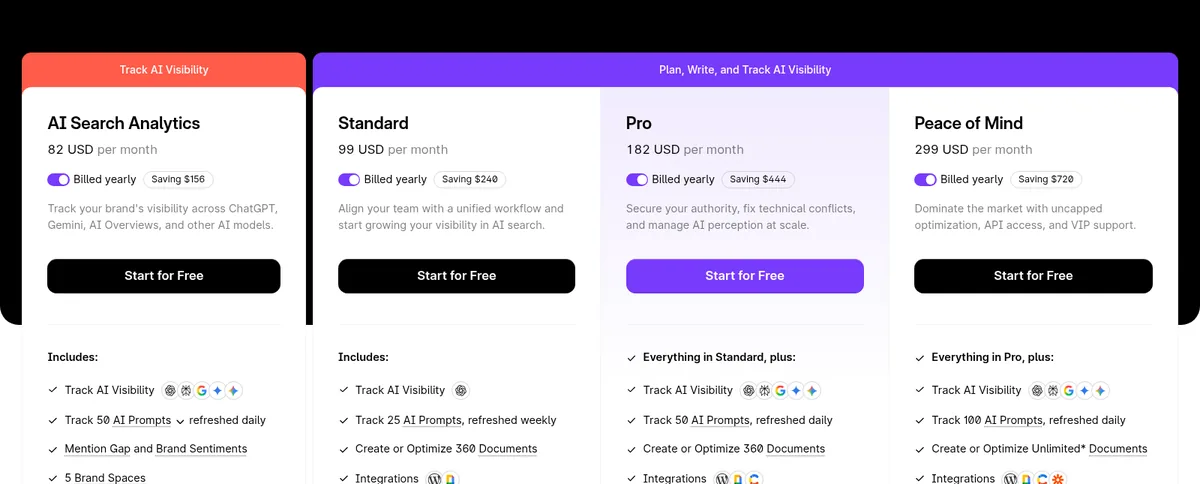
Surfer suits an agency whose central job is turning a topic into a content-editor workspace. Its pricing page makes the production unit unusually visible: Discovery includes 120 documents, Standard and Pro include 360, and Peace of Mind includes unlimited documents subject to fair usage. Standard also includes 50 tracked pages, an AI writing assistant, 1-click content optimization, plagiarism checking and integrations.
The entry paid choice for a real content team is Standard at $99 per month billed yearly, read 4 November 2026. It includes 3 team seats, 360 documents and 25 AI prompts refreshed weekly. Discovery is $49 per month billed yearly with 120 documents, 10 tracked pages and 1 team seat. Discovery has the lower cash price, but a three-person agency would still need to solve access, and the page does not publish a separate timed trial length.
Pro costs $182 per month billed yearly and keeps 360 documents while moving to 5 team seats, 200 tracked pages and 50 AI prompts refreshed daily. For a five-person agency, Pro avoids an extra-seat calculation, but it costs $83 more per month than Standard. Peace of Mind costs $299 per month billed yearly, includes 10 team seats, 500 tracked pages and unlimited documents subject to fair usage. An agency should only pay for that tier when the documented ceiling, API access or page volume is the actual bottleneck.
Surfer is weaker as a total agency operating system. Its pricing page describes content creation, optimization, tracking and AI visibility, not a client-reporting package with a stated client-seat allowance. AI Search Analytics is also separate at $82 per month billed yearly, with 50 AI prompts refreshed daily. An agency wanting content briefs and AI visibility therefore needs to count two products rather than treating the prompt tracker as part of Standard.
Frase: a brief inside a more complete handoff
Best for brief-to-draft handoff Frase Professional 40 articles, 100 AI generations, 3 seats and 5 sites at $103/mo billed yearly, read 4 November 2026.
Frase is the best fit when the brief is one stage in a managed loop that includes research, drafting, auditing and publishing. The official pricing page calls the production unit an article rather than a document or a brief. Starter includes 10 articles per month, Professional includes 40 and Scale includes 100. Each plan also publishes an AI generation allowance, which is separate from the article count.
Starter costs $39 per month billed yearly or $49 per month month to month. It includes 1 seat, 1 site, 10 articles per month, 50 audit pages and 25 AI generations. The plan holds at its monthly limits, so the low tier is predictable, but it is a poor fit for an agency that needs several client sites or shared access.
Professional costs $103 per month billed yearly or $129 per month month to month. It includes 3 seats, 5 sites, 40 articles, 250 audit pages and 100 AI generations. Frase also lists a content calendar, internal linking suggestions, AI crawler monitoring and 50 AI Visibility prompts. This is the first plan in the set that looks designed for a small content team rather than a single operator.
Scale costs $239 per month billed yearly or $299 per month month to month. It includes 5 seats, up to 10 domains, 100 articles, 1,000 audit pages and 350 AI generations. It also includes exportable client-ready reports. White-label reports and a branded client portal are Enterprise features, so Scale is not the same as a fully branded client delivery environment.
Frase is unusually clear about what happens after the included allowance. Professional can add $29 monthly seats, and optional pay-as-you-go capacity costs $5 per extra article, $0.50 per audit page and $0.25 per AI prompt. Scale lists $4 per extra article, $0.40 per audit page and $0.20 per AI prompt. Pay-as-you-go is off by default. Starter simply holds at its monthly limits.
A five-person agency on Frase Scale pays $239 per month billed yearly for 5 seats, 10 domains and 100 articles. A three-person agency on Professional pays $103 per month billed yearly for 3 seats and 40 articles. If it needs 50 articles, the official rate for the 10 extra articles is $50 when optional overages are enabled, giving a $153 month before any other overage. That is more useful budgeting than a vague claim of unlimited briefs.
Semrush: a large content allowance with an unstated brief cap
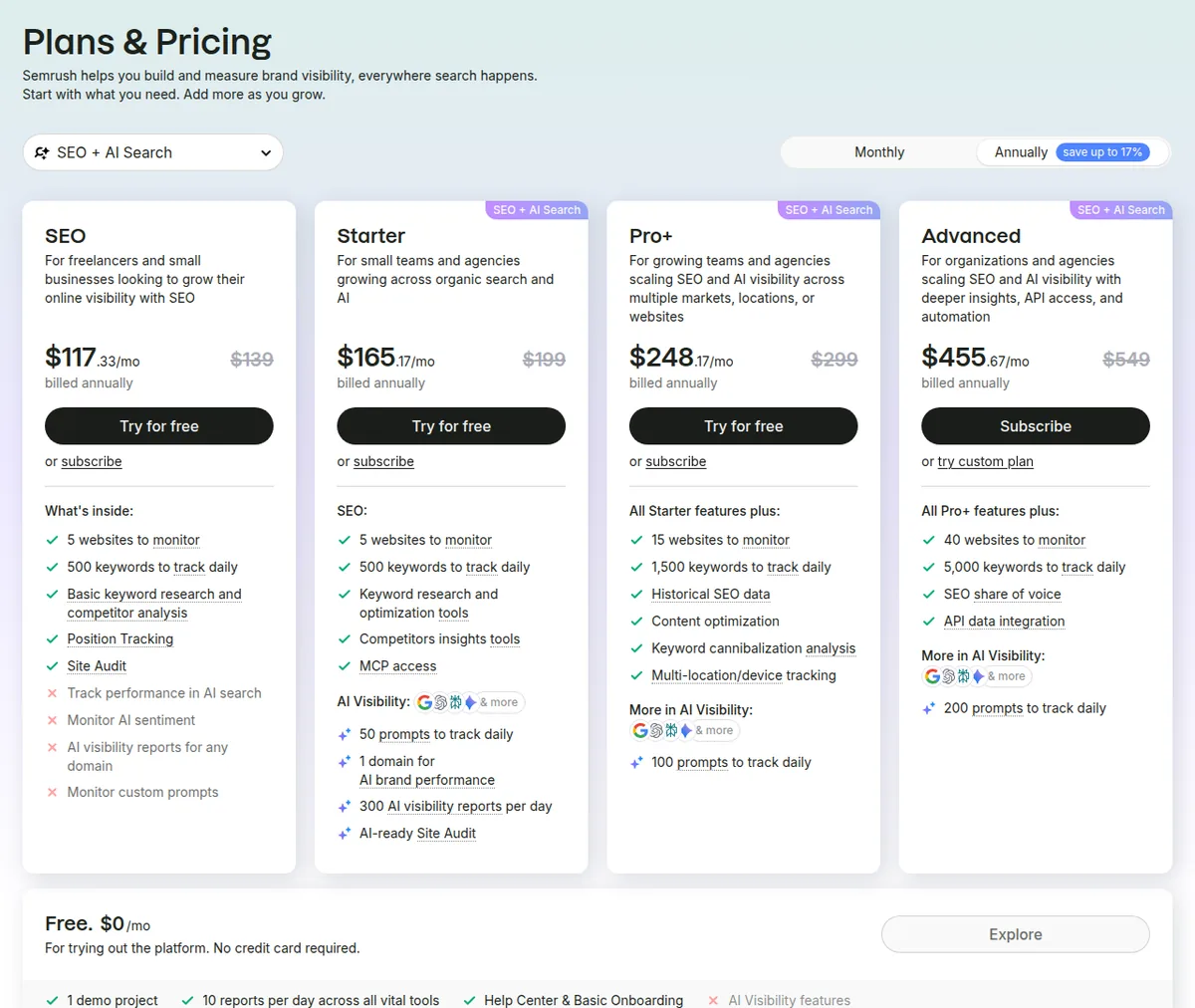
Best for a broad content suite Semrush Content Base $60/mo billed yearly, 10,000 articles/mo and 5 SEO content boosts/mo, with no separate numeric brief cap published, read 4 November 2026.
Semrush Content Base is the hardest plan to compare on a brief-per-month basis because the official content pricing page names a very large article allowance but does not state a separate number for SEO Brief Generator briefs. It includes data-driven content ideas, 10,000 articles per month, 5 SEO content boosts per month, AI and SEO content optimization, content in a brand voice and brief generation. Those are useful capabilities, but an agency should not silently turn 10,000 articles into 10,000 briefs.
The plan costs $60 per month billed annually, read 4 November 2026. Additional users cost $20 per month each on the content pricing page. A three-person team therefore starts at $100 per month billed annually if it needs two additional individual logins. Base Report costs $10 monthly and Pro Report costs $20 monthly. Pro Report adds branding, white-labeling, AI-generated summaries, more integrations and link sharing, which matters if the brief or its resulting report goes to a client.
A five-person content team on Content Base pays $140 per month billed annually if it needs four additional users at $20 each. Add Pro Report and the published recurring total becomes $160 per month, before any other Semrush product. That calculation is exact for the listed users and report add-on, but it still cannot answer how many separate briefs the team may create. The agency has to ask Semrush for that missing unit before promising a fixed monthly brief volume to clients.
Semrush Free is $0 per month with 1 demo project, 10 reports per day across vital tools, basic onboarding and AI Visibility features. The pricing page also states a 7-day free trial. It does not publish a separate content-brief quantity for the free route. Use it to inspect the platform and its general workflow, not as evidence that a free account can run a multi-client brief operation.
SE Ranking: brief inputs tied to SEO projects
Best for SERP-led brief inputs SE Ranking Core 25 Content Marketing articles shown, 10 projects and 1 manager seat at $103.20/mo billed yearly, read 4 November 2026.
SE Ranking's Content Editor uses target SERPs for word count, keywords, content structure, media elements and related recommendations. Its page describes a path from research to brief, writing, publishing and monitoring, linking brief inputs to broader project data.
Core costs $103.20 per month billed annually or $129 monthly. The pricing comparison lists 10 projects, 1 manager seat, 2,000 keywords tracked daily, 250,000 audit pages per month, 25,000 API credits per month and a Content Marketing allowance of 25 articles. The page does not label those 25 articles as a brief-only pool. The careful reading is 25 published Content Marketing articles in the plan comparison, not 25 guaranteed exports of a particular brief format.
SE Ranking makes the extra-seat rule visible. Extra manager seats start at $16 monthly. Extra content articles start at $39.20 monthly in the pricing comparison. Agency Pack adds $69 per month with annual billing only and includes 30 client seats, white-label platform and reporting, unlimited scheduled reporting and AI summaries. These are separate pieces of the bill. A content brief workflow can fit Core while client delivery still needs Agency Pack.
A five-person agency on Core needs four extra manager seats at from $16 each, so its published starting total is from $167.20 per month billed annually before Agency Pack. If it also needs the client-facing package, the starting total becomes from $236.20 per month with Agency Pack. That scenario assumes the extra manager-seat starting price applies to all four seats and does not add unverified content overage. The number is a floor, not a promise of a final invoice.
The four brief workflows compared
The most important difference is what each vendor treats as the unit of work. Surfer gives the clearest document count: 120 on Discovery and 360 on Standard. Frase gives the clearest content-job count: 10, 40 or 100 articles, with separate AI generation limits. Semrush publishes 10,000 articles on Content Base but does not publish a separate brief quantity. SE Ranking publishes 25 or 50 Content Marketing articles in the plan comparison while describing the brief as a Content Editor artefact.
| Platform | Entry plan relevant to briefs | Published monthly unit | Seats or users | Where extra cost starts |
|---|---|---|---|---|
| Surfer | Discovery $49/mo yearly; Standard $99/mo yearly | 120 documents on Discovery; 360 on Standard | 1 on Discovery; 3 on Standard | Standard or Pro for more seats and pages; AI Search Analytics $82/mo yearly |
| Frase | Starter $39/mo yearly; Professional $103/mo yearly | 10 articles on Starter; 40 on Professional | 1 on Starter; 3 on Professional | Professional extra seats $29/mo; optional article overage $5 each |
| Semrush | Content Base $60/mo yearly | 10,000 articles/mo; brief quantity not separately stated | Additional users $20/mo each | Additional users, Base Report $10/mo, Pro Report $20/mo |
| SE Ranking | Core $103.20/mo yearly | 25 Content Marketing articles shown; brief quantity not separately stated | 1 manager seat | Extra manager seats from $16/mo; extra articles from $39.20/mo; Agency Pack $69/mo yearly |
A practical monthly capacity model has three counts. First, count strategy jobs, meaning the number of distinct topics that need intent and structure. Second, count production jobs, meaning the number of briefs that become drafts or refreshes. Third, count review jobs, meaning the pages that require an editor or subject expert. The first count maps to briefs, the second may map to documents or articles and the third often sits outside the plan entirely.
What the free plan actually includes
Surfer publishes no permanent $0 operating plan on the pricing page read 4 November 2026. Discovery has a Start for Free button, but the page does not state a timed trial length. The published entry allowance is the paid Discovery plan at $49 per month billed yearly, with 120 documents, 10 tracked pages and 1 team seat. Do not present the Start for Free button as a free monthly brief quota.
Frase offers a 7-day free trial with no credit card. The trial uses Professional's feature set but is capped at 5 articles, 50 audit pages, 25 AI prompts and up to 3 seats. That is enough for a small agency to run a limited handoff test, but it is not the 40-article Professional allowance. Starter is paid at $39 per month billed yearly and holds at its 10-article monthly limit.
Semrush has a permanent Free route at $0 per month with 1 demo project, 10 reports per day across vital tools, Help Center and Basic Onboarding, and AI Visibility features. The official page also states a 7-day free trial. Neither the permanent free allowance nor the trial publishes a separate number of content briefs, so the free route is for platform inspection rather than capacity planning.
SE Ranking publishes no permanent free plan on its pricing page. Its free 14-day trial requires no credit card and includes up to 10 projects, 750 tracked keywords per day, 20 AI prompts per day and AI competitive research for up to 3 domains with unlimited reports. The trial page does not state a separate Content Editor brief count. Treat the trial as a workflow test, not as a free production tier.
The seat and billing traps
Annual billing changes every headline comparison. Surfer's $99 Standard, Frase's $103 Professional and SE Ranking's $103.20 Core prices are monthly equivalents of annual billing, not necessarily the month's cash charge. The annual commitment matters.
Seats create a second layer. Surfer Standard includes 3 team seats, Frase Professional includes 3, Semrush Content Base starts with an additional-user price of $20 and SE Ranking Core includes 1 manager seat. A two-person strategist and editor team fits the first two more naturally. A five-person agency should not assume that a plan with one included seat can be shared safely or that a shared login is an equivalent substitute for individual access.
Overages are clearer on Frase than on the other three. Professional can add articles at $5 each, audit pages at $0.50 and AI prompts at $0.25 when pay-as-you-go is enabled. Scale uses $4, $0.40 and $0.20. Surfer's Peace of Mind documents are subject to fair usage. Semrush does not publish a separate brief overage on the content pricing page. SE Ranking publishes extra articles from $39.20 monthly, but not a per-brief price.
Reporting is another handoff cost. Semrush Pro Report is $20 per month, SE Ranking Agency Pack is $69 monthly with annual billing only, Frase Scale includes exportable client-ready reports but reserves white-labeling for Enterprise, and Surfer does not publish the same client-report allowance.
Who should not buy this
An agency should buy nothing if it creates only a few briefs each quarter and already has reliable research, writing and editorial checks. A paid platform earns its place when the repeated workflow costs enough time to justify it.
Stay on a free route while the team defines its brief. Semrush Free, Frase's trial and SE Ranking's trial can test their respective workflows. Surfer's paid Discovery plan is not a free tier, despite its Start for Free button.
The SEO tool hidden fees guide covers seats, credits, tracked sites and add-ons across the wider category. The Surfer SEO review and SE Ranking review go deeper on those two platforms' broader limits. The Semrush pricing explanation covers Semrush's separate SEO tiers and reporting add-ons.
Our verdict
For most 2 to 20 person agencies, Frase Professional is the best starting point for a repeatable brief-to-draft workflow. At $103 per month billed yearly, read 4 November 2026, it names 3 seats, 5 sites, 40 articles, 250 audit pages and 100 AI generations. Optional article, audit-page and prompt overages make the next cost visible, while Scale adds 5 seats, 10 domains, 100 articles and client-ready reports for $239 per month billed yearly.
Surfer Standard is the better pick when the agency wants the clearest document allowance and content optimization workspace. Its $99 per month billed yearly plan includes 360 documents and 3 team seats, but it does not publish the same article overage or client-reporting detail. Semrush Content Base is attractive for an existing Semrush customer because it includes brief generation and 10,000 articles per month at $60 billed yearly, but the missing numeric brief cap prevents a clean capacity promise. SE Ranking Core is strongest when SERP-driven brief inputs need to sit beside SEO projects, with 25 Content Marketing articles shown and a separate one-seat constraint.
Frequently asked questions
What are AI content briefs for small agencies?
AI content briefs for small agencies are structured handoffs that use software to organize intent, SERP patterns, topics, headings, evidence needs and production guidance. They still need a strategist to define the audience, commercial purpose, source requirements and editorial risks before a writer uses them.
Which tool is best for AI content briefs for small agencies?
Frase Professional is the clearest default when a brief needs to move into drafting, auditing and publishing. Surfer Standard is the simpler choice when the agency mainly wants a document-based content workspace with 360 documents and 3 team seats.
How many briefs does Frase include?
Frase publishes article and AI-generation limits rather than a separate brief-only allowance. Starter includes 10 articles and 25 AI generations per month, Professional includes 40 articles and 100 AI generations, and Scale includes 100 articles and 350 AI generations, all read 4 November 2026.
How many documents does Surfer include?
Surfer Discovery includes 120 documents, Standard includes 360, Pro includes 360 and Peace of Mind includes unlimited documents subject to fair usage. The plans are billed yearly at $49, $99, $182 and $299 per month respectively, read 4 November 2026.
Does Semrush publish a content brief limit?
Semrush Content Base includes SEO Brief Generator and lists 10,000 articles per month plus 5 SEO content boosts per month at $60 per month billed annually. Its official content pricing page does not publish a separate numeric allowance for briefs, so an agency should not describe the article number as a brief quota.
Does SE Ranking include content briefs in Core?
SE Ranking's Content Editor creates briefs from SERP-driven word count, keywords, structure and media recommendations. Core costs $103.20 per month billed annually and its plan comparison shows 25 Content Marketing articles, but the vendor does not publish a separate brief-only credit pool.
What is the cheapest way to test a brief workflow?
Semrush Free costs $0 per month and includes 1 demo project, 10 reports per day and AI Visibility features, but no separate brief count is published. Frase offers a 7-day no-card trial capped at 5 articles and up to 3 seats, while SE Ranking offers a 14-day no-card trial with 10 projects and 20 daily AI prompts.
What should a content brief include before a writer starts?
It should name the audience, intent, page job, proposed structure, important topics, evidence and source requirements, internal links, conversion role, editorial constraints and review owner. A generated outline without those decisions is a starting suggestion, not a client-ready brief.
Official pricing pages
Prices and limits were read on 4 November 2026 from the official Surfer pricing page, Frase pricing page, Semrush content pricing page, Semrush SEO pricing page and SE Ranking pricing page. Product workflow details for SE Ranking were read from its official Content Marketing Tool page. Prices are in USD. Promotions, billing displays and limits can change, so the read date beside each figure is part of this comparison.
Get started with the tools in this guide
-
See Semrush pricing (opens in a new tab)
Semrush
-
Start a free SE Ranking trial (opens in a new tab)
SE Ranking
14-day free trial, no card required
-
Start free with Surfer (opens in a new tab)
Surfer
Free plan available
These links go to the vendor's own site. We may earn a commission if you sign up, at no extra cost to you. How we fund the site. Every figure in this guide was read from the vendor's pricing page on the date stamped above, so confirm the number before you commit.
Related guides
-
 Best value
SEO Tools for Small Agencies
Is Semrush Worth It for a Small Agency?
The cost maths for Semrush in a small agency, including the website cap on the entry plan that decides which tier you actually need.
-
 Head to head
SEO Tools for Small Agencies
Semrush vs Moz for Consultants
Semrush and Moz compared on verified pricing, included seats and website limits, and the seat maths that decides it for a small consultancy.
-
SEO Tools for Small Agencies
Best SEO Tool for Small Agencies
A cost-per-client comparison of Semrush, Ahrefs and Moz Pro for small agencies, including project caps, keyword limits, annual discounts and extra seats.