Invoicing and Bookkeeping for Agencies · Updated 24 October 2026
Affordable Accounting Software for Agencies
Six accounting platforms priced for a small agency, with what each tier includes, the caps that decide real cost, and the free routes that exist.
- 18 min read
- affordable accounting software for small agency
- Verified against vendor pricing
The short answer
Zoho Books Standard is the cheapest credible paid tier at $15 per organisation per month billed annually, and it covers three users. Wave Starter is the only platform here that is free without a revenue condition. FreeAgent costs nothing for as long as the agency holds a NatWest, Royal Bank of Scotland, Ulster Bank or Mettle business account. Every other platform charges per organisation, not per seat, so the user count is a cap rather than a multiplier.
| If the agency needs | Choose |
|---|---|
| The lowest paid monthly bill | Zoho Books Standard (opens in a new tab) |
| A free tier with no revenue condition | Wave Starter (opens in a new tab) |
| Free software with a qualifying UK bank account | FreeAgent |
| A name the bookkeeper already accepts | Xero Early (opens in a new tab) |
| Payroll and a bank feed on one bill | QuickBooks Online Essentials (opens in a new tab) |
| Client billing with a workable client cap | FreshBooks Plus (opens in a new tab) |
Get started with the tools in this guide
Where a vendor offers a free plan or a free trial, it is stated below, so you can try the tool before you pay for it.
-
See Zoho Books pricing (opens in a new tab)
Zoho Books
Free plan for organisations under 50K revenue, 1 user plus 1 accountant
-
See FreshBooks pricing (opens in a new tab)
FreshBooks
-
See QuickBooks pricing (opens in a new tab)
QuickBooks
-
See Wave pricing (opens in a new tab)
Wave
-
See Xero pricing (opens in a new tab)
Xero
These links go to the vendor's own site. We may earn a commission if you sign up, at no extra cost to you. How we fund the site. Every figure in this guide was read from the vendor's pricing page on the date stamped above, so confirm the number before you commit.
- Cheapest paid tier
- $15
- Platforms compared
- 6
- Free routes that exist
- 3
- Prices checked
- 24 October 2026
Overview
Affordable accounting software for small agency owners is not the platform with the lowest sticker price. It is the one whose cheapest tier covers the number of people, clients and bank accounts the agency actually has, because the caps inside each tier are what move the bill. On price alone, Zoho Books Standard is the cheapest credible paid tier at $15 per organisation per month when billed annually, and it includes three users. Wave Starter is the only platform in this comparison that is free without a revenue condition attached. The runner-up on cost with a full accounting engine is FreeAgent, which costs nothing for as long as the agency holds a business current account with NatWest, Royal Bank of Scotland, Ulster Bank, or a Mettle account with at least one transaction a month.
The important structural point is that five of these six platforms charge per organisation rather than per seat. Xero states on its pricing page that it has no per-user licence fees. Wave states that its Pro subscription is charged per business, not per owner. Zoho Books includes a fixed number of users in each tier and sells extras separately. That means adding a fourth person to a three-person agency usually costs nothing, while exceeding a client cap or a bill limit can cost a great deal. The two exceptions are FreshBooks, which charges $11 per month per extra team member, and QuickBooks Online, which sets a hard user count per plan and expects an upgrade rather than an add-on.
This page covers six platforms that a small agency can realistically run its books on, what the entry tier of each one actually includes, the caps that decide the real monthly cost, and the situations where the correct answer is to buy nothing at all. The invoicing hub at /invoicing/ holds the wider set of guides if the agency is still deciding between invoicing and bookkeeping as separate purchases.
What we compared
Every price, plan limit, seat rule and free-plan allowance on this page was read from the vendor's own pricing page on 24 October 2026, and the same figures are recorded with their source in our verified pricing file. Nothing here is estimated, converted between currencies, or carried over from an older review.
Six platforms were compared on five criteria:
- The entry tier that a small agency can actually use. A plan that caps invoices at 20 a month is a different product from one that does not cap them, even when both are labelled as the cheap option.
- Whether the platform charges per organisation or per seat. This single fact decides whether the bill grows with the team.
- What the free route requires. A free tier that ends at a revenue threshold is not the same as a free tier that is free indefinitely.
- The caps inside the tier. Invoice limits, bill limits, client caps, receipt scan allowances and reporting restrictions.
- The exit terms. Contract length, cancellation behaviour and whether a downgrade is possible once an upgrade has happened.
Two vendors that appear in most agency shortlists are deliberately treated with caution here. HubSpot and FreshBooks are both compared on this site, but neither is a commercial partner, and the same is true of QuickBooks. Where a platform is not a partner, that changes nothing about the price recorded for it.
Zoho Books is the cheapest paid tier that is still a full accounting system
Cheapest paid accounting tier for a small agency Zoho Books Standard $15 per organisation a month billed annually
Zoho Books Standard is $20 per organisation per month on monthly billing and $15 on annual billing, and it includes three users. For a three-person agency that wants bank feeds, sales tax tracking, custom reports, journal templates and API access, this is the lowest paid entry point of the six. The tier above it, Professional at $50 monthly or $40 annually, adds five users, project profitability, billable timesheets, retainers, multi-currency and inventory.
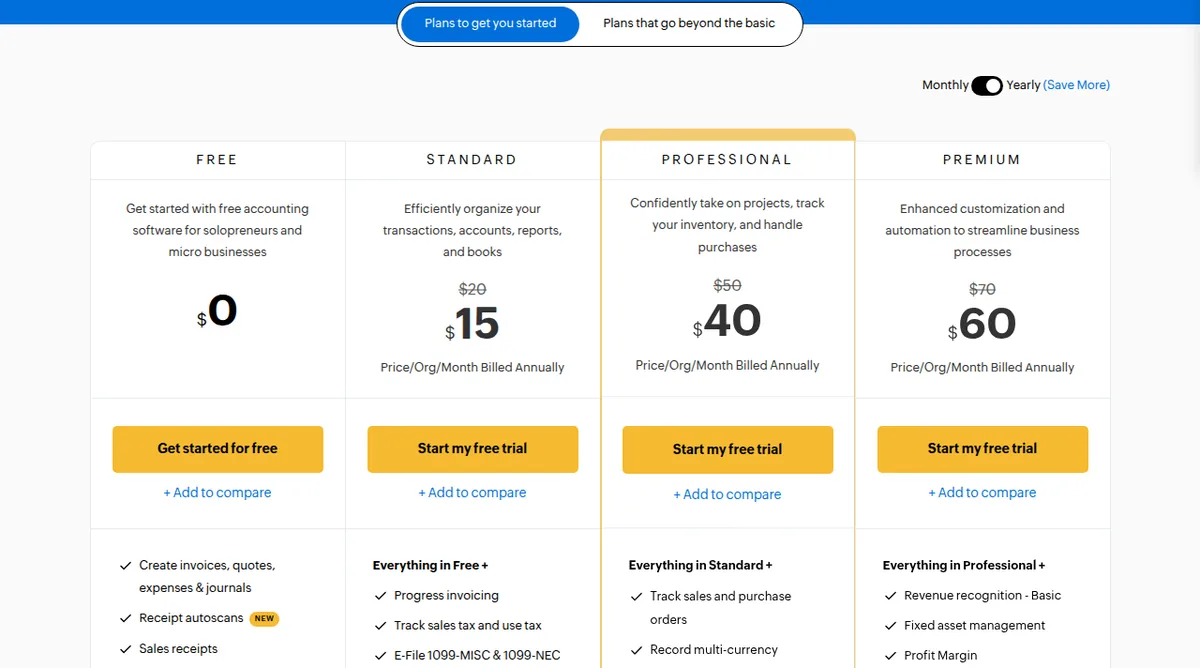
The tier ladder is unusually wide. Premium is $70 monthly or $60 annually with ten users, Elite is $150 or $120, and Ultimate is $275 or $240 with fifteen users. Extra users beyond the tier allowance cost $3 per user per month, or $2.50 billed annually, which is the cheapest per-user add-on in this comparison by a wide margin. Annual invoice limits rise with the tier: 5,000 on Standard, 10,000 on Professional, 25,000 on Premium, and 100,000 on Elite and Ultimate. Receipt autoscans are 200 a month on Standard and Professional, and 1,000 a month on Premium and above.
The honest weaknesses are the ones Zoho's own comparison implies. Standard does not include purchase orders, retainers or project profitability, so an agency that bills against project budgets will need Professional. The interface is denser than Xero or QuickBooks, and the platform is one product inside a much larger suite, which some teams find more application than they wanted. Support on the paid tiers is email, voice and chat, but the free tier is email only.
A three-person agency on Standard billed annually pays $180 a year, or $15 a month. Moving to Professional for project profitability takes that to $480 a year, or $40 a month.
Wave Starter is free without a revenue condition, and that is rare
Best free accounting tier with no revenue cap Wave Starter $0
Wave Starter costs $0 and the pricing page describes it as the place for a business that is just starting or looking for the basics. It lists unlimited estimates, invoices, bills and bookkeeping records, a mobile app for invoicing, and cash flow and customer management in one dashboard. Online payments are available as an add-on at 2.9% plus $0.60 per credit card transaction.
The catch is in the same page's comparison table, which lists automatic bank import, auto-merge and categorisation, and the reporting dashboard as Pro features. Starter therefore means entering transactions by hand or importing a statement rather than letting a bank feed do it, which for a working agency is the difference between ten minutes a month and an afternoon. Wave Pro is $19 per month, or $190 a year, and includes automatic bank import, auto-merge and categorisation, unlimited receipt capture and automated late payment reminders. A promotional price of $9.50 a month applies for the first three months.
Two Wave details matter more than the headline. Pro is charged per business, not per owner, so an agency running three entities under one login pays three times. And Starter reaches live chat and email support only with an optional add-on, which means a free-tier user with a problem is largely on their own. Our Wave review covers the reporting side in more detail.
FreeAgent is free if the agency banks in the right place
Cheapest route for a UK agency with a qualifying bank FreeAgent £0
FreeAgent's regular price for a UK limited company is £33 per month, or £330 a year, and both carry a 50% introductory discount for six months or the first year respectively, taking them to £16.50 a month or £165 for the first year. All prices exclude 20% VAT.
The free route is the reason to look at it. FreeAgent is free for as long as the business holds a business current account with NatWest, Royal Bank of Scotland or Ulster Bank, or holds a Mettle account and makes at least one transaction a month. Optional add-ons may still be chargeable, so the free route is not free of every charge, but the subscription itself is £0.
What the paid tiers include is unusually complete for the price: invoicing and estimates, expenses, projects, time tracking, monthly payroll with PAYE and National Insurance filed to HMRC, Making Tax Digital compatible VAT returns, Self Assessment, end-of-year filing, bank feeds and a cashflow forecast, plus support from UK-based accountants. Smart Capture processes ten receipts and bills a month as standard, and unlimited use is a £5 a month add-on. An Amazon UK connection is £6 a month.
Two limits are worth naming. FreeAgent is built for UK tax rules, so it is not a candidate for an agency billing in the United States or Canada. And its free route is tied to a bank relationship, which means changing bank can change the software bill. FreeAgent also runs its own referral scheme rather than an affiliate programme.
Xero is the name a bookkeeper is most likely to already accept
Best for an agency whose bookkeeper already works in it Xero Early $27 a month
Xero's US pricing page now sells three plans called Early, Growing and Established, and the older Starter, Standard and Premium names no longer appear there. Any comparison still using those names is out of date.
Early is $27 a month, discounted to $2.70 for the first six months under an offer that ends on 2 November 2026. It covers quotes and 20 invoices, five bills, bank reconciliation, smart document capture, real-time reports and a 30 day cash flow forecast. Growing is $59 a month and removes the invoice limit, adding automated bill entry, custom dashboards, health scorecards, budgets and auto-reconcile. Established is $97 a month and adds a 180 day forecast, KPI and ratio analysis, multiple currencies, project time and cost tracking, and expense and mileage claims.
Three details decide whether Early is enough. The 20 invoice limit applies to approving and sending, and transactions started by app partners can count towards it, so an agency with automated billing can hit the ceiling without noticing. Auto-reconcile is an optional $5 a month add-on on Early and is included above it. And Xero Payroll, powered by Gusto, is $36 a month plus $6 per employee or contractor on every plan.
The advantage is familiarity. Xero states that it has no per-user licence fees, so the team can grow without the subscription following it, and accountants and bookkeepers are the audience Xero's own partner programme is built around. The disadvantage is that a downgrade is only possible one month after an upgrade, which is a slower exit than most platforms allow. Our Xero and QuickBooks comparison sets the two side by side.
QuickBooks Online is the most expensive per user and the most complete
Best for an agency that wants payroll and banking on one bill QuickBooks Online Essentials $85 a month
QuickBooks Online lists Simple Start at $38 a month, Essentials at $85, Plus at $140 and Advanced at $340, each with a 50% discount for the first three months. The discount is short and the list price is what an agency should budget for.
The user counts are the reason this platform behaves differently from the rest. Simple Start is one user with access for two accountants. Essentials is three users. Plus is five. Advanced is twenty-five with access for three accountants. There is no per-seat add-on, so exceeding the allowance means moving up a tier rather than paying for one extra person. An agency of four people cannot buy Essentials and add a seat; it buys Plus at $140 a month.
What the tiers add is where the money goes. Essentials is the first plan with enhanced reports and the ability to add employee time to invoices. Plus adds budgets, project profitability, inventory, and classes and locations up to 40. Advanced adds custom user permissions, automated workflows, batch invoicing, Excel sync and priority support. Bill Pay offers free ACH within a monthly allotment and then charges $0.50 per standard ACH transaction. There is a separate $0 product called QuickBooks Free for a business that has not started trading, which is a different thing from a free tier on the paid product. If leaving is the plan, our guide to the alternatives covers the migration path.
FreshBooks is the cheapest way to bill clients and the wrong shape for bookkeeping
Best for an agency that bills a small number of clients FreshBooks Plus $43 a month
FreshBooks Lite is $23.00 a month and Plus is $43.00, with Premium at $70.00 and a Select tier priced on request. The pricing page runs an 80% discount for four months, which takes Lite to $4.60, Plus to $8.60 and Premium to $14.00, and there is a 30 day free trial.
The client cap is the whole story. Lite sends invoices to 5 billable clients. Plus sends to 50. Premium is unlimited. An agency with eight active clients therefore cannot use Lite at all, whatever its price, and the jump from $23 to $43 is not optional. Beyond the cap, accountant access and expense receipt scanning start at Plus, and project profitability, custom email templates and removing FreshBooks branding start at Premium.
Team members are $11 a month each on every tier, which makes FreshBooks the only platform here that charges per additional person. Advanced Payments is $20 a month and FreshBooks Payroll is $40 a month plus $6 per user. The Select tier includes Advanced Payments and two team member accounts, and offers lower card fees and capped ACH fees.
The mismatch is worth stating plainly. FreshBooks is a client billing tool that added accounting features, not an accounting system that added invoicing. An agency that needs multi-currency, purchase orders or inventory will find it thin. Our FreshBooks and QuickBooks comparison covers where the line falls.
What the free plans actually include
Three free routes exist in this comparison, and they are not equivalent.
Wave Starter at $0 is free indefinitely with no revenue condition. It covers unlimited invoices, estimates, bills and bookkeeping records, but the same pricing page's comparison table puts automatic bank import and the reporting dashboard behind Pro at $19 a month. Support is reachable only with an optional add-on.
Zoho Books Free at $0 is free indefinitely while revenue for the financial year does not exceed $50,000, which is a real constraint for an agency rather than a starting business. It allows one user plus one accountant, up to 1,000 invoices and 1,000 bills or expenses a year, 50 receipt autoscans a month and five scheduled reports. Add-ons are not supported on the free plan except document autoscans, and support is email only.
FreeAgent at £0 is free for as long as a qualifying bank account is held, and it is the most complete of the three, because the free route gives the same product as the paid one. The condition is a banking relationship with NatWest, Royal Bank of Scotland, Ulster Bank or Mettle, and optional add-ons such as unlimited Smart Capture at £5 a month remain chargeable.
Xero, QuickBooks Online and FreshBooks offer trials rather than free tiers: 30 days for both QuickBooks and FreshBooks, and a six-month discounted period for Xero rather than a free one.
The seat and billing traps
The organisation-versus-seat question is the first thing to check. Xero states it has no per-user licence fees. Wave charges Pro per business. Zoho Books bundles three users on Standard and sells extras at $3 per user a month, or $2.50 billed annually. FreeAgent does not meter users. FreshBooks charges $11 per team member a month. QuickBooks Online sets a hard user count and requires an upgrade. For a five-person agency, only two of the six grow their bill with the team.
Client caps are harder limits than user caps. FreshBooks Lite's five billable clients is the most restrictive single number in this comparison. Zoho Books' annual invoice limits, from 1,000 on the free plan to 5,000 on Standard, are generous by comparison but still finite.
Introductory discounts are the headline price on several of these pages. FreshBooks advertises $4.60 a month for Lite when the list price is $23.00. QuickBooks advertises $19 for Simple Start when the list price is $38. Xero advertises $2.70 for Early when the list price is $27. All three revert, and two of the three revert within four months. Budget the list price and treat the discount as a trial.
The annual discount is real but not universal. Zoho Books is $15 a month billed annually against $20 monthly. Wave Pro is $190 a year against $19 a month, which is a saving of $38. FreeAgent is £165 for the first year against £16.50 a month for six months and £33 thereafter. Xero and QuickBooks quote monthly figures on their US pages.
Invoice and bill limits are per year on Zoho Books and per month on Xero Early. That distinction matters more than the numbers, because an agency that issues 40 invoices a month is well inside Zoho Books Standard's 5,000 a year and well outside Xero Early's 20 a month.
Payment processing is separate from the subscription on every platform here. Wave charges 2.9% plus $0.60 per card transaction on Starter and 2.9% plus $0 for the first ten transactions a month on Pro. QuickBooks charges $0.50 per standard ACH transaction beyond a monthly allotment. Xero states that payment fees apply to online invoice payments and are not eligible for subscription discounts.
Who should not buy this
An agency that issues fewer than five invoices a month and has no employees should not buy a paid accounting subscription at all. Zoho Books Free covers 1,000 invoices a year for one user, and Wave Starter covers unlimited invoices for nothing. Paying $15 or $27 a month to avoid a spreadsheet is a decision an agency can make, but it should be made knowingly rather than by default.
An agency whose bookkeeper or accountant already provides the software should not buy its own. FreeAgent is available free through an accountant, and Xero and QuickBooks both have partner programmes through which a practice supplies the licence. Buying a second subscription in that situation duplicates a cost that is already covered.
An agency that only needs to send invoices and get paid should not buy an accounting platform. That is the case for a dedicated invoicing tool, and the best invoicing software for consultants guide covers that decision separately.
An agency in the United States or Canada should not choose FreeAgent, because it is built for UK tax rules. An agency that needs multiple currencies should not choose Xero Early, which adds multi-currency only at Established, nor Zoho Books Standard, which adds it at Professional.
Where the constraint is a client cap, a user cap or a minimum term rather than the price, our guide to accounting software without a contract sets out the terms that decide whether an agency can move.
Our verdict
For a small agency that wants the lowest credible paid bill, Zoho Books Standard at $15 per organisation a month billed annually is the answer, provided the agency does not need project profitability, retainers or purchase orders, all of which start at Professional. For an agency that can hold a qualifying bank account, FreeAgent at £0 is the strongest free route here, because the free product is the full product. For an agency that needs nothing paid at all, Wave Starter is free with no revenue condition, at the cost of entering transactions by hand.
Where the agency expects to grow past five people, Xero and Wave are the two that will not raise the bill as the team grows. Where the agency wants one invoice for software and payroll, QuickBooks Online Essentials at $85 a month is the entry point, and the $140 Plus tier is the realistic destination for anything above three users. FreshBooks is the right purchase only when client billing is the priority and the client count stays under 50.
Frequently asked questions
What is the cheapest affordable accounting software for a small agency?
Zoho Books Standard is the cheapest paid tier in this comparison at $20 per organisation per month on monthly billing, or $15 billed annually, and it includes three users. Wave Starter is free at $0 and FreeAgent is free for as long as a qualifying bank account is held. Which of the three is cheapest depends on whether the agency qualifies for the FreeAgent banking condition and whether it can work without an automatic bank feed.
Do any of these platforms charge per user?
Two do. FreshBooks charges $11 per month per additional team member on every tier. QuickBooks Online sets a fixed user count per plan, from one user on Simple Start to twenty-five on Advanced, and expects an upgrade rather than a seat purchase. Xero states it has no per-user licence fees, Wave charges Pro per business rather than per owner, and Zoho Books includes three users on Standard with extras at $3 per user per month.
Is a free accounting plan enough for a working agency?
It can be, with conditions. Zoho Books Free is capped at $50,000 of revenue for the financial year and one user, so an agency that grows past either limit must pay. Wave Starter is free without a revenue cap but leaves automatic bank import and the reporting dashboard to Pro. FreeAgent's free route is the most complete of the three and depends entirely on holding a NatWest, Royal Bank of Scotland, Ulster Bank or Mettle business account.
How much does accounting software cost for a five-person agency?
On the tiers that include five users, Zoho Books Professional is $40 a month billed annually, Xero Growing is $59 a month with no per-user fees, QuickBooks Online Plus is $140 a month, and FreshBooks Premium is $70.00 a month with unlimited clients. FreeAgent is £33 a month for a UK limited company unless the free banking route applies. Wave Pro is $19 a month per business, and it does not meter users.
Why is the advertised price lower than what gets charged?
Because several of these pages advertise an introductory discount rather than the list price. FreshBooks shows Lite at $4.60 a month against a list price of $23.00, QuickBooks shows Simple Start at $19 against $38, and Xero shows Early at $2.70 against $27. FreshBooks and QuickBooks both revert after a fixed number of months, and Xero's offer carries an end date. The list price is the number to budget.
Can an agency switch accounting software without losing its data?
The migration path depends on the platform. FreshBooks Select includes a data import tool, and Zoho Books publishes a migration route from other platforms. The practical constraint is not the export but the history: most platforms export transactions cleanly but not the reconciliation state or the audit trail, which is why the switch is usually made at a year end. Our guide to leaving QuickBooks works through what actually transfers.
Does the free plan include support?
Not to the same standard as a paid tier. Zoho Books states that the free plan comes with email support, available Monday to Friday from 9am to 9pm Eastern. Wave reaches live chat and email support only when an optional add-on is active, and its published hours are Monday to Friday from 9am to 4:45pm Eastern. FreeAgent's free route includes the same UK-based support accountants as the paid route, which makes it the outlier.
Should an agency buy accounting software or bookkeeping software?
They are different purchases. Accounting software holds the ledgers, produces the statutory reports and handles tax filing. Bookkeeping software records transactions and reconciles bank accounts. Several platforms here do both, and Zoho Books and Xero both span the line. An agency that already pays a bookkeeper may need only the invoicing and reporting layer, which is the case our bookkeeping software guide sets out.
Before the paid tiers, it is worth knowing which platforms are actually free and which are only free for a month. That comparison is in free bookkeeping software for consultants.
Get started with the tools in this guide
-
See Zoho Books pricing (opens in a new tab)
Zoho Books
Free plan for organisations under 50K revenue, 1 user plus 1 accountant
-
See FreshBooks pricing (opens in a new tab)
FreshBooks
-
See QuickBooks pricing (opens in a new tab)
QuickBooks
-
See Wave pricing (opens in a new tab)
Wave
-
See Xero pricing (opens in a new tab)
Xero
These links go to the vendor's own site. We may earn a commission if you sign up, at no extra cost to you. How we fund the site. Every figure in this guide was read from the vendor's pricing page on the date stamped above, so confirm the number before you commit.
Related guides
-
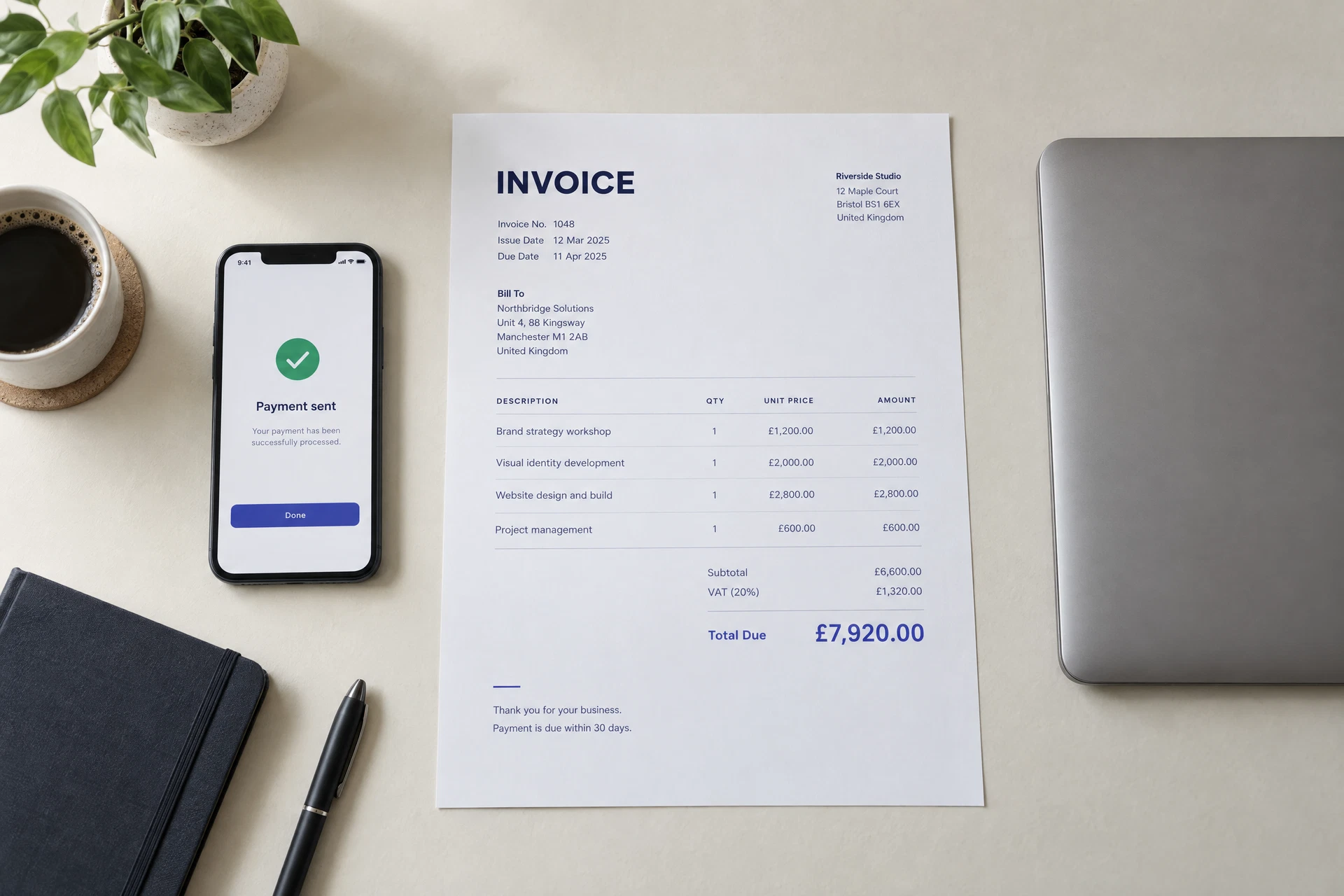 Best value
Invoicing for Small Agencies
Best Invoicing Software for Consultants
Wave, FreshBooks and Xero compared on verified pricing, per-user charges and client limits, which decide real cost more than the monthly price does.
-
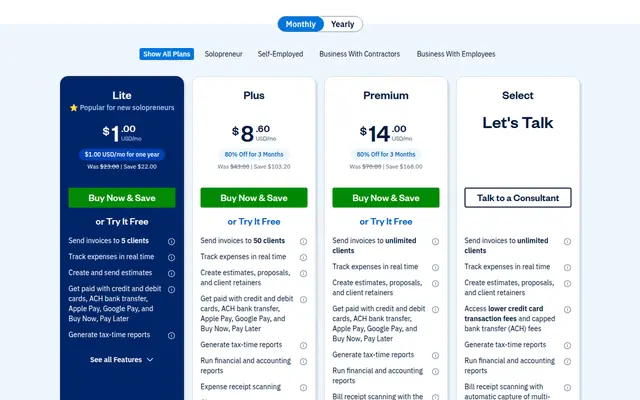
Invoicing for Small Agencies
FreshBooks vs QuickBooks for Consultants
A verified FreshBooks versus QuickBooks comparison for consultants, with real monthly scenarios for billable clients, team members and accounting needs.
-
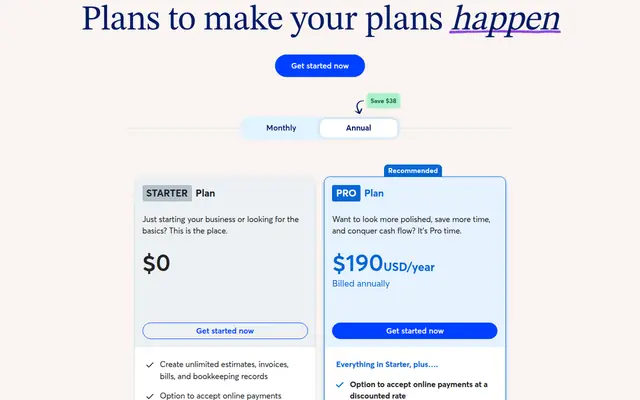
Invoicing for Small Agencies
Best Bookkeeping Software for Small Agencies
A practical comparison of Xero, QuickBooks Online, Wave and Zoho Books, focused on bookkeeping boundaries, invoice caps, user access and accountant-ready records.