Invoicing and Bookkeeping for Agencies · Updated 25 October 2026
Accounting Software for Small Agencies
Which accounting platforms a small agency can actually leave, what per-user pricing does to the bill, and the client and invoice limits that decide the tier.
- 16 min read
- accounting software for small agencies no contract
- Verified against vendor pricing
The short answer
Five of the six platforms compared here can be cancelled at any time with no annual commitment. Xero auto-renews monthly until cancelled, QuickBooks states "No annual contract, Cancel anytime", Wave states that subscriptions auto-renew and can be cancelled at any time, Zoho Books states that no contract is required, and FreshBooks offers a 30 day money back guarantee. FreeAgent also states "Cancel at any time". The real lock-in is not the contract, it is the downgrade rule, the client cap and the per-user charge.
| If the agency is | The platform to look at |
|---|---|
| Wants month to month with no per-user fees | Xero (opens in a new tab) |
| Wants the plainest cancellation wording | QuickBooks Online (opens in a new tab) |
| Wants to pay nothing at all | Wave Starter or Zoho Books Free (opens in a new tab) |
| Banks with NatWest, RBS, Ulster Bank or Mettle | FreeAgent |
| Bills a fixed list of clients | FreshBooks (opens in a new tab) |
| Wants three users on the cheapest paid tier | Zoho Books Standard (opens in a new tab) |
Get started with the tools in this guide
Where a vendor offers a free plan or a free trial, it is stated below, so you can try the tool before you pay for it.
-
See Zoho Books pricing (opens in a new tab)
Zoho Books
Free plan for organisations under 50K revenue, 1 user plus 1 accountant
-
See FreshBooks pricing (opens in a new tab)
FreshBooks
-
See QuickBooks pricing (opens in a new tab)
QuickBooks
-
See Wave pricing (opens in a new tab)
Wave
-
See Xero pricing (opens in a new tab)
Xero
These links go to the vendor's own site. We may earn a commission if you sign up, at no extra cost to you. How we fund the site. Every figure in this guide was read from the vendor's pricing page on the date stamped above, so confirm the number before you commit.
- Platforms compared
- 6
- No annual commitment
- 5 of 6
- Lowest paid tier
- $15 a month
- Terms checked
- 25 October 2026
Overview
Searching for accounting software for small agencies no contract is the right instinct, because the contract is almost never the part that traps an agency. Five of the six platforms in this comparison state plainly that there is no annual commitment, and the sixth offers a money back guarantee instead. What actually decides whether an agency can move is three other things: the downgrade rule, the client or invoice cap on the tier, and whether the price rises when a second or third person needs access.
That distinction matters most for an agency rather than a solo trader. A small agency usually starts on the cheapest tier, adds a designer or a project manager, discovers that the tier does not include a bank feed or a second seat, and upgrades. The upgrade is easy. Coming back down is where the friction lives, and the agency that never checked the downgrade rule is the one that ends up paying $97 a month for a $27 a month job.
This page works through the six platforms on the two questions that matter to an agency: how it leaves, and what the bill does when the team changes size. Every term, price, user allowance and client limit was read from the vendor's own pricing page on 25 October 2026 and recorded with its source. The invoicing hub holds the wider set of guides, including the price band walkthrough and the affordable accounting comparison.
What we compared
Six platforms were compared on the terms that govern an exit rather than the features that govern a purchase. Prices are the standing list prices unless a promotional figure is stated separately, and no figure has been converted between currencies, estimated, or carried over from an earlier review.
The five questions each platform was held to:
- What the cancellation wording actually says. A page that says "cancel anytime" is making a different promise from one that says "cancel at the end of your billing period", and both are different from a page that says nothing.
- Whether there is an annual commitment at all. Several of these pages sell monthly and annual billing side by side, which is not the same as requiring a term.
- What the downgrade rule is. This is the only genuinely restrictive term found in the whole comparison, and it belongs to one vendor.
- What the tier caps at. A client limit, an invoice limit or a revenue threshold can force an upgrade long before the feature list does.
- Whether a second person costs more. Two of these platforms charge per person. Four do not, or charge so little that it does not change the decision.
Three of the platforms here are commercial partners of this site and three are not. That has no effect on any figure or term recorded on this page, and no vendor is ranked by it.
What each vendor's cancellation wording actually says
Clearest cancellation wording of the six QuickBooks Online No annual contract, cancel anytime
Best month to month terms for a growing agency Xero Auto-renews monthly until cancelled
The wording is worth reading closely, because it is the only part of these pages that an agency can hold a vendor to.
QuickBooks Online states the position in its checkout panel: "Product support", "No annual contract", "Cancel anytime". It is the plainest statement of the six, and it sits next to the price rather than in a policy page. The pricing page also offers a 30 day free trial and a 50% discount for three months on every plan.
Xero says: "Xero subscriptions auto-renew monthly until they are cancelled." That is a monthly commitment that renews, which is functionally the same as no commitment, and there is no annual price on the US page at all. The restriction Xero does carry is on moving down, and it is discussed below.
Wave answers the question directly in its pricing FAQ: "Yes, you can unsubscribe at any time! The cancellation of your subscription will take effect at the end of the billing period in which you cancel." A footnote on the same page repeats the position: "Subscriptions auto-renew. Cancel anytime."
Zoho Books answers it in a FAQ headed "Am I bound to Zoho Books forever?": "No! As Zoho Books is a pay-as-you-go service, you are not obligated to sign a contract or commit to continuing your subscription." It also offers a separate 14 day free trial before any subscription starts.
FreshBooks frames the same promise as a guarantee rather than a cancellation right. The pricing page carries a "Risk Free. 30-Day Money Back Guarantee", and the trial FAQ states that an agency gets access "with no contracts and no credit card required". If the trial ends without a subscription, FreshBooks keeps the data and severs any connected bank account until the agency resumes.
FreeAgent prints "30-day free trial" and "Cancel at any time" in the header of its pricing page, above the plans rather than below them.
The one genuinely restrictive term in this comparison
The term to check before upgrading Xero downgrade rule One month after upgrading
Xero states: "If you later decide to change to a less expensive plan you can do so 1 month after upgrading." That is the only term found in this comparison that limits an agency's ability to reduce its bill, and it is easy to miss because it sits in the small print under the plan cards rather than next to the prices.
The practical consequence is small but real. An agency that upgrades to Xero Established at $97 a month to test multi-currency or project tracking cannot come back to Early at $27 in the same week. It waits a month. For an agency making a deliberate, permanent move up, this costs nothing. For an agency trying a tier for a single project, it costs a month of the difference.
None of the other five platforms publishes a comparable restriction. FreshBooks, Wave, Zoho Books, QuickBooks and FreeAgent all present their plans as switchable, and Wave states explicitly that an agency can "change plans easily" and links to the help article for doing it.
What per-user pricing does to the bill
The second question an agency asks is what happens when a second person needs access, and here the six platforms split cleanly into two groups.
The four that do not charge per person. Xero states on its pricing page that it has "No per-user license fees", which is the strongest position in the comparison for an agency that expects to grow. Wave charges its Pro plan per business rather than per owner, and its FAQ is explicit that a second business under the same account is charged again but a second owner is not. FreeAgent does not meter users at all, and neither does its free route. Zoho Books sits in this group with a caveat: the free plan allows one user plus one accountant, Standard includes three users, and extras cost $3 per user per month, or $2.50 billed annually, which is the lowest per-seat rate here and unlikely to change a decision on its own.
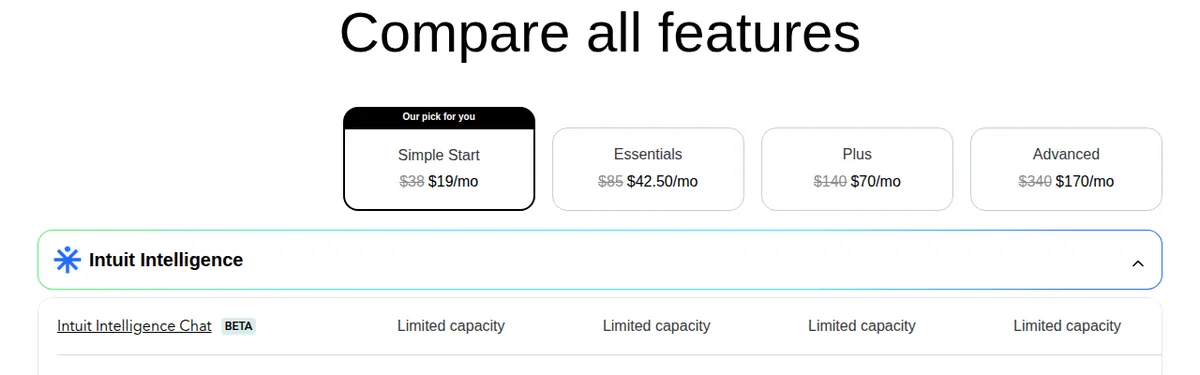
The two that do. QuickBooks Online sets a fixed user count per plan and sells no per-seat add-on, so a fourth person on Essentials means moving to Plus at $140 a month rather than adding a seat to an $85 plan. The jump is $55 a month for one person. FreshBooks charges $11 a month per team member on every tier, which is a gentler slope, but it stacks: three people on Premium is $70 plus $22.
For an agency, this is the single most important number on the page. An agency of five people that chooses QuickBooks Online is choosing Plus at $140 a month, not Essentials at $85, and the difference over a year is $660. The same five people on Xero pay the plan price and nothing more.
Client and invoice limits that force an upgrade
The third trap is a cap that has nothing to do with users. Three of these platforms cap something an agency consumes steadily.
FreshBooks caps billable clients. Lite sends invoices to 5 billable clients, Plus to 50 and Premium is unlimited. An agency with more than five active clients cannot use the $23 tier at any price, so the effective entry point is Plus at $43.00 a month. This is the most restrictive limit in the comparison and the one most likely to be discovered late, because five clients sounds adequate until a busy month arrives.
Xero caps invoices on the entry tier. Early covers "Send quotes and 20 invoices", and the page's own footnote states that the limit "applies to both approving and sending invoices" and that "transactions initiated by app partners may automatically contribute to your invoice limit". An agency running retainer invoicing through an automation can therefore reach a 20 invoice ceiling faster than the number suggests. Growing removes the cap entirely, which is the main reason to move from $27 to $59.
Zoho Books caps annually rather than monthly. Free allows 1,000 invoices and 1,000 bills or expenses a year, Standard 5,000 of each, Professional 10,000, Premium 25,000, and Elite and Ultimate 100,000. Annual counting is more forgiving than monthly counting for an agency with lumpy months. The free tier also carries a revenue condition, covered below.
QuickBooks Online, Wave and FreeAgent do not impose invoice caps at the tiers discussed here. Wave Starter includes unlimited estimates, invoices, bills and bookkeeping records at $0, and QuickBooks Online does not publish an invoice ceiling on its plan cards.
The seat and billing traps worth knowing before signing
Promotional prices are short and the list price is the one to budget. QuickBooks Online shows Simple Start at $38 struck through to $19, Essentials at $85 to $42.50, Plus at $140 to $70 and Advanced at $340 to $170, all for three months. FreshBooks runs 80% off for four months, taking Lite to $4.60 against a list price of $23.00. Xero runs 90% off for the first six months under an offer that ends at 11:59pm UTC on 2 November 2026 and applies only to base subscriptions, not to add-ons, usage or payment fees. An agency planning a year should plan on the list price and treat the discount as a trial.
Add-ons are where the second bill appears. Xero charges $5.00 a month for auto-reconcile on Early and $36 a month plus $6 per employee or contractor for payroll. FreshBooks charges $20 a month for Advanced Payments and $40 a month plus $6 per user for payroll. Wave charges $11 a month or $96 a year for unlimited receipts on Starter, and $8 a month or $72 a year on Pro, with payroll from $25 a month on Starter. FreeAgent charges £5 a month for unlimited Smart Capture and £6 a month for the Amazon UK connection.
Payment processing sits outside the subscription on every platform. Wave charges 2.9% plus $0.60 per credit card transaction on Starter, and 2.9% plus $0 for the first ten cumulative transactions a month on Pro before reverting to 2.9% plus $0.60. QuickBooks Online includes free ACH within a monthly allotment and then charges $0.50 per standard ACH transaction, and notes that allotments may vary. Xero states that payment fees are additional to the subscription and are not eligible for subscription discounts.
Support is tiered, not included. Wave's live chat and email support is available Monday to Friday, 9am to 4:45pm Eastern, and the plan comparison places it with "any optional add-on" rather than with the free tier. Zoho Books gives email support on the free plan, Monday to Friday, 9am to 9pm Eastern, and adds voice and chat from Standard upward. Xero includes free personalised onboarding with a product specialist for the first 90 days. FreeAgent's support is staffed by UK-based accountants reachable online or by phone.
What the free accounting tiers actually include
Three genuinely free routes exist across these six platforms, and they are not equivalent.
Zoho Books Free at $0 is a complete ledger rather than a trial. It allows one user plus one accountant, 1,000 invoices and 1,000 bills or expenses a year, 50 receipt autoscans a month, five scheduled reports and bank reconciliation, with more than 50 reports listed among the included features. Two conditions apply. The plan is available indefinitely only "as long as your revenue for the financial year does not exceed the threshold of $50K", and add-ons are not supported except document autoscans, so an agency that outgrows the revenue line has to move to a paid tier rather than buy its way around it.
Wave Starter at $0 carries no revenue condition and includes unlimited estimates, invoices, bills and bookkeeping records, invoicing from the mobile app, and cash flow and customer management in one dashboard. The automatic bank import, the auto-merge and categorisation, and the reporting dashboard are all listed under Pro at $19 a month, so a Starter user records transactions by hand. Bank connections run through Plaid and the page notes that not every institution is supported.
FreeAgent at £0 is free for as long as the agency holds a business current account with NatWest, Royal Bank of Scotland or Ulster Bank, or holds a Mettle account and makes at least one transaction a month. Optional add-ons may still be chargeable. What makes this the most complete free route in the comparison is that the free account is the same software as the paid one, including Making Tax Digital compatible VAT returns, Self Assessment, end-of-year filing, monthly payroll filing PAYE and National Insurance to HMRC, projects, time tracking and bank feeds. It is built for UK tax rules, so it is not a candidate for an agency invoicing in US dollars from the United States or Canada.
Xero, QuickBooks Online and FreshBooks do not offer free tiers. QuickBooks sells a separate $0 product called QuickBooks Free, which is a different product from a free tier on the paid plans and should not be confused with one.
Who should not buy this
An agency with fewer than five active clients and no employees should not pay for accounting software yet. Zoho Books Free covers the ledger, the reconciliation and the reporting for one user plus one accountant, and Wave Starter covers unlimited invoicing for nothing with no revenue condition. The upgrade is worth making when a bank feed, a second user or a client cap forces it, and not before.
An agency whose accountant already supplies the platform should not buy a second subscription. FreeAgent is available through accountants, and Xero and QuickBooks both run partner programmes through which a practice provides the licence, which is a cheaper route than a direct subscription for many small agencies.
An agency that only needs to raise invoices and take payment should not buy an accounting platform at all. That is an invoicing decision, and it is covered separately in our guide to invoicing software for consultants.
An agency that bills in more than one currency should not choose a tier that lacks multi-currency support. Xero adds it at Established rather than Early, and Zoho Books adds it at Professional rather than Standard, which is set out in our multi-currency invoicing guide.
An agency still deciding whether to leave its current platform should read our guide to leaving QuickBooks first, because the practical constraint on a switch is the reconciliation history rather than the data.
Our verdict
For an agency that wants the fewest strings, QuickBooks Online has the clearest wording of the six, stating "No annual contract" and "Cancel anytime" next to the price, but it is also the platform where adding a person costs the most, because a fourth user means moving from $85 to $140 a month. An agency of five should price that in before choosing it.
For an agency that expects to grow, Xero is the better answer despite carrying the only downgrade restriction in the comparison, because it states that it has no per-user licence fees and because Growing at $59 removes the 20 invoice limit that constrains Early. An agency that adds people steadily will not see the bill move. An agency that wants to test a higher tier for one month cannot come back down immediately, and should know that before it upgrades.
For an agency that wants to pay nothing while it decides, Zoho Books Free is the strongest free product here because reconciliation and reporting are inside it, with the $50,000 revenue condition being the trade. For a UK agency that banks with NatWest, Royal Bank of Scotland, Ulster Bank or Mettle, FreeAgent at £0 is better still, because the free account is the full product and includes the tax filing.
Frequently asked questions
Is there accounting software for small agencies with no contract at all?
Yes. Five of the six platforms compared here state that there is no annual commitment. QuickBooks Online prints "No annual contract" and "Cancel anytime" in its checkout panel, Xero states that subscriptions auto-renew monthly until cancelled, Wave states that subscriptions auto-renew and can be cancelled at any time, Zoho Books states that no contract is required and that it is a pay-as-you-go service, and FreeAgent prints "Cancel at any time" above its plans. FreshBooks takes a slightly different approach, offering a 30 day money back guarantee and a free trial with no contract and no credit card.
Can an agency reduce its plan later, or only upgrade?
It depends on the vendor, and this is the term most worth checking. Xero states that a change to a less expensive plan can be made one month after upgrading, which is the only downgrade restriction found across the six. Wave states that plans can be changed easily and publishes a help article for it. Zoho Books describes itself as pay-as-you-go with no obligation to continue. FreshBooks, QuickBooks Online and FreeAgent present their plans as switchable without publishing a waiting period.
How much does accounting software cost for a five person agency?
On Xero, five people cost the plan price alone because the vendor states it has no per-user licence fees, so Growing is $59 a month and Established is $97. On QuickBooks Online, five users is the Plus plan at $140 a month, because the plan sets a fixed user count and a sixth person would require Advanced at $340. On FreshBooks, Premium is $70 a month for unlimited billable clients plus $11 a month per team member, so five people is $70 plus four additional seats. On Zoho Books, Professional includes five users at $50 a month on monthly billing or $40 billed annually, with extras at $3 per user per month.
Does the cheapest tier include a bank feed?
Not always, and this is the most common reason an agency upgrades. On Wave, automatic bank import, auto-merge and categorisation and the reporting dashboard are listed under Pro at $19 a month rather than Starter at $0. On Zoho Books, connected bank feeds start at Standard, which is $20 a month on monthly billing or $15 billed annually. On Xero, reconciliation is included from Early upward, but the 20 invoice limit on that tier is the constraint. On FreeAgent, bank feeds are included on the free route as well as the paid one.
What happens to agency data if the subscription is cancelled?
FreshBooks states the position most explicitly: after a free trial ends without a subscription, "your invoices, expenses, bank transactions, and other data will be securely stored in case you decide to upgrade later on", and if a bank account was connected, "the connection will be severed until you resume using it". The general pattern across these platforms is that transaction data can be exported while the reconciliation state and audit trail do not always transfer cleanly, which is why a switch is usually made at a year end.
Is a free tier enough for a small agency?
It can be for a while. Zoho Books Free allows one user plus one accountant with 1,000 invoices a year, bank reconciliation and more than 50 reports, while revenue for the financial year stays under $50,000. Wave Starter is free without a revenue condition but leaves the bank feed to Pro. FreeAgent is free for a UK agency with a qualifying bank account and gives the full product including VAT and payroll filing. The moment an agency needs a bank feed, a second user or more than five billable clients, the free routes stop being sufficient.
Why is the advertised price lower than what the agency will pay?
Because several pricing pages lead with a short introductory discount. QuickBooks Online advertises Simple Start at $19 against a list price of $38 for three months, FreshBooks advertises Lite at $4.60 against $23.00 for four months, and Xero advertises 90% off for six months under an offer ending 2 November 2026 that does not extend to add-ons, usage or payment fees. Budget the list price, treat the discount as a trial, and add the cost of any add-on the agency actually needs.
Do these platforms charge extra for an accountant to have access?
Mostly not, and the allowances are worth checking because they differ. QuickBooks Online includes access for two accountants on Simple Start, Essentials and Plus, and for three on Advanced. Zoho Books Free includes one accountant alongside the single user. FreeAgent gives the same accountant access on the free route as on the paid one. Xero is built around accountant and bookkeeper access and states that it has no per-user licence fees, so a practice can be given access without buying a licence.
Get started with the tools in this guide
-
See Zoho Books pricing (opens in a new tab)
Zoho Books
Free plan for organisations under 50K revenue, 1 user plus 1 accountant
-
See FreshBooks pricing (opens in a new tab)
FreshBooks
-
See QuickBooks pricing (opens in a new tab)
QuickBooks
-
See Wave pricing (opens in a new tab)
Wave
-
See Xero pricing (opens in a new tab)
Xero
These links go to the vendor's own site. We may earn a commission if you sign up, at no extra cost to you. How we fund the site. Every figure in this guide was read from the vendor's pricing page on the date stamped above, so confirm the number before you commit.
Related guides
-
 Best value
Invoicing for Small Agencies
Best Invoicing Software for Consultants
Wave, FreshBooks and Xero compared on verified pricing, per-user charges and client limits, which decide real cost more than the monthly price does.
-
Invoicing for Small Agencies
FreshBooks vs QuickBooks for Consultants
A verified FreshBooks versus QuickBooks comparison for consultants, with real monthly scenarios for billable clients, team members and accounting needs.
-
Invoicing for Small Agencies
Best Bookkeeping Software for Small Agencies
A practical comparison of Xero, QuickBooks Online, Wave and Zoho Books, focused on bookkeeping boundaries, invoice caps, user access and accountant-ready records.