SEO Tools for Small Agencies · Updated 30 October 2026
Low-Cost SEO Tools: Where Cheap Tiers Stop
All five SEO platforms were re-read on 30 October 2026. What each entry tier allows in keywords, projects, seats, history and exports, and where it stops.
- 15 min read
- low cost seo tools
- Verified against vendor pricing
The short answer
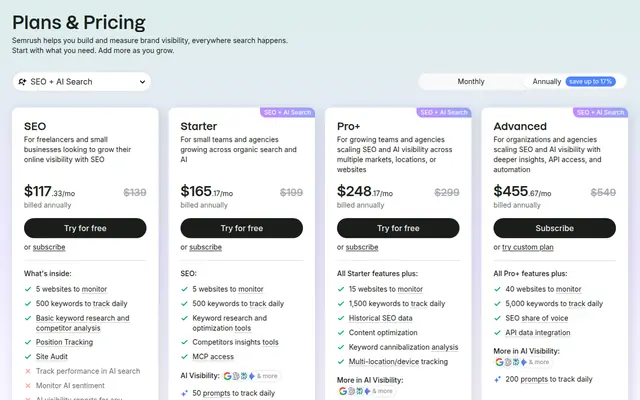
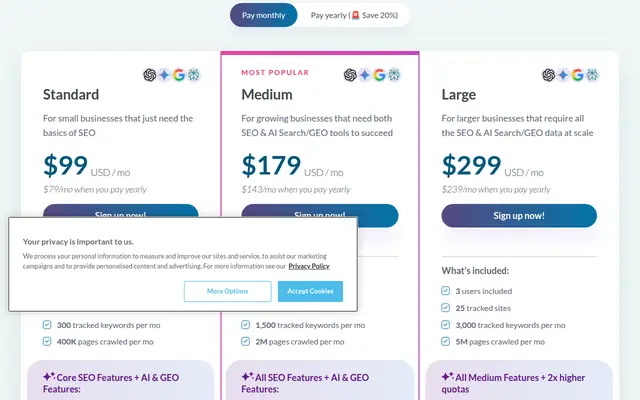
Low cost SEO tools are cheap at the entry tier and expensive at the second one, because the entry tier caps keywords, projects, seats and history rather than features. On 30 October 2026 the entry tiers published allowances of 2,000 keywords a day at SE Ranking, 750 at Ahrefs Lite, 500 a day at Semrush SEO and 300 a month at Moz Standard, with 10, 5, 5 and 3 projects or sites respectively. Four of the five bundle AI prompt tracking into that entry tier, which is part of why the keyword caps look low next to the price. Every figure on this page carries the date it was read, and the other pages in this cluster were checked against the same tier tables the same week.
| If you need | Reach for |
|---|---|
| Several client projects on the cheapest multi-project tier | SE Ranking (opens in a new tab) |
| The lowest entry price for one site | Ahrefs Starter (opens in a new tab) |
| One site with a stated allowance | Moz Starter (opens in a new tab) |
| Content work rather than rank tracking | Surfer Discovery (opens in a new tab) |
| A permanent free tier to test on | Semrush Free (opens in a new tab) |
Get started with the tools in this guide
Where a vendor offers a free plan or a free trial, it is stated below, so you can try the tool before you pay for it.
-
See Semrush pricing (opens in a new tab)
Semrush
-
Start a free Moz Pro trial (opens in a new tab)
Moz Pro
Free trial, plus a free community account for limited research
-
See Ahrefs pricing (opens in a new tab)
Ahrefs
-
Start a free SE Ranking trial (opens in a new tab)
SE Ranking
14-day free trial, no card required
-
Start free with Surfer (opens in a new tab)
Surfer
Free plan available
These links go to the vendor's own site. We may earn a commission if you sign up, at no extra cost to you. How we fund the site. Every figure in this guide was read from the vendor's pricing page on the date stamped above, so confirm the number before you commit.
- Platforms re-read
- 5
- Entry tiers compared
- 5
- Read date
- 30 October 2026
- Platforms bundling prompt tracking at the entry tier
- 4
Best value among the multi-project entry tiers SE Ranking 10 projects, 1 manager seat and 2,000 keywords a day for less than Moz, Semrush or Ahrefs charge for their second tier
Best for a one person practice with one site Moz Starter The only vendor here selling a single-site plan at a single-site price
Best for content work on a budget Surfer Discovery Cheapest way into a content editor, provided you accept 10 tracked pages and no prompt tracking
Best free route to test the category Semrush Free A permanent free plan rather than a trial clock
Where the cheap tier stops The seat, the keyword cap and the branded report Those three are what force the upgrade, not the feature list
Overview
Low cost SEO tools have a specific problem, and it is not the price. The entry tier of every platform in this category is genuinely affordable. What it is not is durable, because the cheap tier limits the things that scale with client work: tracked keywords, projects, seats, historical data and branded reporting. You do not discover the limit while comparing prices. You discover it in month two, with a client waiting.
This page is the companion to our price floor comparison. That page answers what the cheapest published tier costs. This one answers what the cheapest published tier allows, where it stops, and what the next step costs in money rather than in adjectives.
Every figure below was read from the vendor's own pricing page on 30 October 2026, and the site's other pages in this cluster were checked against the same tables the same week, so the numbers agree with each other. That matters more than usual in a category where tier names move, for the reason set out next.
What the entry tiers have in common now
The tier names across this category now read as AI visibility products rather than rank tracking products. Moz leads with Standard, Medium and Large. Semrush leads with SEO, Starter and Pro+. SE Ranking leads with Core and Growth. Ahrefs leads with Lite, Standard and Advanced, with a cheaper Starter tier kept on a side banner. Surfer leads with Discovery, Standard, Pro and Peace of Mind, with an AI Search Analytics tier alongside them.
What matters for a buyer is what those names contain. Four of the five bundle AI prompt tracking into the entry tier: SE Ranking Core includes 100 prompts a day, Moz Standard 150 tracked prompts, Ahrefs Lite 150 prompt checks, and Semrush SEO includes AI search tracking and custom prompts. Surfer is the exception, and it is an explicit one: Discovery tracks no AI prompts at all and refreshes none, so its cheapest tier is a content tool rather than a visibility tool. That bundling is why the keyword caps look low next to the price. Part of what you are paying for is prompt tracking, and if you do not need prompt tracking you are paying for something you will not use.
This is also why the date matters more than usual on a page like this one. Every figure below was read on the day it is stamped with, and the site's older pages were written against the same tier tables, so they agree. When you read a comparison of these tools anywhere, check the date on it, including on our own pages.
What the entry tier allows today
All five figures read on 30 October 2026.
| Platform | Entry tier and price | Projects or sites | Keywords tracked | Seats included | Crawl or audit allowance | History |
|---|---|---|---|---|---|---|
| SE Ranking | Core, $129 monthly or $103.20 billed annually | 10 projects | 2,000 a day | 1 manager seat | 250,000 pages a month | 6 months |
| Moz Pro | Standard, $99 monthly or $79 billed yearly | 3 tracked sites | 300 a month | 1 user | 400,000 pages a month | Not listed at this tier |
| Ahrefs | Lite, $129 monthly | 5 unverified, unlimited verified | 750 | 1 user | 100,000 crawl credits a month | 6 months |
| Semrush | SEO, $139 monthly or $117.33 billed annually | 5 websites | 500 a day | Not listed | Site audit included | Not listed at this tier |
| Surfer | Discovery, $49 billed yearly | 1 brand workspace | None, no prompt tracking | 1 team seat | Not an audit tool | 1 week of version history |
Three things stand out when the numbers sit next to each other.
The keyword allowance is quoted in different units. SE Ranking and Semrush publish a daily figure. Moz publishes a monthly figure. Ahrefs publishes a tracked total. A daily cap of 500 and a monthly cap of 300 are not the same kind of limit, and neither is a tracked total of 750. Read the unit before you compare the number.
The project cap is the real dividing line, not the price. SE Ranking sells 10 projects at its entry tier. Ahrefs sells unlimited verified projects but only 5 unverified ones. Moz sells 3 sites. Semrush sells 5 websites. Surfer's entry tier is not a rank tracking product at all, so its 1 brand workspace and 10 tracked pages are a different purchase.
The historical data allowance is where the cheap tier is thinnest. SE Ranking Core and Ahrefs Lite both publish 6 months. Moz and Semrush do not list historical data at their entry tiers, and Semrush lists historical SEO data as an addition at Pro+, which tells you where it starts. If a client asks what their rankings did last year, the entry tier may not be able to answer.
The four walls a cheap tier hits
These are the four limits that turn a cheap plan into an upgrade conversation. None of them are about features, which is why the feature comparison on a pricing page will not warn you.
Wall one: the keyword cap
Tracked keywords are the unit of work in this category, and every entry tier caps them. SE Ranking Core allows 2,000 a day. Ahrefs Lite allows 750. Semrush SEO allows 500 a day. Moz Standard allows 300 a month.
The cap matters once you hold more than one client. A single local business can consume a few hundred tracked terms without trying. Four clients sharing 750 tracked keywords is a planning problem, and four clients sharing 300 a month is not workable for anything except a very small engagement.
The escape routes are priced differently, which is the part worth knowing before you choose. Moz publishes an add-on of $20 a month for an additional 200 tracked keywords. SE Ranking publishes extra keywords from $22.40 a month on Core. Ahrefs and Semrush do not publish a per-keyword add-on at their entry tiers, so the route there is a tier jump: Ahrefs Lite to Standard is $120 a month more, and Semrush SEO to Starter is $60 a month more.
Wall two: the project or site cap
Projects are how you separate clients, and the cap is where agencies feel the entry tier first.
SE Ranking Core allows 10 projects, which is the most generous published figure in this set and the reason it is our pick for a small agency running several clients. Ahrefs Lite allows unlimited verified projects, which sounds unlimited until you notice that unverified projects are capped at 5: verification means you control the domain, so a competitor analysis you do not own counts against the smaller number. Moz Standard allows 3 tracked sites. Semrush SEO allows 5 websites.
If you are an agency, count client domains first and compare the rest afterwards. A platform that caps keywords generously but projects tightly will fail earlier than one that does the opposite.
Wall three: the seat
This is the quietest wall and often the most expensive one, because it is charged per person per month and it recurs.
SE Ranking Core includes 1 manager seat, with extra manager seats from $16 a month. Moz Standard includes 1 user, and additional seats cost $49 a month each on any plan level. Ahrefs Lite includes 1 user with up to 2 more at $40 each. Semrush lists additional users as an add-on from $45 a month. Surfer Discovery includes 1 team seat, rising to 3 at Standard and 5 at Pro.
The same need, a second person who can log in, costs between $16 and $49 a month depending on the platform. Over a year that gap is worth more than the difference between most of these entry tiers, and it is invisible on a pricing page that lists the base price only.
One related rule is worth reading before you buy. SE Ranking states that only one active session is allowed per login, so sharing credentials will log the other person out. If two people need access, that is a seat or a guest link, not a shared password.
Wall four: history, exports and the branded report
The last wall is the one clients notice, because it is the wall between you and a document with their logo on it.
On history: SE Ranking Core and Ahrefs Lite publish 6 months. SE Ranking Growth and Ahrefs Standard publish all time and 2 years respectively. Moz and Semrush do not list historical data at their entry tiers.
On exports: Ahrefs Lite publishes 500,000 export rows a month and a 2,500 row limit per report, while Standard raises both to 1.5 million rows and 30,000 rows per report. SE Ranking Core publishes 50,000 export rows, rising to 100,000 at Growth.
On branded reporting, the costs are published and they differ sharply. SE Ranking's Agency Pack is $69 a month, adds 30 client seats and white label, and is available on annual billing only. Semrush sells a Pro Report add-on at $20 a month for branding, white labelling and AI summaries. Moz lists branded reports as unavailable at Standard and available from Medium, which makes branding part of a $179 a month monthly plan or $143 a month billed yearly. Ahrefs sells Report Builder as a separate $99 a month add-on.
So the cost of putting your own logo on a client report ranges from $20 a month to a tier jump of $80 a month, depending on which platform you already pay for. That is the number to check before choosing, not the entry price.
The upgrade triggers, in money
Stated as the specific moment rather than as advice. All figures read on 30 October 2026.
| The moment | What it costs to resolve |
|---|---|
| A second person needs a login | $16 a month at SE Ranking, $40 at Ahrefs Lite, $45 at Semrush, $49 at Moz |
| You run out of tracked keywords | $20 per 200 keywords at Moz, from $22.40 at SE Ranking, or a tier jump of $60 at Semrush and $120 at Ahrefs |
| A client wants a report with your logo | $20 a month at Semrush, $69 a month at SE Ranking on annual billing, $99 a month at Ahrefs, or Medium at Moz |
| A client asks for last year's rankings | Growth at SE Ranking or Standard at Ahrefs, both a tier jump |
| You need more than 250,000 audit pages a month | Growth at SE Ranking, which raises it to 2 million |
| You need white label on Surfer | Enterprise, which is custom priced |
The pattern is consistent. Seats are the cheapest thing to add. Branding is the most awkward, because three of the five sell it as a separate product rather than as part of the tier. Keywords sit in the middle, and only two vendors sell them by the unit.
What the free plans actually include
Check these on the day you sign up. Free tiers change more often than paid ones, and every figure here was read on 30 October 2026.
Semrush Free is the only permanent free plan in this set. It gives 1 demo project, 10 reports a day across the tools, and access to the AI visibility features, with no card required. It is a genuine way to test whether the platform suits your workflow before paying, and it is not a working plan for a client account.
Ahrefs Free gives limited access to Site Explorer and Site Audit for website owners. Ahrefs states plainly that it never runs discounts and that the free route is the way to sample the data.
Moz offers a free trial plus a free Moz Community account, which gives limited access to MozBar, Keyword Explorer and Link Explorer for backlink research. Moz also states that it has no student discount, and that registered 501(c)(3) non-profits can apply for one.
SE Ranking runs a 14 day free trial with no credit card required, covering 10 projects, 750 tracked keywords a day, 20 AI prompts a day and AI competitive research for 3 domains. That is enough to run a real client project before deciding, which is more than most trials allow.
Surfer publishes a start for free button and a $49 a month entry tier billed yearly, but no permanent free plan appears on its pricing page. Treat the entry tier as the free route's replacement, and note that annual plans there are charged for the entire year upfront.
Moz Starter deserves its own line because it is unusual. Moz continues to sell a $49 a month plan for an individual managing a single website, outside the Standard, Medium and Large table. It is the only single-site plan in this set sold at a single-site price, and it is the cheapest published way to use a full platform rather than a free tool on one domain.
Where a low cost tool stops being the right answer
Three situations, stated plainly, because pretending otherwise is how people end up paying twice.
You are reporting to clients who pay you. If a client is paying a retainer and expects a monthly document with your branding and a year of history behind it, the entry tier is the wrong instrument. The branded report and the history are the deliverable. Buy the tier that includes them, or the saving you made on the plan is paid back in an awkward conversation.
Two or more people touch the account. A single seat forces shared credentials, and at least one platform states outright that shared logins will be interrupted. Seats are cheap relative to the cost of two people locked out of the same dashboard.
You are buying data rather than workflow. If your need is keyword and backlink data at volume, a cheap all-in-one tier is a poor substitute, and the row limits and export caps will be the first thing you hit. That is a data purchase, and the honest test is whether the entry tier's row limit survives one month of real work.
In every other case, and for a one or two person practice working on a small number of sites, the entry tier is the correct purchase. It is also worth saying that the cheapest published plan in this set, at $29 a month, is cheaper than most of the free tiers are worth in time saved.
Frequently asked questions
What counts as a low cost SEO tool?
For this page, a platform whose entry tier is priced for a small practice rather than a marketing department, with the entry tier published openly. On 30 October 2026 that band ran from $29 a month at Ahrefs Starter to $139 a month at Semrush SEO, with SE Ranking Core at $129 monthly or $103.20 billed annually, Moz Standard at $99 monthly or $79 billed yearly, and Surfer Discovery at $49 billed yearly.
Why do the keyword allowances look so different between platforms?
Because they are quoted in different units. SE Ranking and Semrush publish a daily figure, Moz publishes a monthly figure, and Ahrefs publishes a tracked total. A daily cap and a monthly cap measure different things, so convert them to the same basis before comparing, and check whether the number counts keywords you own or all keywords you can research.
What is the first limit a small agency hits?
The project cap in most cases, because it is counted per client. Moz Standard allows 3 tracked sites, Semrush SEO allows 5 websites, Ahrefs Lite allows 5 unverified projects and unlimited verified ones, and SE Ranking Core allows 10 projects. A practice with more clients than its plan has projects will hit that wall before it hits a feature gap.
Which entry tier includes the most for the money?
SE Ranking Core publishes the most generous combination in this set as of 30 October 2026: 10 projects, 1 manager seat, 2,000 keywords a day, 250,000 audit pages a month and 6 months of history, for $103.20 a month billed annually or $129 monthly. That is less than Moz charges for Medium, less than Semrush charges for Pro+, and far less than Ahrefs charges for Standard, on the published figures.
Is the cheapest tier on a platform the cheapest way to run it?
No, and this is the trap. A $29 or $49 tier that publishes no keyword or project allowance is not comparable to a tier that publishes one, because you cannot tell what you are buying. Where a vendor does not publish an allowance for a tier, this page says so rather than estimating it.
What does a branded client report cost?
It depends entirely on the platform. Semrush sells it as a $20 a month add-on. SE Ranking sells it inside the Agency Pack at $69 a month, on annual billing only. Ahrefs sells Report Builder at $99 a month. Moz includes branded reports from Medium upwards, which is $179 a month monthly or $143 a month billed yearly. Only one of those is a rounding error, and it is not the one people expect.
Are the free plans enough to test a platform properly?
Semrush Free is enough to learn the interface, not to run a client. The SE Ranking 14 day trial is the most generous testing allowance here at 10 projects, 750 keywords a day and 20 prompts a day, and it needs no card. Ahrefs Free and the Moz Community account are both deliberately limited to a few tools.
Do annual plans cost less, and what do I give up?
Annual billing is cheaper on every platform that publishes both figures: SE Ranking by 20 per cent, Moz by 20 per cent, Semrush by roughly 16 per cent, and Ahrefs by up to 17 per cent. What you give up is the exit. SE Ranking states that annual plans are billed upfront and that payments are non-refundable except where the service was not delivered as promised. Surfer charges the entire year upfront and states that credits reset yearly or on a plan change rather than monthly.
Can I buy features from a more expensive tier on a cheaper plan?
Generally no. SE Ranking states that plan features are tied to each tier and that you cannot buy features individually, so unlocking a feature set means upgrading the plan. Add-ons exist for capacity, such as extra seats, extra keywords and white label, and those are the exceptions rather than the rule.
How often do these tiers change?
Less often than the marketing language suggests, but the naming does move. Every platform on this page now leads with AI visibility wording, and the allowances behind those names are the part that changes quietly. That is why every figure here carries the date it was read, and why a comparison without a date should be treated as unreliable, including our own older pages.
Our verdict
Low cost SEO tools are a good purchase for a small practice and a bad purchase for an agency that reports to clients, and the dividing line is not the price. It is the seat, the branded report and the history window.
If you run one or two sites yourself, buy the cheapest published plan that states what it includes. Moz Starter at $49 for a single website, and Ahrefs Starter at $29, are both defensible purchases at that scale, with the caveat that neither publishes a keyword or project allowance on the tier table, so you are buying on trust rather than on arithmetic.
If you run client work, buy on projects and seats rather than on price, because that is what runs out. On the figures published on 30 October 2026, SE Ranking Core is the strongest entry tier in this set for a small agency: 10 projects, a manager seat, 2,000 keywords a day and 250,000 audit pages a month, with extra seats from $16 and the Agency Pack adding white label and 30 client seats for $69 a month on annual billing. It is not the cheapest plan here. It is the cheapest plan that does not force a decision in month two.
Whichever you choose, run the free route first and count your client domains before you pay. If the arithmetic does not survive your real client list, the tier is wrong, and the fact that it was cheap will not help you.
If you are working out the total rather than the entry price, the add-on and overage arithmetic is set out in SEO tool hidden fees, and the per-client totals for a five client book are in what SEO software costs an agency. For the bottom tier of each platform rather than the capability behind it, see the cheapest SEO tools. Two of the platforms above are covered in more depth in our SE Ranking review and our Surfer review, and the wider set sits in the SEO tools hub.
Get started with the tools in this guide
-
See Semrush pricing (opens in a new tab)
Semrush
-
Start a free Moz Pro trial (opens in a new tab)
Moz Pro
Free trial, plus a free community account for limited research
-
See Ahrefs pricing (opens in a new tab)
Ahrefs
-
Start a free SE Ranking trial (opens in a new tab)
SE Ranking
14-day free trial, no card required
-
Start free with Surfer (opens in a new tab)
Surfer
Free plan available
These links go to the vendor's own site. We may earn a commission if you sign up, at no extra cost to you. How we fund the site. Every figure in this guide was read from the vendor's pricing page on the date stamped above, so confirm the number before you commit.
Related guides
-
 Best value
SEO Tools for Small Agencies
Is Semrush Worth It for a Small Agency?
The cost maths for Semrush in a small agency, including the website cap on the entry plan that decides which tier you actually need.
-
 Head to head
SEO Tools for Small Agencies
Semrush vs Moz for Consultants
Semrush and Moz compared on verified pricing, included seats and website limits, and the seat maths that decides it for a small consultancy.
-
SEO Tools for Small Agencies
Best SEO Tool for Small Agencies
A cost-per-client comparison of Semrush, Ahrefs and Moz Pro for small agencies, including project caps, keyword limits, annual discounts and extra seats.