AI Meeting Notes for Agencies · Updated 26 October 2026
No-Contract AI Meeting Transcription
Which meeting transcription platforms an agency can actually leave, what the cancellation and refund rules say, and what happens to transcripts when you go.
- 19 min read
- AI meeting transcription software no contract
- Verified against vendor pricing
The short answer
Every paid platform compared here offers monthly billing, so none of them locks an agency into a year. What separates them is what happens when you leave. Fireflies publishes the only real refund window, a full refund inside seven days with a usage condition. Otter states plainly that subscriptions are non-refundable but lets you pause a plan once. MeetGeek publishes its full terms, cancels on request and deletes your content 30 days after closure. Avoma sells annual-only on its top tier with a ten seat minimum and offers no refunds or credits for unused seats. Fathom has no minimum term at all and a free tier that is not time limited.
| If the agency needs | The platform to look at |
|---|---|
| A refund window rather than a goodwill policy | Fireflies (opens in a new tab) |
| To pause rather than cancel | Otter (opens in a new tab) |
| No annual commitment on any tier | Fathom (opens in a new tab) |
| Contract terms published before signing | MeetGeek |
| The cheapest single paid seat | Notta |
| To pay only for the people who record | Avoma |
Get started with the tools in this guide
Where a vendor offers a free plan or a free trial, it is stated below, so you can try the tool before you pay for it.
-
Start free with Fireflies.ai (opens in a new tab)
Fireflies.ai
Free tier available
-
See Otter.ai pricing (opens in a new tab)
Otter.ai
-
See Fathom pricing (opens in a new tab)
Fathom
These links go to the vendor's own site. We may earn a commission if you sign up, at no extra cost to you. How we fund the site. Every figure in this guide was read from the vendor's pricing page on the date stamped above, so confirm the number before you commit.
- Platforms compared
- 6
- Offering monthly billing
- 6
- With a published refund window
- 1
- Terms checked
- 26 October 2026
Overview
Searching for AI meeting transcription software no contract usually means one of two things. Either you want to try a tool without signing a year away, or you have already been caught once by an annual plan you could not leave. Both are reasonable, and both are harder to answer than the pricing pages suggest, because almost every vendor in this category now shows a monthly toggle on the pricing page while keeping the rules that actually decide your exit somewhere else entirely.
Those rules are the cancellation clause, the refund policy, the downgrade behaviour and the deletion schedule. They are not marketing copy, so they live in a help centre article or a terms of service page that most buyers read after the problem has already happened. Across the six platforms compared here, one publishes a genuine refund window with a stated usage condition, one states outright that subscriptions are non-refundable, one sells annual-only on its top tier with a ten seat floor, and one will delete your transcripts 30 days after your account closes whether you exported them or not.
That last point matters more than the price for a consultancy. A transcript is a client record. If it cannot be exported before you leave, the money you saved on the subscription is not the number that matters.
This page works through the six platforms an agency or a freelancer is most likely to shortlist, and states what each vendor's own cancellation, refund, export and deletion terms say today. Every term was read on 26 October 2026 and recorded with its source. The meetings hub holds the wider set of guides, including the transcription allowance comparison and the five person cost scenarios.
What "no contract" actually means in this category
The phrase is used loosely, and it hides three different commitments that are worth separating before you compare prices.
The first is the billing term. This is whether the vendor sells you a month at a time or only a year at a time. Every platform here offers monthly billing on at least its standard tiers. Avoma is the partial exception: its Startup and Organization tiers are available monthly, but Enterprise is annual only with a minimum of ten paid recorder seats.
The second is the renewal rule. A monthly plan that renews automatically is still a commitment, because the charge recurs unless you act. Otter states it in one line: "Subscriptions automatically renew unless you cancel them." Notta frames the same rule as a deadline, because cancelling before the next renewal cycle is what preserves access to the end of the period you already paid for.
The third, and the one nobody checks before buying, is the exit rule. Cancelling is not the same as leaving, because what happens next is decided by three separate clauses: whether you get money back, how long you keep access, and what happens to your transcripts. A vendor can be generous on the first and strict on the third.
An agency that reads only the monthly price is comparing the least important number on the page.
The cancellation rule, vendor by vendor
Otter handles cancellation in the help centre rather than the terms, and the wording is unusually clear. Only the owner or an admin can cancel, and a subscription "may be canceled at any time to set the subscription to expire at the end of the billing period." Access does not stop when you cancel: "If you cancel, you can keep using the paid features until the subscription expires at the end of the current billing period."
The deadline is the part to diarise. Otter asks you to "cancel your subscription at least 24 hours before the next billing date to avoid an unwanted charge." A day of margin is tighter than most vendors give, and it is the difference between a clean exit and a charge you cannot reverse, because Otter also states that it "does not offer refunds for subscriptions purchased per our Terms of Service." That answer is given twice, once for the general case and once for the specific case of forgetting to cancel and wanting the unused portion back.
Otter does offer one thing none of the others do, which is a pause. In Account Settings, under Plan, you can select Pause Plan instead of cancelling, with the restriction that "you can only pause your subscription once."
Subscriptions bought through the Apple App Store or Google Play sit outside all of this. Otter sends you to those platforms for billing, refunds and cancellations, and their policies apply instead. The pricing page also answers the PayPal question directly: asked whether PayPal is accepted, it says "Not yet."
Fireflies is the only platform here that publishes a numbered refund policy, and it is worth reading closely because the conditions are not symmetrical between monthly and annual billing.
On a monthly plan you get a full refund if the subscription has been active for seven days or less and three meetings or fewer have been logged. You get a pro-rated refund if the subscription has been active for seven days or less, or if more than three meetings have been logged. The two conditions are joined differently in each case, which is easy to misread: full refund needs both tests to pass, pro-rated needs either one to fail.
On an annual plan the window is wider but the fallback is worse. A full refund applies if the subscription has been active for seven days or less and 20 meetings or fewer have been logged, and the policy states flatly that "Pro-rated refunds are not available on annual plans." Buy annually, use the tool for a month, and there is no partial route back.
Two further conditions apply. Refunds cover subscription plans only and never AI Credits, which the policy calls non-refundable in the same paragraph. And a refund needs a stored card: "your card details must be stored in your Fireflies account to process a refund." Refunds take five to ten business days.
MeetGeek publishes the most complete picture because its terms of service carry the rules rather than a help article. Renewal is automatic until cancelled. Price increases come with at least 30 days' notice and take effect at your next renewal. Refunds are the strict line: "Fees are non-refundable except as stated in these Terms or required by law."
Cancellation itself is frictionless. You may cancel at any time in your account settings or by emailing support, and paid services continue until the end of the current billing period. The terms also work in both directions, which is rare: MeetGeek may terminate for convenience on 30 days' notice, and if it does, it will "refund any prepaid fees for the unused period."
MeetGeek is also the only vendor here that splits its service into two legal entities, and the terms say so before anything else: "MeetGeek runs two separate instances. The instance you sign up to decides which company you contract with, where your data is stored and which law applies." The EU instance contracts with AIVISION PRODUCTS SRL in Romania, stores content in the European Union and is governed by Romanian law. The US instance contracts with MeetGeek US Infra, Inc. in Delaware, stores content in the United States and is governed by Delaware law. For an agency with EU clients and a data residency clause in its own contracts, that is the single most useful fact on this page. Enterprise customers can request a migration between instances under their order form.
Notta frames cancellation around what you keep. Cancelling before the next renewal cycle retains access to paid features until the end of the subscription period. Changing plan is less flexible than it looks: switching from Pro to Business, or from annual to monthly, requires cancelling and subscribing again, with the new plan taking effect from the following billing period. A downgrade is a cancel-and-rebuy, not a switch, and there is a gap in between.
Avoma is the clearest example of a vendor where the cancellation rule is fine and the seat rule is the real constraint. Adding seats is charged immediately and prorated for the rest of the cycle. Removing seats takes effect at the start of the next billing cycle, which means you pay for the whole of the current one. And the help centre states plainly that "Avoma doesn't offer refunds or credits for unused seats mid-cycle."
Add-ons follow the base plan's cycle, and the help centre answers the obvious follow-up question directly. Asked whether add-ons can be tried monthly on an annual base plan, the answer is "No."
Fathom publishes no minimum term on its pricing page and offers monthly billing on every paid tier, from Premium for a single user up to Business with a two user minimum. Enterprise is the exception: it is quoted as "Talk to sales" and is the only tier listing "Custom contracts and red-line support."
Which vendors publish a refund policy, and which do not
The pattern across the six is worth stating plainly, because it is the fastest way to judge how a vendor will behave when something goes wrong.
Fireflies publishes a refund policy with eligibility tests, worked examples and a stated processing time. The page even includes a table showing what a pro-rated refund looks like on a monthly Business plan after ten days of use. That level of detail is unusual in this category.
Otter publishes the opposite: a clear and repeated statement that subscriptions are non-refundable, softened only by the pause option.
MeetGeek states that fees are non-refundable except as its terms allow or the law requires, and then balances it by committing to refund prepaid fees if it terminates your account.
Avoma answers the seat question directly and does not offer refunds or credits for unused seats mid-cycle.
Notta's position is implied by its cancellation wording rather than stated as a refund policy, and the practical advice it gives is to export before downgrading rather than to expect money back.
Fathom advertises a "90 day guarantee" badge on every tier, including the free one, but the pricing page does not state what that guarantee covers. Treat a badge as a question to ask on the sales call rather than as a refund term you can rely on, and get the answer in writing if the annual price is what is on the table.
For an agency buying its first transcription tool, the ordering is therefore simple. If you want a refund window, Fireflies is the only one here that gives you one in writing. If you want to avoid the refund question altogether, buy monthly and treat the annual discount as a decision you make in month four, after the tool has survived a month of real client calls.
What annual billing actually costs a three person team
Every vendor here discounts annual billing, and the discounts are large enough to be tempting. What the pricing pages do not do is show the size of the bet in money.
For a three person team, comparing the same plan billed monthly against the same plan billed annually, the first year looks like this. Otter Pro is $611.64 billed monthly against $299.88 billed annually, a difference of $311.76. Otter Business is $1,080.00 against $719.64, a difference of $360.36. Fathom Team is $684.00 against $540.00, a difference of $144.00. Fathom Business is $1,224.00 against $900.00, a difference of $324.00. Avoma Startup is $1,044.00 against $684.00, a difference of $360.00, and Avoma Organization is $1,404.00 against $1,044.00, the same $360.00 difference.
Those figures are the list prices shown on each vendor's page on 26 October 2026, multiplied out for three users over twelve months. They are not a quote and they are not a recommendation.
The point of the arithmetic is that the annual discount is worth a few hundred dollars a year per team, which is real money and also roughly the cost of one billable hour at a consultancy rate. Against that, an annual plan removes your refund route at the vendors that offer one: Fireflies refunds a monthly plan pro rata after the first week but offers nothing pro rata on an annual plan, and Otter's no-refund position applies to whatever you paid, monthly or annual. Buying monthly for a quarter and then switching to annual, if the tool has earned it, costs you one quarter of the discount and buys you the information you need.
What happens to your transcripts when you leave
This is the clause that decides whether an exit is cheap or expensive, and the six vendors take four different positions.
Notta is the most explicit about the risk, and the wording is worth reading in full: "Your transcription data will be saved even if you cancel your paid plan, however, you can only view the first 3 minutes of the transcript as a Free user. We suggest you export the transcript to local storage before downgrading your plan." The data survives but becomes nearly unreadable, and the vendor's own advice is to export first. On a 45 minute discovery call, three minutes is the introduction.
Otter reduces access rather than deleting it. After a paid subscription expires, the workspace continues on the Basic plan and team members keep access to the 25 most recent conversations. Anything older than the 25 most recent is out of reach without upgrading again.
MeetGeek is the only vendor here that puts a deletion schedule in writing. Before your account closes you can export your content, and if MeetGeek terminates the account it will try to give you advance notice so you can do so, unless that is impractical, unlawful or unsafe. After closure, customer content is deleted from active systems within 30 days and from encrypted backups within a further 35 days, unless the law requires it to be kept.
Avoma keeps recording storage unlimited on every plan, so the retention question is about seat access rather than a storage cap. When a seat is removed the change takes effect at the next billing cycle, which gives you a full cycle to export before access ends.
Fireflies ties storage to the tier, so a downgrade reduces how much can be kept rather than deleting what is already there.
Fathom includes unlimited recordings and transcriptions on the free tier, which changes the calculus: there is no paid tier to fall back from, so the export question is only about whether you keep using the tool at all.
The practical rule for a consultancy is the same at every vendor. Export the transcripts you would need to produce if a client asked, before you cancel anything, and check that the tier you are on includes export in the first place. The guide to transcription allowances covers which tiers include export, and the privacy guide covers what a consultancy should tell a client before recording at all.
The clearest exit terms in this category Fireflies A published refund policy with stated conditions
The vendor to read first if you have EU clients MeetGeek Two instances, EU or US, stated up front
What the free tiers actually include
A free tier is the cheapest way to avoid a contract question entirely, so it is worth knowing what each one really gives you before you decide that you need to pay at all.
Fathom has the strongest free position here, because it is not time limited and it includes unlimited recordings and transcriptions along with instant AI summaries. It is described as free forever, and it carries the same guarantee badge as the paid tiers. The limits that matter are elsewhere: CRM syncs are capped at three users per domain, so a team that wants its notes pushed into a CRM will need a paid tier for the fourth person.
Otter gives 300 transcription minutes per user per month on Basic, 300 imported-file minutes per user per month, a 30 minute cap on a single conversation, three lifetime file imports and access to the 25 most recent conversations. It is a genuine working allowance for occasional use rather than a demo, but the 30 minute cap is the constraint a consultancy will hit first.
MeetGeek gives three hours of transcription a month on its free Basic plan, with a two hour recording limit per meeting, three months of transcript storage and one month of audio storage. Downloading transcripts is not included on the free plan, which matters if the whole point is to file them.
Notta gives 120 transcription minutes a month free, and the cap on a single free conversation is three minutes. That is a trial allowance rather than a working one, and it explains why the downgrade advice is to export first.
Fireflies gives a free tier with unlimited transcription and 400 minutes of storage per team, which is a shared pool rather than a per seat one. It scales less well than the headline suggests as a team grows.
Avoma does not have a free plan at all. What it has is unlimited free view-only seats, so an agency can pay for the people who record and let everyone else watch, read and comment at no cost. It also starts every account with a 14 day trial of the Organization plan with all add-ons enabled and no credit card required, which is the most generous trial here but the only one that ends with a bill.
A freelancer who records a handful of client calls a month can stay on Fathom's free tier or Otter's Basic plan indefinitely and never sign anything. An agency with three people recording daily will not.
Who should not buy this
An agency that records client calls without telling the client. Every platform here notifies participants when a bot joins, and MeetGeek states in its terms that notifying participants does not replace your own obligation to obtain any consent the law requires. Buying a tool does not solve a consent problem.
An agency that wants a single number to compare. The monthly price is the least informative figure on these pages. Two plans at the same headline rate can differ by a factor of four on the per conversation cap, and a plan that looks cheap per seat can cost more once you count the seats that never record.
A team that needs its notes inside a CRM for more than three people. Fathom caps CRM syncs at three users per domain, and CRM field sync sits on the Business tier. Avoma puts two-way CRM field updates behind an add-on that follows the base plan's billing cycle.
Anyone buying annual billing in the first month. The discount is real, worth a few hundred dollars a year for a three person team, but it removes the refund route at the vendors that offer one and it commits you before the tool has been tested against a real client call.
A consultancy that has not checked where its transcripts are stored. MeetGeek makes the choice explicit and permanent at signup, EU or US, and a migration between them is an Enterprise order form item rather than a setting. The other vendors here do not offer a comparable regional choice on their published pages.
Our verdict
The contract question has a simple answer and a complicated one.
The simple answer is that no platform here locks an agency into a year, because every one of them sells monthly billing on its standard tiers. Avoma is the partial exception, with annual-only pricing and a ten seat floor on Enterprise, but its Startup and Organization tiers are available monthly.
The complicated answer is that the exit is decided by clauses nobody reads. On the evidence of what the vendors publish today, Fireflies is the only platform here with a refund policy detailed enough to rely on, including a stated pro-rated route for monthly plans and a clear statement that annual plans do not get one. Otter is the most transparent about the opposite position: it will not refund you, but it will let you pause once and it tells you to cancel 24 hours before the renewal date. MeetGeek publishes the most complete terms, including a 30 day deletion schedule and a commitment to refund prepaid fees if it terminates your account. Fathom has the least commitment of any of them and a free tier that is not time limited. Avoma charges only for the people who record and is the most predictable vendor on seat arithmetic, with no refunds for seats you stop using mid-cycle. Notta is the cheapest single paid seat here and the one that punishes a downgrade most sharply, reducing a free user to the first three minutes of each transcript.
For a consultancy, the recommendation that follows from the terms rather than from the prices is to start monthly, export as you go, and move to annual billing in month four if the tool has survived contact with real client work. The comparison of what each platform charges a five person agency works through the same vendors from the cost side, and the hidden fees guide covers the add-ons that sit on top of these plans. If you are still deciding whether to pay for any of this at all, the break even analysis does that arithmetic first.
Frequently asked questions
Can I use meeting transcription software without any contract at all?
Yes, and four of the six platforms here let you do it for nothing. Fathom's free tier is not time limited and includes unlimited recordings and transcriptions. Otter's Basic plan gives 300 minutes per user per month indefinitely. MeetGeek gives three hours a month free. Fireflies gives unlimited transcription with 400 minutes of team storage. None of these requires a card or a commitment, and all four reduce what you can do rather than charging you.
Does cancelling a meeting transcription subscription give me a refund?
Usually not. Otter states that subscriptions are non-refundable and repeats the answer when asked about refunding an unused portion. MeetGeek states that fees are non-refundable except as its terms allow or the law requires. Avoma does not offer refunds or credits for unused seats mid-cycle. Fireflies is the exception: it publishes a full refund window of seven days with a usage condition, and a pro-rated refund for monthly plans that fall outside it.
What is the difference between a pro-rated refund and a full refund?
A full refund returns everything you paid. A pro-rated refund returns the unused part and keeps a charge for the time you used. Fireflies works it out per day: its published example refunds $19.40 of a $29 monthly Business charge after ten days of use. That route exists only on monthly plans. On annual plans Fireflies offers a full refund inside the seven day window and states that pro-rated refunds are not available.
What happens to my transcripts if I cancel?
It depends on the vendor, and the range is wide. Notta keeps the data but limits a free user to the first three minutes of each transcript and advises exporting first. Otter drops the workspace to the Basic plan with access to the 25 most recent conversations. MeetGeek deletes customer content from active systems within 30 days of closure and from encrypted backups within a further 35 days. Avoma keeps storage unlimited but removes the seat at the next billing cycle. The safe assumption is that you should export anything you need before you cancel.
Can I pause a subscription instead of cancelling it?
Otter is the only platform here that offers a documented pause. You can select Pause Plan in Account Settings instead of cancelling, and the restriction is that you can only pause once. Every other platform here offers cancellation only, so the alternative to cancelling is staying on a paid tier or dropping to a free one where that exists.
Does annual billing save enough to justify giving up the monthly exit?
For a three person team the difference is a few hundred dollars a year on the plans compared here. Otter Pro is $311.76 cheaper annually, Otter Business $360.36, Fathom Team $144.00, Fathom Business $324.00, and both Avoma tiers $360.00. That is real money, and it is also roughly the value of one billable hour. The trade is that an annual plan removes the pro-rated refund route at Fireflies and does not change Otter's no-refund position, so the discount is worth taking only after the tool has been tested in live client work.
Do I have to pay for everyone in the team?
Not on Avoma, which charges only for recorder seats and states that viewers and collaborators are always free. That is the most seat-efficient model here for an agency where only some people run client calls. Elsewhere the seat model matters just as much: Otter charges per user and shares a minute pool across transcription types, Fireflies gives a shared storage pool per team on its free tier, and Fathom requires a two user minimum on its team tiers.
Where is my data stored, and can I choose the region?
Only MeetGeek makes this a documented choice. Its terms state that it runs two separate instances and that the instance you sign up to decides which company you contract with, where your data is stored and which law applies, with content held in the European Union or the United States accordingly. Enterprise customers can request a migration between instances under their order form. The other vendors compared here do not publish a comparable regional selection.
Can I share transcripts with a client without buying extra seats?
Usually yes. Avoma states that free view-only users can watch recordings, read notes and transcripts, and comment or share at no cost, and that there is no limit on the number of free viewers. Fathom includes unlimited call downloads and clips, which makes sending a recording to a client straightforward. Fireflies allows recap links to be shared with participants without adding them to the team. Otter supports sharing through private channels and public links from Pro upward.
Get started with the tools in this guide
-
Start free with Fireflies.ai (opens in a new tab)
Fireflies.ai
Free tier available
-
See Otter.ai pricing (opens in a new tab)
Otter.ai
-
See Fathom pricing (opens in a new tab)
Fathom
These links go to the vendor's own site. We may earn a commission if you sign up, at no extra cost to you. How we fund the site. Every figure in this guide was read from the vendor's pricing page on the date stamped above, so confirm the number before you commit.
Related guides
-
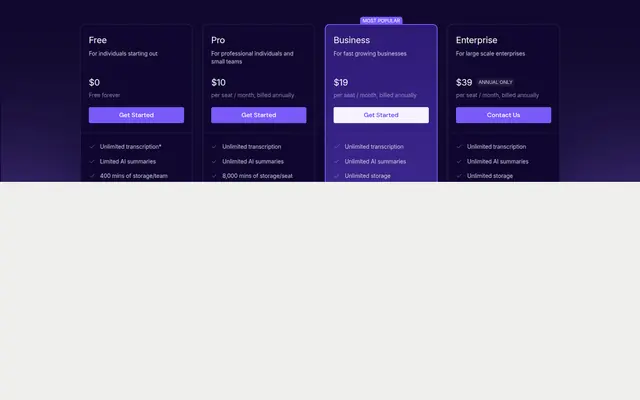 Head to head
AI Meeting Notes for Agencies
Fireflies vs Otter for Client Calls
Which of the two dominant AI meeting note tools fits a small agency, based on verified pricing, seat limits and how each behaves in a client call.
-
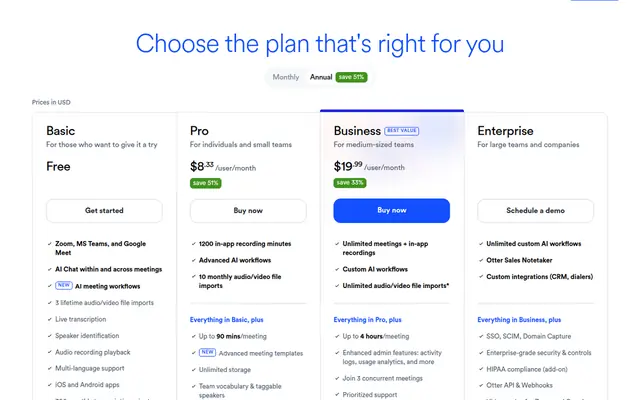 Best overall
AI Meeting Notes for Agencies
Best AI Meeting Notes for Consultants
Four AI meeting note tools compared for consultancies on verified pricing, the free-tier limits that actually bite, and client confidentiality.
-
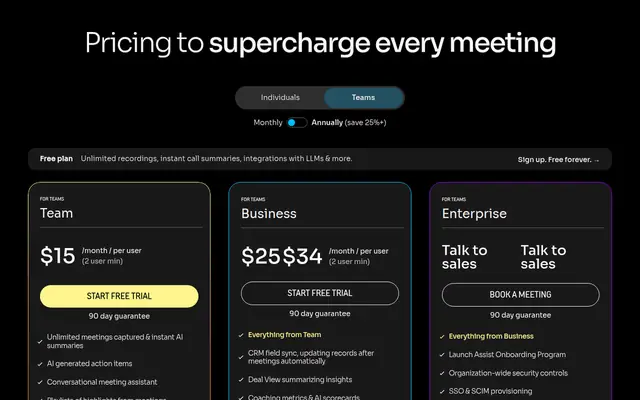 Head to head
AI Meeting Notes for Agencies
Fathom vs Fireflies for Consultants
Fathom and Fireflies compared on verified pricing, the free-tier limits that decide real cost, and how each behaves in a client call.