AI Meeting Notes and Client Calls · Updated 21 October 2026
AI Meeting Notes Hidden Fees
The limits that change an AI meeting notes bill after purchase, covering minute caps, AI credits, storage retention and seat minimums across eight tools.
- 14 min read
- ai meeting notes hidden fees
- Verified against vendor pricing
The short answer
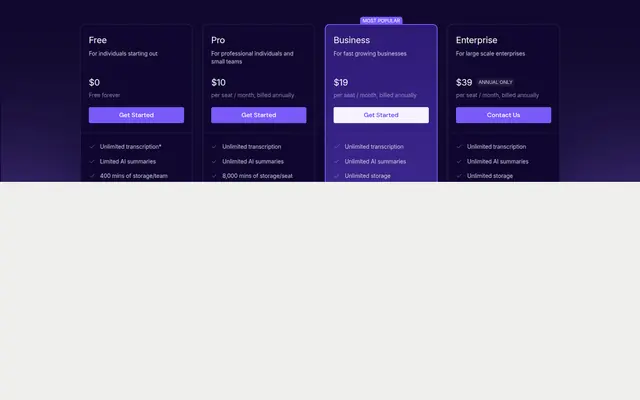
The advertised price is rarely the cost that lands. Fireflies caps AI credits at 20, 30 and 50 across its plans and stores 8,000 minutes per seat on Pro. Otter caps Pro at five billed users and applies a 30 minute ceiling to a single Basic conversation. MeetGeek charges $0.50 for every extra hour past 20 hours. Avoma's Enterprise tier requires a minimum of 10 recorder seats, which is $390 a month before add-ons. Notta keeps transcripts after cancellation but shows a Free user only the first 3 minutes.
| What matters most to you | Start with |
|---|---|
| No minute ceiling at all | Avoma or Fathom |
| A free tier that is not a countdown | Fathom (opens in a new tab) |
| Knowing what an extra hour costs | MeetGeek Pro |
| A team larger than five | Fireflies (opens in a new tab) |
| Keeping old transcripts | Otter Pro or Business (opens in a new tab) |
| Adding a sixth person on a cheap plan | Not Fireflies Free, Otter Pro or Notta Pro |
| A single long client call | Not Notta Free |
| Pushing notes into a CRM for the whole team | Not Fathom |
Get started with the tools in this guide
Where a vendor offers a free plan or a free trial, it is stated below, so you can try the tool before you pay for it.
-
Start free with Fireflies.ai (opens in a new tab)
Fireflies.ai
Free tier available
-
See Otter.ai pricing (opens in a new tab)
Otter.ai
-
See Fathom pricing (opens in a new tab)
Fathom
These links go to the vendor's own site. We may earn a commission if you sign up, at no extra cost to you. How we fund the site. Every figure in this guide was read from the vendor's pricing page on the date stamped above, so confirm the number before you commit.
- Tools checked
- 8
- Shortest single-recording cap
- 3 min
- Cheapest extra hour
- $0.50
- Checked
- 21 October 2026
Overview
Buying AI meeting notes is usually a decision made on two numbers, which are the monthly price and the number of seats. Both are on the pricing page in large type, and both are the least reliable part of the estimate. The limits that decide what an agency actually pays sit underneath, in the allowances, retention windows and seat rules that most comparison pages skip entirely.
This guide covers AI meeting notes hidden fees in the operational sense: the caps that generate an upgrade prompt, an overage charge or a deleted recording, rather than the headline subscription. Every figure was read from the vendor's own pricing page on 21 October 2026, and where a vendor publishes a number it is quoted rather than paraphrased. Where a vendor does not publish a number, that is stated rather than filled in with an estimate.
The tools covered are the same eight used in the comparison for small agencies and the five-seat cost scenarios, so the caps here can be read directly against the prices there. If the question is which tool fits an agency rather than what the caps do, start with the comparison. This guide assumes the tool has already been shortlisted and answers the narrower question of what changes the bill afterwards.
The four places the bill moves after you buy
Minute allowances. Every vendor counts something, and no two count the same thing. Fireflies counts storage per seat. Otter counts transcription minutes per user with no rollover. MeetGeek counts transcription hours per month and prices the overflow. Notta counts transcription minutes per month and caps a single conversation. Avoma counts nothing for transcription but limits uploaded files per user. Two tools advertise unlimited transcription and mean it, which is Avoma on every paid tier and Fathom on every tier including Free.
AI credits and assistant quotas. Summaries, chat and agentic features are increasingly metered separately from recording. Fireflies publishes 20, 30 and 50 AI credits across Pro, Business and Enterprise. Notta includes 1,000 AI credits a month on paid plans and consumes them at published rates per action. Otter caps AI Chat queries per user per month at 20, 50 and 200. Fathom describes advanced summaries as limited use on Free without publishing a number.
Storage and retention. Audio, video and transcripts expire on different clocks. MeetGeek stores audio for one month on Basic while keeping transcripts for three, so the recording is deleted while the text survives. Granola shows 30 days of history on Basic. Otter keeps the 25 most recent conversations on Basic. Notta's own FAQ states that after cancellation the data is kept but a Free user can see only the first three minutes of it.
Seat rules. Seat minimums and seat ceilings change the effective price more than any discount. Fathom's team plans require two users. Avoma's Enterprise tier requires ten recorder seats. Otter's Pro plan stops at five billed users and its Basic plan at five workspace members. Notta's Pro plan is a single seat. Fathom caps CRM sync at three users per domain on every plan, including Business.
Minute caps: where the allowance actually applies
The most expensive misunderstanding in this category is assuming that a minute cap applies to meetings. On Fireflies it does not. The vendor's own FAQ states that Pro and Business users "have access to meeting and audio file transcription. There are no rate limits for using the meeting bot or chrome extension on a monthly basis. There are rate limits for using certain features to transcribe like the API, Dialers, and bulk file uploads."
That distinction matters for an agency that records client calls through a bot, because the cap that appears to threaten the subscription does not apply to that workflow at all. It matters in the opposite direction for an agency that imports recordings from a dialer or pushes audio through an integration, because that is exactly where the limit bites.
| Tool | Free allowance | Entry paid allowance | Where the cap applies |
|---|---|---|---|
| Fireflies.ai | Unlimited transcription, 400 minutes of storage per team | 8,000 minutes of storage per seat on Pro | Storage and AI credits, plus API, dialer and bulk upload transcription |
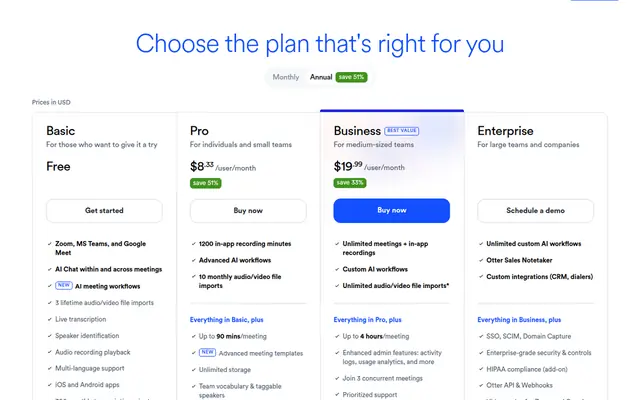
| Otter.ai | 300 minutes per user a month | 1,200 minutes per user a month on Pro | Meetings and imported files share one pool, with no rollover |
| MeetGeek | 3 hours a month | 20 hours a month on Pro | Transcription hours, with $0.50 per extra hour |
| Notta | 120 minutes a month | 1,800 minutes a month on Pro | Transcription minutes, with no carryover |
| Fathom | Unlimited | Unlimited | Advanced summaries rather than recording |
| Avoma | No free tier, 14 day trial | Unlimited transcription on Startup | Uploaded files, at 5 per user a month on Startup |
| Granola | Unlimited meeting notes | Unlimited on Business | History depth rather than recording volume |
| tl;dv | Meeting-counted rather than minute-counted | Pro on annual billing | AI meeting allowance rather than raw recording |
Two consequences follow from that table. First, the word unlimited is doing different work on different pages. On Avoma and Fathom it covers transcription itself. On Fireflies it covers meetings recorded through the bot while storage stays metered. Second, a single-conversation ceiling is a different constraint from a monthly one. Notta's Free tier allows 120 minutes a month but only 3 minutes for any one conversation, so a 45 minute client call cannot be transcribed there at all regardless of how much of the monthly allowance is left. Otter applies the same shape of rule more gently, at 30 minutes on Basic, 90 minutes on Pro and 4 hours on Business.
AI credits and assistant quotas
Credits are the newest line item and the least predictable, because the unit is defined by the vendor rather than by anything an agency can measure in advance. Fireflies publishes 20 AI credits on Free and Pro, 30 on Business and 50 on Enterprise, without converting those credits into a number of summaries. Otter publishes its AI Chat allowance as queries per user per month, which is easier to reason about: 20 on Basic, 50 on Pro and 200 on Business.
Notta is the most transparent of the group, because it publishes both the monthly allowance and the consumption rate. Paid plans include 1,000 AI credits a month, and the vendor's own FAQ states that credits are consumed only after output is successfully generated, at 100 credits per knowledge-base question, 200 per image, 300 per presentation file and 200 per Excel or Word file. It also sells a Notta Brain add-on at $93.59 a year for 8,000 AI credits a month, which is the clearest signal in this category that AI usage is now a separate commercial line rather than part of the seat price.
For an agency the practical question is what happens at the ceiling. On Otter and Fireflies the answer is that AI features stop or degrade while recording continues, so the transcript survives and the summary does not. On Notta the answer is that further AI work requires either waiting for the next month or buying the add-on. Neither is a crisis, and both are worth knowing before a busy month rather than during one.
Storage and retention: what survives, and for how long
Retention is where the quiet losses happen, because nothing fails loudly. A recording that expires simply is not there when someone needs it, usually during a dispute about what a client agreed to.
MeetGeek separates the three assets most explicitly. Basic stores transcripts for three months and audio for one month. Pro stores transcripts for a year and audio for six months. Business stores transcripts without limit and video for twelve months. The pattern is that audio always expires before the transcript, so the text outlives the recording, and video is stored on a shorter clock than either. For an agency that wants to prove what was said rather than read a summary, that ordering is the one to check.
Fireflies meters storage rather than time. Free pools 400 minutes for the whole team, Pro gives 8,000 minutes per seat, and Business and Enterprise are unlimited. Because the Free allowance is pooled rather than per seat, a five-person team on Free shares 400 minutes in total, which is under seven hours of meeting audio for the entire agency. On Pro the same five seats hold 40,000 minutes, so the seat model changes the storage position as much as the price does.
Otter and Granola limit visibility rather than storage. Otter's Basic tier keeps the 25 most recent conversations, so the limit is expressed in items rather than duration. Granola shows 30 days of meeting history on Basic and removes the limit on Business, and its MCP integration on Basic is confined to personal notes from the last 30 days. Both approaches mean the old material is technically retained but practically unreachable without an upgrade.
Notta publishes the most consequential retention rule of the eight, in its own FAQ: after cancelling a paid plan the transcription data is kept, "however, you can only view the first 3 minutes of the transcript as a Free user." An agency that cancels after a project can therefore keep the file and lose the ability to read it, which is a stronger argument for exporting transcripts before downgrading than any retention window.
Seat minimums and seat ceilings
Seat rules are the most common reason a plan that looked cheap at one user stops being cheap at five, and they run in both directions.
Fathom sets a floor: Team and Business both require a minimum of two users. Avoma sets a much higher one on its top tier, requiring a minimum of 10 recorder seats on Enterprise, which at $39 a recorder seat is $390 a month before any add-on. Avoma also sets ceilings on the tiers below, at up to 25 paid seats on Startup and up to 100 on Organization. Its saving grace is that viewers and collaborators are always free, and the vendor states plainly that only users who record and transcribe need a paid seat.
Otter sets ceilings rather than floors. Basic allows a maximum of five workspace members, Pro allows five billed users, and Business allows 25 billed users. A five-person agency sits exactly at the ceiling of the two cheaper tiers, which means the first new hire triggers an upgrade. Enterprise single sign-on requires a minimum 100-user licence, so the security features most agencies would want for client work are not available at agency scale.
Fireflies takes the opposite approach to seat growth. Any teammate added to the workspace counts as a seat on a paid plan, but the vendor states that individual meeting recap links can be shared with participants or other users without adding them to the team, free of charge. That single rule lets one person record and the rest of the agency read, which is why it appears as the answer for a team that expects to pass five people.
Two further seat-adjacent limits are worth flagging because they are easy to miss. Fathom caps CRM sync at a maximum of three users per domain on every plan, so an agency of eight cannot have every consultant's notes writing back to the CRM even on Business. MeetGeek lists concurrent meetings as limited on every plan including Business and Enterprise, so a five-person agency cannot run five simultaneous recordings.
The monthly billing penalty
Paying monthly is the single largest avoidable cost in this category, and the size of the penalty varies enough that it should be checked per vendor rather than assumed.
| Tool and tier | Monthly | Annual | Monthly costs this much more |
|---|---|---|---|
| Otter Pro | $16.99 | $8.33 | 2.04 times the annual rate |
| Fireflies Pro | $18 | $10 | 1.80 times |
| tl;dv Pro | EUR 29 | EUR 18 | 1.61 times |
| MeetGeek Pro | $15.99 | $9.99 | 1.60 times |
| Avoma Startup | $29 | $19 | 1.53 times |
| Fathom Premium | $20 | $16 | 1.25 times |
| Fathom Team | $19 | $15 | 1.27 times |
| Notta Pro | Not published in this pass | $8.17 | Compare before switching |
Rates are per seat or per user per month at the prices published on 21 October 2026. tl;dv quotes in euros, so its figures are not directly comparable with the dollar rates above and are shown in the currency the vendor uses. Notta's page presented the annual rate as the recommended option with a stated 40% discount, and its monthly equivalent was not published in the same view, so no ratio is claimed here.
The practical rule is that the monthly rate is a trial rate. An agency that intends to keep a tool past two months is paying a premium that in Otter's case exceeds the cost of moving to Business on annual billing, which is the comparison made in the five-seat cost guide.
The downgrade and cancellation traps
Three traps are worth naming because each one costs something real and none of them appears on a pricing card.
The export problem. Notta's first-three-minutes rule applies after cancellation, so transcripts that are still stored become unreadable. Export before downgrading rather than assuming retention equals access. The comparison of cancellation, refund and deletion terms sets out what each vendor returns, how long access survives a cancellation and when stored transcripts are finally deleted.
The pooled allowance. Fireflies Free pools 400 minutes of storage across the whole team rather than per person, so a growing team consumes the shared allowance faster than any individual expects. The same logic applies to Otter's shared pool across transcription types on paid plans.
The add-on stack. Avoma prices Conversation Intelligence and Revenue Intelligence at $29 per seat per month each, and Lead Router at $19 annually or $25 monthly, all on top of the recorder seat. An agency that wants conversation intelligence for four recorders is adding $116 a month to a $19 seat price, which is the largest single multiplier in this comparison. Avoma's 14 day trial includes every add-on, so the trial experience is materially better than the entry subscription and the gap should be checked deliberately.
What the free plans actually include
Six of the eight publish a permanent free tier. Avoma offers a 14 day trial instead of a free plan, and tl;dv's free tier is counted in AI meetings rather than in minutes or hours, so it is not directly comparable with the rest.
| Tool | Free allowance | Retention on Free | The limit that ends it |
|---|---|---|---|
| Fathom | Unlimited recording and transcripts | Not stated | Advanced summaries are limited use |
| Fireflies.ai | Unlimited transcription, 20 AI credits | 400 minutes of storage pooled for the team | Storage, and summaries are limited |
| Granola | Unlimited meeting notes | 30 days of history | History depth, and no integrations at all |
| MeetGeek | 3 hours of transcription a month | 3 months of transcripts, 1 month of audio | Pro raises the hours to 20 |
| Otter.ai | 300 minutes per user a month, 20 AI Chat queries | 25 most recent conversations | 5 workspace members, and 30 minutes per conversation |
| Notta | 120 minutes a month, 10 AI summaries | Not stated | 3 minutes maximum per conversation |
| tl;dv | Counted in AI meetings, not minutes | Stated as a retention window | Pro removes the meeting allowance |
| Avoma | No free tier, 14 day trial of Organization | Not applicable | The trial ends |
Two of these free tiers are genuinely usable for client work and two are not. Fathom gives unlimited recording and transcription at $0, which makes it the strongest free option for an agency that only needs transcripts and basic summaries. Fireflies gives unlimited bot transcription but pools storage at team level and limits summaries, which works for a small team that exports regularly. Otter's five-member ceiling and Notta's three-minute conversation limit are the two that fail on a real client call, because both bite inside a normal workflow rather than at its edges.
Fewest limits overall Avoma $19 a recorder seat with free viewers, unlimited transcription and no storage metering
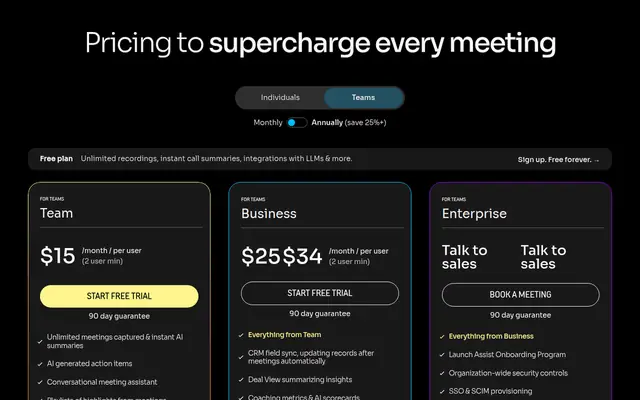
Most predictable bill Fathom Unlimited recording and transcription at every tier, with a 90 day guarantee
Best for a team that will pass five people Fireflies $10 a seat with recap links shareable without buying seats
Cheapest published overage MeetGeek Pro $0.50 per extra hour past the 20 hours included
Most transparent AI metering Notta 1,000 credits a month with published consumption rates per action
Our verdict
The tool with the fewest hidden limits is Avoma, and it is also the one with the largest add-on multiplier. Unlimited transcription on every paid tier and free viewer seats match how an agency actually works, with a few people recording and everyone else reading, but the $390 monthly floor on Enterprise and the $29 per seat add-ons mean the published $19 entry price is the start of the calculation rather than the end of it. An agency that wants conversation intelligence should price the whole stack before comparing it with anything else.
Fathom is the best answer for a small agency that wants predictable billing. Unlimited recording and transcription at every tier, including Free, plus a published 90 day guarantee and no storage metering, leaves the CRM sync cap of three users per domain as its only structural limit. That cap is the reason Fathom appears in the do-not-buy row of the table above for a team that needs every consultant's notes in the CRM.
Fireflies remains the strongest choice for a team that expects to grow past five people, because recap links can be shared without buying seats and storage is per seat rather than pooled once the plan is paid. The two limits to watch are AI credits, which are published without a conversion into summaries, and the fact that the minute cap lands on API, dialer and bulk upload transcription rather than on the bot that most agencies actually use.
MeetGeek and Otter are the two where a single number changes the decision. MeetGeek's $0.50 per extra hour makes overage visible and cheap, which is unusual in this category, while its concurrent meeting limit is the constraint to check against a team that meets at the same time. Otter's five billed user ceiling on Pro means the plan is priced for a team that has already stopped growing.
Frequently asked questions
What are AI meeting notes hidden fees?
They are the limits that change what an agency pays after subscribing rather than at the point of purchase. The four that matter most are minute or storage allowances, AI credit and assistant quotas, retention windows that expire audio before transcripts, and seat rules such as minimums, ceilings and per-domain caps. Fireflies' 20 to 50 AI credits, Otter's five billed user ceiling on Pro, MeetGeek's $0.50 per extra hour and Avoma's 10 recorder seat Enterprise minimum are all examples read from the vendors on 21 October 2026.
Which AI meeting notes tool has no minute limit?
Avoma and Fathom both publish unlimited transcription, and Fathom includes it on its free tier. Fireflies also advertises unlimited transcription, but its vendor FAQ states that the rate limits apply to the API, dialers and bulk file uploads rather than to meetings recorded through the bot or the Chrome extension, so the practical position depends on how the agency captures audio. Granola does not meter recording volume at all and limits history depth instead.
Why does a free AI meeting notes plan stop working?
The reason differs by vendor and usually appears inside a normal workflow rather than at its edge. Notta's free tier allows 120 minutes a month but caps a single conversation at 3 minutes, so a 45 minute client call cannot be transcribed. Otter's free tier caps the workspace at five members and each conversation at 30 minutes. Fireflies' free tier pools 400 minutes of storage for the whole team. Granola's free tier keeps 30 days of history and includes no integrations at all.
Do AI meeting notes credits expire?
Notta states that its transcription quota carries no rollover, and Otter states the same for its monthly minute allowances, so unused capacity is lost at the end of the month. Fireflies' AI credits are published as a monthly figure per plan without a stated rollover. The safe assumption across this category is that allowances reset rather than accumulate, which is why a quiet month does not fund a busy one.
What happens to recordings if an agency cancels?
Notta publishes the clearest answer of the eight in its own FAQ: the transcription data is kept, but a Free user can view only the first 3 minutes of a transcript. MeetGeek's audio expires before its transcripts on every tier, so the recording is deleted while the text survives. The practical rule is to export transcripts and recordings before downgrading rather than assuming that retained data stays readable.
Is annual billing always cheaper for meeting notes software?
Yes on every vendor checked here, but by very different amounts. Otter Pro costs 2.04 times its annual rate when paid monthly, Fireflies Pro 1.80 times, MeetGeek Pro 1.60 times and Fathom Premium 1.25 times. Notta publishes an annual rate with a stated 40% discount without showing the monthly equivalent in the same view, so its ratio cannot be stated. An agency that expects to keep a tool past two months should treat the monthly rate as a trial rate.
Fireflies is a useful example of how credit and storage rules interact, and both are set out in the Fireflies.ai review for agencies.
Get started with the tools in this guide
-
Start free with Fireflies.ai (opens in a new tab)
Fireflies.ai
Free tier available
-
See Otter.ai pricing (opens in a new tab)
Otter.ai
-
See Fathom pricing (opens in a new tab)
Fathom
These links go to the vendor's own site. We may earn a commission if you sign up, at no extra cost to you. How we fund the site. Every figure in this guide was read from the vendor's pricing page on the date stamped above, so confirm the number before you commit.
Related guides
-
 Head to head
AI Meeting Notes for Agencies
Fireflies vs Otter for Client Calls
Which of the two dominant AI meeting note tools fits a small agency, based on verified pricing, seat limits and how each behaves in a client call.
-
 Best overall
AI Meeting Notes for Agencies
Best AI Meeting Notes for Consultants
Four AI meeting note tools compared for consultancies on verified pricing, the free-tier limits that actually bite, and client confidentiality.
-
 Head to head
AI Meeting Notes for Agencies
Fathom vs Fireflies for Consultants
Fathom and Fireflies compared on verified pricing, the free-tier limits that decide real cost, and how each behaves in a client call.