CRM for agencies · Updated 7 November 2026
Zoho CRM vs HubSpot
Zoho CRM vs HubSpot for 2 to 20 person agencies, with dated free limits, automation, AI, and three, five and ten-seat costs.
- 17 min read
- Zoho CRM vs HubSpot
- Verified against vendor pricing
The short answer
Zoho CRM wins the free-tier decision because Free supports 3 users and 5,000 records, while HubSpot Free stops at 2 users and publishes 1,000 contacts. HubSpot Starter is the cheaper paid route at three, five and ten seats on its displayed annual price, but Zoho Standard has the clearer low-cost path when a team can stay within its free cap and needs more generous basic capacity.
| If you need | Choose |
|---|---|
| The most useful free workspace for a small agency | Zoho CRM Free (opens in a new tab) |
| A paid CRM with the lower displayed seat price | HubSpot Starter (opens in a new tab) |
| AI agents and predictive intelligence inside Zoho | Zoho CRM Professional (opens in a new tab) |
| A free CRM with an AI assistant | HubSpot Free (opens in a new tab) |
| The better fit for a team that expects 5 to 10 paid seats | HubSpot Starter (opens in a new tab) |
Get started with the tools in this guide
Where a vendor offers a free plan or a free trial, it is stated below, so you can try the tool before you pay for it.
-
Start free with HubSpot (opens in a new tab)
HubSpot
Free CRM for up to 2 users and 1,000 contacts, with no expiry
-
See Zoho CRM pricing (opens in a new tab)
Zoho CRM
Free forever plan for up to 3 users, no card required
These links go to the vendor's own site. We may earn a commission if you sign up, at no extra cost to you. How we fund the site. Every figure in this guide was read from the vendor's pricing page on the date stamped above, so confirm the number before you commit.
- Free Zoho users
- 3
- Free HubSpot users
- 2
- Annual paid entry
- $7 per seat
- Seats compared
- 3, 5 and 10
Best free plan for a small agency Zoho CRM Free Three users, 5,000 records and workflow automation make it the more generous starting point, read 7 November 2026
Best paid price for a growing team HubSpot Starter The displayed annual price is $7 per seat per month, but it is a new-customer offer and credits reset monthly, read 7 November 2026
Overview
For a 2 to 20 person agency, Zoho CRM is the better free starting point and HubSpot Starter is the better paid price. Zoho CRM Free supports 3 users and 5,000 records, while HubSpot Free supports up to 2 users and publishes 1,000 contacts. Once a third person needs access, HubSpot Starter is displayed at $7 per seat per month billed annually, so HubSpot is cheaper at three, five and ten paid seats than Zoho Standard's latest official annual figure of US$14 per user per month. Those Zoho USD figures were recorded from the official calculator on 5 November, while the current 7 November extraction shows the USD selector but does not render the numeric paid price.
That is the central decision in Zoho CRM vs HubSpot. Zoho gives a small team more room to stay free and includes workflow automation in Free. HubSpot has a tighter free user cap, but its Starter bundle has a low displayed seat price and unlocks more of the automation an agency may expect from a paid CRM. Both can work for a small agency. The right answer depends on whether the priority is avoiding a licence bill for three people, or buying a low-cost paid workspace that can include five or ten logins.
This is a direct comparison, not a list of every CRM feature. It focuses on a normal agency process: capturing enquiries, assigning owners, moving opportunities through stages, setting follow-ups, keeping client and prospect history together, and giving enough people access to maintain the record. It also separates CRM records from contacts, file storage from data storage, and AI assistance from automation that runs a workflow.
Zoho CRM is an approved affiliate partner of Agency Software Report. HubSpot is not monetisable in this article. That commercial distinction does not decide the recommendation. The recommendation follows the dated published limits, and every unresolved pricing display is labelled rather than filled with an estimate.
What we compared
The first test is the free plan. A free label is useful only when the user ceiling and data ceiling fit the agency. Three users can be enough for a founder, account lead and delivery lead, but a five-person studio cannot treat a two-user free plan as a company-wide option. The second test is the first paid tier. The headline seat price matters, but so do the features that force an upgrade, including automation, multiple pipelines, email tools and AI.
The third test is capacity. Zoho publishes a Free limit of 5,000 records and 10 MB of data storage, plus 1 GB of organisational file storage. HubSpot's official CRM product page publishes up to 1,000 contacts for Free and says there are no limits on customer data, while the CRM pricing page does not state a separate CRM-record cap. These are not identical measurements. An agency should not present 1,000 HubSpot contacts and 5,000 Zoho records as a perfect like-for-like database test.
The fourth test is team growth. Costs below show three, five and ten seats. Zoho Standard uses the latest official USD annual figure already recorded on 5 November, US$14 per user per month. The official pricing page fetched on 7 November showed plan names and features but did not render the numeric USD price in the extracted view. That is a verification limitation, not a reason to pretend a new number was published today.
HubSpot figures come from the official CRM pricing page read on 7 November 2026. Starter is displayed at $7 per seat per month when billed annually and $20 when paid monthly. HubSpot says the offer is for new customers and that applicable tax may apply. The calculations therefore show the displayed offer, not a promise that every existing account receives it.
For context, the CRM for agencies hub covers the wider category. The best CRM for a 5-person consultancy also compares the arithmetic of a five-seat team, while the CRM software hidden fees guide explains why seats, capacity and add-ons should be budgeted together.
Zoho CRM: the stronger free starting point
Best for a continuing free pilot Zoho CRM Free Three users, 5,000 records and workflow automation, read 7 November 2026
Zoho CRM Free suits a small agency that can assign clear ownership to three people. It is described on the official pricing page as forever free for 3 users, with no credit card required. It is not merely a short trial. A two-person agency can keep the licence bill at zero, and a three-person agency can do the same if its data and feature needs stay within the published boundaries.
The feature list is practical for a basic sales process. Free includes contact management, follow-up reminders, workflow automation, custom email templates, tasks, meetings and calls, standard reports, data import and export, mobile apps and 5,000 API calls per day. Zoho also lists up to 10 custom email templates for Free. Workflow automation matters here because the free plan can support a simple rule such as assigning a lead, updating a field or reminding an owner without moving immediately to a paid edition.
The capacity rule is more specific than the word free. Zoho's feature comparison lists 5,000 records and 10 MB of data storage for Free in the 1 to 200-user organisation band. It lists 1 GB of organisational file storage separately. A proposal attachment is not the same thing as a CRM data record. An agency importing historic prospects, companies, deals, renewals and delivery contacts should count the rows it will create, not only the people currently in an active pipeline.
The Free user ceiling is also a working limit. A three-person agency can divide responsibility between commercial ownership, account management and delivery administration. A fourth person cannot simply be added as a minor exception under the published Free allowance. A team that needs broad editing access has a paid-plan decision even if the fourth person only updates a few records each month.
Zoho Standard is the first paid edition to consider when Free no longer covers users or capacity. Zoho's published feature descriptions put email integration, mass emails, built-in calling, multiple pipelines, calendar integration, forms, sales forecasting, data enrichment and custom modules in Standard. The latest official USD annual figure already recorded from Zoho's calculator is US$14 per user per month, which makes five seats US$70 per month equivalent or US$840 for a year, before tax.
Standard is not the same as an AI tier. Zoho's official pricing page describes Professional as the growing-team edition and names AI agents, process management and predictive intelligence there. Professional's latest official USD annual figure recorded on 5 November is US$23 per user per month. A five-person agency would therefore pay US$115 per month equivalent, or US$1,380 for a year, before tax. That is the price of getting the named AI and predictive layer, not merely the price of having a larger team.
The weakness is the pricing display. On 7 November, Zoho's fetched pricing page exposed the currency selector and plan names but did not render the USD numeric paid prices. The official feature comparison and calculator also rendered INR values in the extracted page. The US$14 and US$23 figures in this article are the latest official USD figures already recorded on 5 November, not a claim that the extracted 7 November page showed them again. A buyer should confirm the live USD quote before approval.
For a more detailed edition-by-edition view, the Zoho CRM review for small agencies covers Free, Standard, Professional and Enterprise. It is useful when the question changes from which vendor to choose to which Zoho edition solves a specific limit.
HubSpot: the lower displayed paid price
Best for a low-cost paid team workspace HubSpot Starter $7 per seat per month annually or $20 monthly, read 7 November 2026
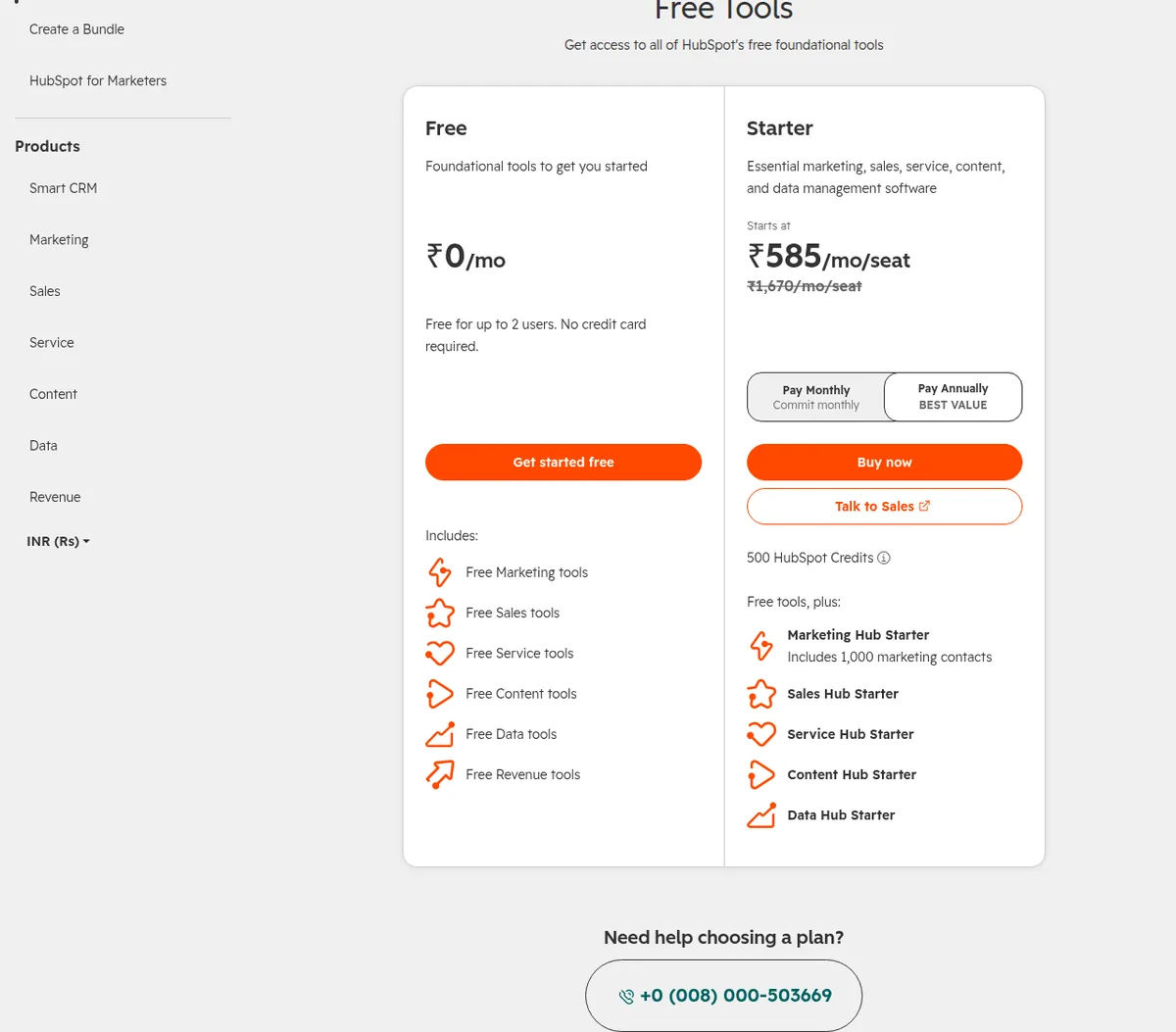
HubSpot Free is polished and broad, but its published user ceiling is tighter. The official CRM pricing page says Free is $0 per month for up to 2 users, with no credit card required. HubSpot's CRM product page adds that the free CRM includes up to 1,000 contacts and no expiration date. The product page also says the free functionality has no limits on customer data, so the safest description is that HubSpot publishes a 1,000-contact allowance, not a separate total CRM-record ceiling on the pricing page.
Free includes contact and deal management, tasks, reporting dashboards, meeting scheduling, email tracking, shared tools and Breeze Assistant. HubSpot's product page says Breeze Assistant can research companies, prepare for sales calls and summarise CRM records. That makes HubSpot a credible free option for a one-person operator or a pair who want an AI assistant as part of the initial workflow. It does not solve the free-plan user cap for a three-person agency.
Starter is where the paid comparison changes. The current CRM pricing page displays $7 per seat per month with annual billing and $20 per seat per month when paid monthly. It labels the annual display as best value, says discounts are available for new customers only, and notes that tax may apply. Three seats are therefore $21 per month equivalent on the displayed annual price, five are $35, and ten are $70. Monthly billing would be $60, $100 and $200 respectively.
Starter also includes 500 HubSpot Credits. Credits are not a permanent pool. HubSpot's official catalogue says they reset monthly and unused credits do not roll over. Additional credits are priced at $0.010 each, or a capacity pack costs $10 for each additional 1,000-credit monthly pack. An agency using AI agents or other credit-consuming actions should monitor the allowance instead of treating the $7 seat price as the entire automation budget.
Sales Hub Starter lists up to 50 workflows with restricted triggers and actions, up to 15 total pipelines across object types, and 1,000 personal and team meeting links. The CRM pricing page also lists email automation as up to 10 automated actions, compared with one automated action in Free. This is the paid feature boundary a small agency is likely to feel first. A team can move from a free test into defined lead routing and follow-up rules without buying Professional immediately, but the workflows are still restricted.
HubSpot's AI is split across the free assistant, paid features and credits. Breeze Assistant is in Free. Starter includes 500 credits and some Starter automation, while the official CRM product page places more advanced AI such as the AI customer agent in paid editions. The official pricing page does not say that every HubSpot AI agent is included in Starter. An agency should identify the exact agent, action or recurrence before assuming that a paid seat includes unlimited AI.
The HubSpot Starter vs Professional guide explains the boundary between the lower paid plan and the next tier. The HubSpot Credits guide covers expiry, capacity packs and why an agency should separate seats from usage-based AI. For a broader HubSpot comparison, see HubSpot vs Pipedrive for agencies.
Zoho CRM vs HubSpot compared on cost
The table below uses the published or latest recorded annual figures. Zoho's current 7 November extracted USD page did not render numeric paid prices, so its US$14 Standard figure carries the stated 5 November source caveat. HubSpot's figures are the current displayed annual offer from 7 November and exclude tax.
| Seats | Zoho CRM Free | Zoho Standard annual equivalent | HubSpot Free | HubSpot Starter annual equivalent |
|---|---|---|---|---|
| 2 | US$0, within 3-user and 5,000-record limits | US$28/mo equivalent at 2 x US$14 | US$0, within 2-user and 1,000-contact allowance | US$14/mo equivalent at 2 x $7 |
| 3 | US$0, within the Free user cap | US$42/mo equivalent | Paid access required | $21/mo equivalent at 3 x $7 |
| 5 | Paid plan required | US$70/mo equivalent, US$840/year | Paid plan required | $35/mo equivalent, $420/year |
| 10 | Paid plan required | US$140/mo equivalent, US$1,680/year | Paid plan required | $70/mo equivalent, $840/year |
At two seats, both vendors can be free if the data fits. Zoho has more room because its free user cap is three, while HubSpot has the broader free assistant story but stops at two users. At three seats, Zoho is the only one that can remain at $0, which is a meaningful saving for a new agency proving that a CRM will be maintained.
At five and ten paid seats, HubSpot Starter is the lower displayed annual route. Its five-seat total is $420 per year, compared with US$840 for Zoho Standard using the latest official annual figure recorded on 5 November. At ten seats, HubSpot's displayed annual total is $840, compared with US$1,680 for Zoho Standard. Those comparisons are not a claim that HubSpot has a lower total cost in every workflow. Credits, marketing contacts, implementation, tax and the exact automation requirement can change the bill.
Zoho becomes more expensive in a different place. It is generous at the free edge, then moves to a per-user paid edition whose first AI-focused tier is Professional at US$23 per user per month annually in the latest official USD schedule. HubSpot's entry paid price is lower, but its free user cap is smaller and Starter's 500 monthly credits introduce a usage boundary. The question is not simply which company charges more. It is where the agency crosses the boundary that matters.
The seat and billing traps
The first trap is assuming that a free CRM is a company-wide licence. Zoho Free is for 3 users, not an unlimited number of staff sharing one login. HubSpot Free is for up to 2 users. Shared logins make ownership, audit history and permission control worse, so the correct calculation counts people who create or update records, not only the person who first configured the account.
The second trap is comparing records and contacts as though they have the same definition. Zoho publishes 5,000 records for Free and 10 MB of data storage, with 1 GB of organisational file storage separately. HubSpot's official CRM product page publishes 1,000 contacts and says no limits on customer data, while the pricing page does not provide a separate CRM-record cap. A team moving a database should ask how companies, contacts, deals, tickets and custom objects are counted before treating either figure as a full capacity forecast.
The third trap is treating HubSpot's $7 as a universal price. The pricing page displays $7 per seat per month for annual billing and $20 monthly. It also says new-customer discounts are available and may be discontinued, and applicable tax is extra. A team already on another HubSpot package should confirm the applicable quote rather than multiply the promotional headline without checking the account's billing context.
The fourth trap is ignoring the annual commitment. HubSpot's five-seat annual equivalent is $35 per month, but monthly billing is $100 for five seats. The annual figure is attractive only when the agency expects to keep the seats for the commitment. Zoho's current extracted pages did not expose a fresh USD monthly Professional figure. The official USD record used here should therefore be treated as an annual comparison, not as proof of the month-to-month Zoho bill.
The fifth trap is pricing AI by seat alone. HubSpot Starter includes 500 credits, and unused credits reset each month. More AI or automation can consume credits, and extra capacity is priced separately. Zoho Professional lists AI agents and predictive intelligence, but the feature comparison puts other Zia capabilities in higher editions and sometimes attaches minimum licence rules. The buying question is the named action the agency needs, not whether a pricing page contains the word AI.
The sixth trap is upgrading for a feature that the process does not use. Zoho Standard may be enough for multiple pipelines, email connection, forms, forecasting and custom fields. HubSpot Starter may be enough for restricted workflows, up to 15 pipelines and a more accessible paid seat price. An agency should define the required trigger, owner, report or AI action before moving to Zoho Professional or a higher HubSpot product tier.
The seventh trap is forgetting that attachments and CRM data have different ceilings. Zoho's 1 GB Free file storage does not remove the 5,000-record and 10 MB data-storage boundaries. HubSpot's contact allowance does not tell an agency how much document storage or other product capacity it will receive. Proposals, briefs, signed scopes and meeting files may belong in a connected document system rather than being counted as a reason to buy a more expensive CRM edition.
The Zoho CRM vs Pipedrive comparison is useful if the real alternative is a focused paid pipeline. The AI CRM features comparison is useful when an agency is choosing on assistant, agent or predictive features rather than on free seats alone.
Who should not buy this
Do not buy either paid plan before naming the person responsible for each next action. A CRM will not fix an unowned pipeline. If the agency has no agreed stages, no rule for updating a deal and no weekly habit for clearing follow-ups, the sensible first step is a short process definition and a Free account where the limits fit.
Do not choose Zoho CRM Free if more than three people need routine access, if the database is approaching 5,000 records, or if the process depends on the paid AI and predictive layer. It is a strong small-team starting point, but the cap is part of the product rather than a temporary inconvenience.
Do not choose HubSpot Free if a third person must edit the workspace or if 1,000 contacts is already an uncomfortable ceiling. Its Breeze Assistant and broad free tools may be attractive, but a free plan that excludes a core operator is not free in practical terms. HubSpot Starter is the more logical comparison once three people need access.
Do not choose HubSpot Starter solely because $7 looks like a permanent price. Confirm whether the displayed offer applies, whether annual billing fits cash flow, and whether 500 monthly credits cover the intended AI actions. Do not choose Zoho Professional solely because it is the first edition naming AI agents. Confirm the exact feature, licence rule and current USD quote before signing.
Our verdict
Choose Zoho CRM Free for a 2 or 3 person agency that wants to avoid a licence bill, can keep the database within 5,000 records, and benefits from workflow automation without moving to a paid tier. This is the clearest free-plan recommendation because Zoho gives the team one more user than HubSpot and publishes a larger basic record allowance.
Choose HubSpot Starter for a five or ten person agency that needs individual paid access and wants the lower displayed annual seat price. At the current displayed offer, five seats are $35 per month equivalent and ten are $70, before tax. The agency must still budget for the 500 monthly credits and confirm that the new-customer offer applies.
Choose Zoho Standard instead when the agency prefers Zoho's data model, wants a route from Free into more pipelines and forms, or needs its current Zoho workflow. Choose Zoho Professional when AI agents and predictive intelligence are the reason for the purchase, using the latest official US$23 annual figure as a planning figure that needs current reconfirmation. For the broader decision method, read the methodology.
In short, Zoho is the one an agency outgrows later on users if it can stay within three seats, while HubSpot is the one an agency outgrows sooner on free seats but may find cheaper once it accepts paid Starter. Neither is universally cheaper. The free winner and the paid winner are different products for different team sizes.
Frequently asked questions
Which is better in Zoho CRM vs HubSpot for a small agency?
Zoho CRM is better for a 2 or 3 person agency that wants a genuine free workspace with 3 users, 5,000 records and workflow automation. HubSpot is better for a team that has already accepted paid access and wants the lower displayed Starter seat price. The answer changes at the point where a third HubSpot user needs access.
Is Zoho CRM Free really free for three users?
Yes. Zoho's official pricing page read on 7 November 2026 describes Free as forever free for 3 users. The feature comparison also lists 5,000 records and 10 MB of data storage, with 1 GB of organisational file storage shown separately.
How many users and contacts does HubSpot Free include?
HubSpot's official pricing page says Free is $0 per month for up to 2 users. HubSpot's CRM product page says the free CRM includes up to 1,000 contacts and no expiration date. The pricing page does not state a separate total CRM-record cap.
Which is cheaper for three seats?
Zoho can be cheaper at three seats because Free covers 3 users, so the licence cost is US$0 if the 5,000-record limit fits. HubSpot Free stops at 2 users, so a three-person team needs Starter, displayed at $21 per month equivalent when billed annually. That HubSpot figure is before tax and subject to the displayed new-customer offer.
Which is cheaper for five or ten seats?
HubSpot Starter is the lower displayed annual route at five and ten seats. Five seats are $35 per month equivalent and ten are $70, while Zoho Standard is US$70 and US$140 respectively using the latest official USD annual schedule recorded on 5 November. Zoho's current 7 November extracted USD page did not render numeric paid prices, so its figures should be reconfirmed before purchase.
Which product includes automation first?
Zoho Free includes workflow automation, so it reaches basic workflow rules without a paid licence. HubSpot Free lists one automated email action, while Starter lists up to 50 sales workflows with restricted triggers and actions and up to 10 automated email actions. The exact workflow requirement matters because the two products use different feature and limit descriptions.
Which CRM has better AI for a small agency?
HubSpot Free includes Breeze Assistant, which can help research companies, prepare for sales calls and summarise CRM records. Zoho Professional is the first Zoho tier whose official pricing page names AI agents and predictive intelligence, using the latest official annual figure of US$23 per user per month recorded on 5 November. HubSpot Starter includes 500 monthly credits, but the full cost depends on which AI actions consume those credits.
Do HubSpot credits carry over?
No. HubSpot's official product and services catalogue says credits reset monthly and unused credits do not roll over. Starter includes 500 credits, while extra credits can be purchased at $0.010 each or through a $10 capacity pack for an additional 1,000 credits per month.
Is Zoho CRM an affiliate partner in this comparison?
Zoho CRM is an approved affiliate partner of Agency Software Report, and that relationship is disclosed here. HubSpot is not monetisable in this article. The comparison does not treat affiliate status as evidence of product quality, and it labels the current Zoho USD pricing-display limitation rather than hiding it.
Official pricing pages
The Zoho CRM pricing page, feature comparison and licence calculator were read on 7 November 2026. The current extracted USD selector did not expose numeric paid prices, so the article identifies the latest official USD figures recorded on 5 November and tells agencies to reconfirm them. The Zoho CRM pricing page, Zoho CRM feature comparison and Zoho CRM licence calculator are the official sources.
The HubSpot CRM pricing page, HubSpot CRM product page and HubSpot product and services catalogue were read on 7 November 2026. Prices, discounts, credit allowances, contact limits and feature packaging can change, so the read date is part of this comparison.
Get started with the tools in this guide
-
Start free with HubSpot (opens in a new tab)
HubSpot
Free CRM for up to 2 users and 1,000 contacts, with no expiry
-
See Zoho CRM pricing (opens in a new tab)
Zoho CRM
Free forever plan for up to 3 users, no card required
These links go to the vendor's own site. We may earn a commission if you sign up, at no extra cost to you. How we fund the site. Every figure in this guide was read from the vendor's pricing page on the date stamped above, so confirm the number before you commit.
Related guides
-
 Best overall
CRM for Small Agencies
Best CRM for Design Studios
CRM options for design studios compared on verified seat pricing and setup effort, including which free tiers actually hold up for a small team.
-
 Free tier
CRM for Small Agencies
Best Free CRM for Consultants
Which free CRM plans hold up for a consultant, what each one actually limits, and the point where a free tier starts costing you time.
-
CRM for Small Agencies
Best CRM for Small Marketing Agencies
A verified comparison of five CRMs for small marketing agencies, focused on proposals, retainers, referrals, adoption speed and the real per-seat bill.