Email Marketing for Agencies · Updated 23 October 2026
No-Contract Email Marketing Software
Which email platforms genuinely have no minimum term, what an annual plan locks, and the exit cost of each of the eight, read from the vendors in October 2026.
- 14 min read
- email marketing software with no contract
- Verified against vendor pricing
The short answer
All eight platforms in this comparison bill month to month with no minimum term, so a no-contract requirement rules out none of them. What actually differs is the exit cost. Kit is the only platform that publishes a refund window, offering a refund within the first 30 days of signup on either a monthly or an annual plan. Mailchimp states plainly that no refund is given for previously billed charges. MailerLite will not move an annual plan to monthly until the annual term expires. Mailchimp's 12-month introductory discount is forfeited immediately if the account is cancelled during the promotional period, and pausing the account does not pause that clock.
| What a no-contract requirement really means | Which platform answers it best |
|---|---|
| Nothing beyond one month | Any of the eight |
| A published refund if it goes wrong | Kit (opens in a new tab) |
| Leaving without a penalty | EmailOctopus |
| Getting the discount without the commitment | MailerLite, GetResponse, Moosend |
| A trial that needs no card | Kit, MailerLite |
| No contract and no cost at all | Kit, EmailOctopus |
| Pausing instead of cancelling | Mailchimp |
| An annual plan that cannot be unpicked | MailerLite (opens in a new tab) |
Get started with the tools in this guide
Where a vendor offers a free plan or a free trial, it is stated below, so you can try the tool before you pay for it.
-
Start free with Kit (opens in a new tab)
Kit
Free plan up to 10,000 subscribers
-
Start free with MailerLite (opens in a new tab)
MailerLite
Free plan up to 250 subscribers
These links go to the vendor's own site. We may earn a commission if you sign up, at no extra cost to you. How we fund the site. Every figure in this guide was read from the vendor's pricing page on the date stamped above, so confirm the number before you commit.
- Platforms with a minimum term
- 0 of 8
- Platforms publishing a refund window
- 1 of 8
- Kit refund window
- 30 days, monthly or annual
- Mailchimp refund on cancellation
- None, stated explicitly
Only published refund window Kit 30 days from signup, on monthly and annual plans alike
Cleanest exit on a paid plan EmailOctopus Cancel auto-renew before the next billing period and nothing is forfeited
Best zero-commitment free plan Kit Free 10,000 subscribers at $0 with no sending limits and no time limit
Hardest annual plan to unpick MailerLite An annual to monthly switch only takes effect once the annual term expires
Discount that behaves like a term Mailchimp A 12-month promotional period that survives pausing and is forfeited on cancellation
Best trial with no card Kit and MailerLite 14 days of premium features with no credit card required to start
Overview
The query assumes that some email platforms tie a practice into a contract and others do not. Having read the billing terms of eight of them, the assumption does not survive contact with the pages. Every platform in this comparison bills monthly, none imposes a minimum term, and every one of them describes a monthly plan as something that renews until it is cancelled.
So a no-contract requirement rules out none of the eight. That does not make the requirement pointless. It means the question being asked is the wrong one, and the useful version of it is about exit cost: how much does leaving cost, how long does leaving take, and what is forfeited at the moment of leaving.
Read that way, the eight platforms separate sharply. One publishes a refund window and seven do not. One will not convert an annual plan to a monthly one until the annual term expires. One makes downgrading effective only at the end of the billing period and states that no refund is given for charges already billed. One turns a discount into a twelve-month horizon that survives a pause.
Every term on this page was read from the vendor's own pricing, help or legal pages. Mailchimp, Kit and MailerLite were re-read on 23 October 2026 for this guide. EmailOctopus, GetResponse, Moosend, Brevo and AWeber carry the verification dates recorded in the project's pricing file, and the dates are kept beside the figures rather than collapsed into a single claim of freshness.
The pricing side of the same decision is covered by the contact cost guide, and the fees that appear after signup are covered by the hidden fees guide. If the reason for wanting no contract is that client work comes and goes, the multi-client account comparison is the closer match.
How we checked the contract terms
Each platform was read on the page where it states its own billing rules. Where a platform publishes promotional terms separately from its pricing page, both were read, because the promotional terms are where the commitment usually hides. Where a platform publishes no refund policy, this guide says that rather than inferring one from a competitor or a review.
One caution applies to every figure here. Billing terms are legal text and legal text changes. The dates are given so a practice can see how old a reading is before relying on it, and the vendor's own page remains the authority.
Every platform here is month to month
The starting point is worth stating plainly because it removes most of the work. None of the eight platforms imposes a minimum term on its standard paid plans.
Mailchimp's promotional terms say that the account "will automatically be charged on a monthly basis until you cancel", which is the definition of a rolling monthly plan. Kit advertises both of its paid plans as "Cancel anytime". MailerLite states that plans can be switched at any time and that a monthly plan can be downgraded once the current billing cycle ends. EmailOctopus asks that auto-renew be cancelled before the next billing period, which only makes sense if there is no fixed term. GetResponse publishes monthly and twelve-month billing periods, with Enterprise available on twelve or twenty-four months. Moosend publishes monthly, biannual and annual periods. Brevo prices monthly and yearly. AWeber prices monthly and annually.
On that reading the answer to the query is that every one of these platforms can be taken on a month-by-month basis. What differs is what happens at the end of that month.
Annual billing is where the commitment actually lives
The commitment in this category is not a contract. It is a discount, and the discount is what buys the term.
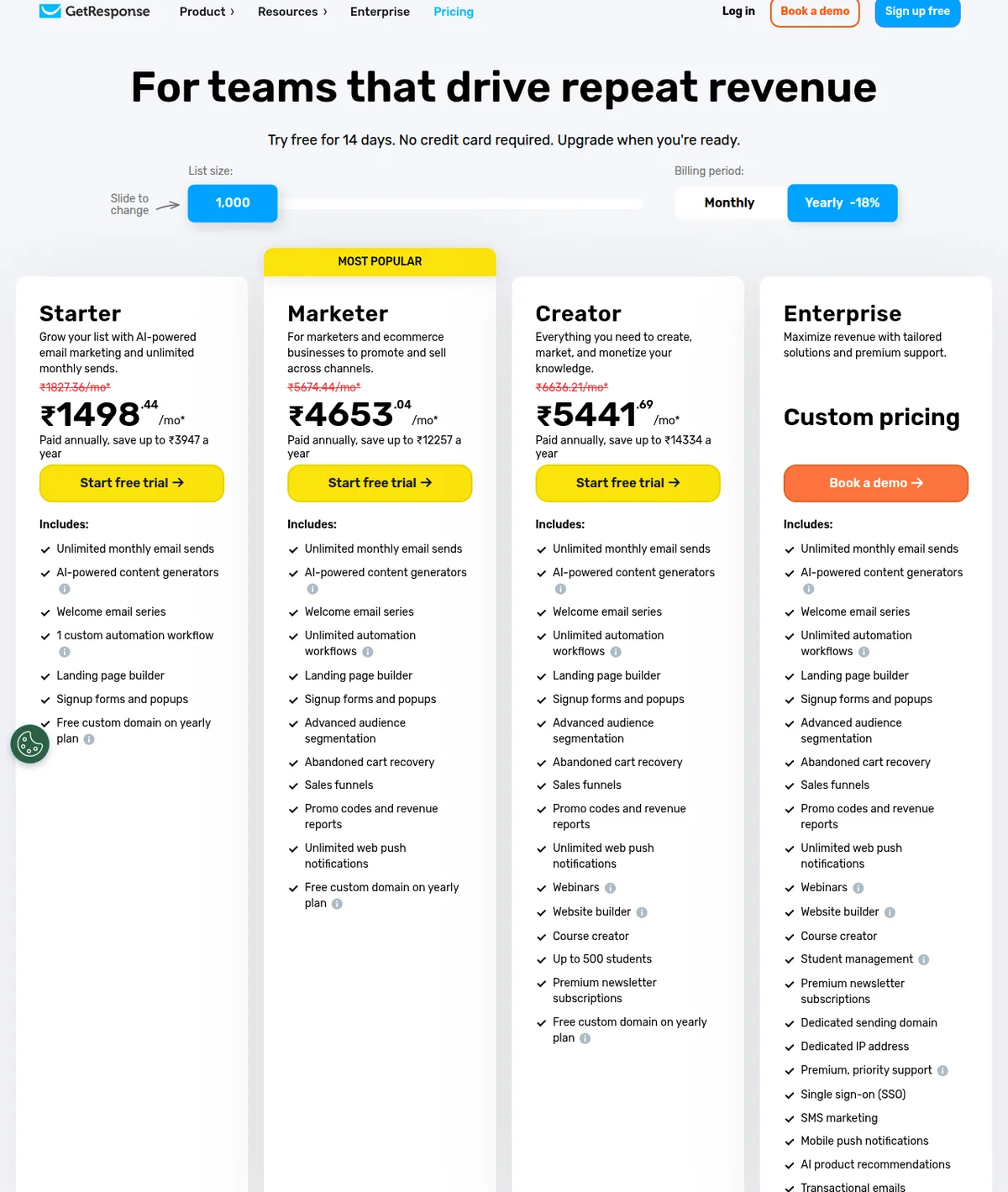
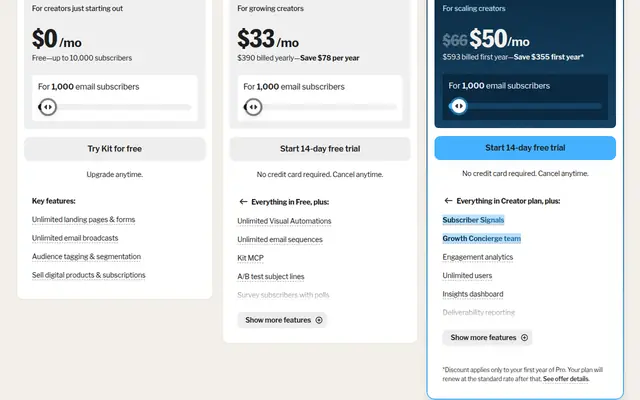
MailerLite's annual plans save 10%, taking Comfort from $12 to $10.80 a month and Power from $25 to $22.50 a month. Kit's annual plans save 17%, taking Creator to $390 billed yearly against $33 a month, a stated saving of $78 a year. Moosend offers 15% off on biannual billing and 20% off annually. Brevo applies a 10% discount to yearly billing and publishes its yearly prices as annual totals rather than monthly equivalents. GetResponse saves 18% on yearly billing at the Starter tier, where 2,500 contacts cost EUR 27 a month monthly and EUR 22.14 a month billed yearly.
A practice that wants no commitment can simply pay monthly on every one of these platforms, and the price of that freedom is the discount, which ranges from 10% to 20%. That is a real and quantifiable number, and it is the honest way to frame the decision: the question is not whether a contract exists, but whether a 10% to 20% saving is worth an annual term.
Two annual plans deserve a specific warning. MailerLite states that a switch from an annual plan to a monthly plan can be initiated but will not be effective until the annual plan has expired, so an annual MailerLite plan cannot be unpicked partway through. And Mailchimp's promotional terms note that additional terms apply to annual paid marketing plans, which is a signal to read the annual agreement rather than the monthly one before committing.
The refund window, and the one platform that publishes one
Refunds are where the eight platforms separate most clearly, and the separation is not the one a practice would guess.
Kit publishes a refund policy. A refund is available within the first 30 days of the date the account was signed up for, on either a monthly or an annual plan. Kit states that its team cancels the account and sends the refund immediately, and that the money takes three to five days to appear on a card. That is a genuine thirty-day exit window on an annual commitment, which no other platform in this comparison publishes.
Mailchimp states the opposite position explicitly. In its promotional terms, downgrading a monthly plan becomes effective at the end of the monthly billing period, and Mailchimp adds that no refund will be received for previously billed charges. Cancelling during a promotional period forfeits the offer immediately.
MailerLite requires the current billing cycle, monthly or annual, to end before a downgrade takes effect, and the lesser plan then starts at the next cycle. MailerLite publishes no refund window on its pricing page. EmailOctopus asks that auto-renew be cancelled before the next billing period, which is a cancellation instruction rather than a refund promise. GetResponse, Moosend, Brevo and AWeber publish trial periods rather than refund policies on the pages checked.
The practical conclusion is that in this category a refund is the exception. A practice that might need to reverse a decision inside a month should either choose the platform that publishes a thirty-day window or pay monthly and accept the loss of the annual discount.
Downgrade timing is the slowest part of leaving
Cancelling is fast on most of these platforms. Coming down a tier is not, and the difference catches practices that have grown and then cleaned their list.
Mailchimp is explicit: pausing a monthly plan or deleting the account takes effect immediately, while downgrading a monthly plan takes effect at the end of the monthly billing period. MailerLite's rule is the same shape, requiring the current cycle to end before the lesser plan starts. EmailOctopus asks for cancellation of auto-renew ahead of the next billing period. Moosend states that a downgrade takes effect at the end of the current billing cycle.
Kit is the sharpest case. Upgrades are automatic, and Kit states that when a plan's subscriber limit is passed the account moves to the next tier without skipping a beat. Downgrades are manual, and Kit states that its team has to downgrade plans by hand and that a practice which deletes subscribers should email support so the subscription can be adjusted. A list that spikes and settles therefore keeps paying the higher tier until someone asks.
For a practice with a bursty list, that asymmetry is the real cost of the arrangement. The upgrade arrives without being chosen and the downgrade requires a support request.
Promotional pricing is a contract in disguise
Mailchimp's introductory offers are the clearest example in this comparison of a discount that behaves like a term.
The 15% offer for 10,000 or more contacts applies to the monthly base price of Premium, Standard or Essentials for the first twelve months of service, and the discount also applies to purchases of add-on contact blocks. After twelve months the price moves to the then-current monthly list price based on contacts and email sends.
Three conditions turn that into a commitment. Cancelling during or before the end of the promotional period forfeits the offer immediately. Pausing the account does not pause the promotional period, which expires twelve months after it was originally applied regardless. And changing the marketing plan does not extend the period. Mailchimp also states that accounts are placed on hold if no valid payment method is on file after the promotional period ends.
The result is a monthly plan with no minimum term that nevertheless has a twelve-month horizon, because leaving early costs the discount and pausing does not stop the clock. A practice that wants a genuinely clean monthly arrangement should prefer a platform whose standard price is the standard price, or should treat the discounted first year as a fixed cost and budget the second year at list price from the outset.
Kit publishes a similar shape on its Pro plan, where a limited-time offer reduces the price to $50 a month and $593 for the first year, with the discount applying only to the first year and the plan renewing at the standard rate afterwards. Kit's own terms state that plainly, which makes it easier to plan around than a term buried in an offer page.
Free plans and trials, the genuinely zero-commitment options
If the requirement is genuinely no contract in any sense, including no card and no commitment, then the free plans and trials are the only options that meet it fully.
Kit offers a 14-day free trial on Creator and Pro with no credit card required to start. When the trial ends, a card is needed to continue on a paid plan, and the account can otherwise continue on the free plan. MailerLite also gives every new account 14 days of premium features with no card required, and states that when the period ends the premium features stop but no data, including subscribers, automations, forms and sites, is removed from the account. Moosend offers a 30-day trial. GetResponse offers a 14-day trial on its paid plans.
Beyond trials, two platforms offer a permanent free plan that requires nothing at all. Kit's free plan runs to 10,000 subscribers. EmailOctopus's free plan runs to 2,500 subscribers and 10,000 emails a month with no time limit.
What the free plan actually includes
Because the free plans are the only arrangements with no billing relationship at all, the detail matters.
Kit's free plan allows up to 10,000 subscribers at $0 and includes unlimited landing pages and forms, unlimited email broadcasts, audience tagging and segmentation, and the ability to sell digital products and subscriptions. There are no sending limits on any Kit plan. It excludes branding removal, automations, email sequences, integrations and priority support.
EmailOctopus's free plan allows 2,500 subscribers and 10,000 emails a month with no time limit and includes unlimited seats. It excludes branding removal and automation.
MailerLite's free plan allows 250 subscribers, 2,500 monthly emails and two user seats, and includes campaigns, automations, a landing page, one digital product or booking, signup forms, MCP access and more than 100 integrations. Exceeding 250 active subscribers locks sending for campaigns and automations until the account is upgraded or subscribers are removed, which is a harder stop than a billing change.
Mailchimp's free plan allows 250 contacts and 500 sends a month with one seat. Brevo's free plan is metered by daily sending rather than by subscribers. GetResponse's free plan allows 2,500 contacts with a monthly email ceiling and one automation workflow. AWeber's free plan allows 500 subscribers with a monthly send ceiling. Moosend has no permanent free plan at all, only the 30-day trial.
Promotional entry pricing behaves the same way on the platforms that are not in this comparison, and the Brevo alternatives for consultancies page records a first-year offer at Kit that reverts, alongside the standard price it sits next to. The distinction that matters for a no-contract requirement is what happens at the ceiling. Kit and EmailOctopus charge for the next tier when a threshold is passed. MailerLite and Mailchimp stop the account at the threshold. A practice that wants to remain genuinely uncommitted should prefer the first pattern, because passing a threshold then produces a price decision rather than an outage.
Our verdict
If no contract means no minimum term, then every platform in this comparison qualifies and the requirement can be dropped from the shortlist. The eight are all month-to-month on their standard paid plans, and none of them requires a notice period to leave.
If no contract means the exit is cheap and quick, the ranking changes. Kit is the strongest of the eight because it is the only platform that publishes a refund window, and that window covers annual plans as well as monthly ones, which makes a thirty-day trial of a yearly commitment possible. EmailOctopus is next, because its free plan runs permanently to 2,500 subscribers with unlimited seats and its paid plan asks only that auto-renew be cancelled before the next billing period.
If the priority is the lowest price with the fewest strings, paying monthly is the honest answer on every platform here, and the cost of that choice is a discount of between 10% and 20% that a practice declines in exchange for the freedom. On MailerLite that is $1.20 a month at the Comfort tier and $2.50 at Power. On Kit it is $78 a year at Creator. Those are the numbers to weigh against an annual term, and they are small enough that paying monthly is a defensible default for a practice whose client work is unpredictable.
The platform to be most careful with is Mailchimp, not because its terms are unusual but because its discount creates a twelve-month horizon on a monthly plan, and because it states plainly that no refund is given for charges already billed. A practice that takes the introductory rate should budget the second year at list price from the beginning.
Frequently asked questions
Is there email marketing software with no contract at all?
All eight platforms in this comparison bill monthly with no minimum term, so all of them qualify. Mailchimp states that accounts are charged monthly until cancelled. Kit advertises both paid plans as cancel anytime. MailerLite allows plan switches at any time. EmailOctopus asks only that auto-renew be cancelled before the next billing period. The commitment in this category is not a contract but an annual discount, worth between 10% and 20%.
Which email platform offers a refund if a practice cancels?
Kit is the only platform in this comparison that publishes a refund window. It offers a refund within the first 30 days of the date the account was signed up for, on either a monthly or an annual plan, and states that the refund is sent immediately and takes three to five days to appear on a card. Mailchimp states the opposite explicitly, saying that no refund is given for previously billed charges.
What does an annual email marketing plan actually lock?
It locks the price, not the account. On MailerLite, a switch from an annual plan to a monthly plan can be initiated but only takes effect once the annual plan has expired, so the term cannot be unpicked partway through. Mailchimp notes that additional terms apply to annual paid marketing plans. On Kit, GetResponse, Moosend, Brevo and AWeber the annual plan is a billing period rather than a term, and the discount is 10% to 20%.
Can a practice pause instead of cancelling?
Mailchimp allows a subscription to be paused or an account to be deleted at any time through Settings in the Account and Billing area, and pausing a monthly plan takes effect immediately. The important limitation is that pausing does not pause a promotional period, which expires twelve months after it was originally applied regardless of any pause. Pausing also does not extend the promotion if the marketing plan is changed.
How long does it take to downgrade a plan?
Downgrades are consistently slower than cancellations. Mailchimp makes a monthly downgrade effective at the end of the monthly billing period while pausing or deleting takes effect immediately. MailerLite requires the current cycle, monthly or annual, to end before the lesser plan starts. Moosend states that a downgrade takes effect at the end of the current billing cycle. Kit requires an email to support, because its team downgrades plans manually.
Which platforms have a free trial that needs no card?
Kit and MailerLite both offer 14 days with no credit card required. Kit's trial covers the Creator and Pro plans, and when it ends the account can continue on the free plan rather than converting to a paid one. MailerLite states that when its 14-day premium period ends, the premium features stop but no data is removed from the account. Moosend offers a 30-day trial and GetResponse a 14-day trial on its paid plans.
What is the difference between a free plan and a trial?
A trial is time-limited and a free plan is not. Kit's free plan runs to 10,000 subscribers at $0 with no time limit and no sending cap, and EmailOctopus's free plan allows 2,500 subscribers and 10,000 emails a month indefinitely. MailerLite's free plan allows 250 subscribers and stops sending when that is exceeded. Moosend has no permanent free plan at all, only a 30-day trial, which makes it the weakest fit for a practice that wants to stay uncommitted.
Get started with the tools in this guide
-
Start free with Kit (opens in a new tab)
Kit
Free plan up to 10,000 subscribers
-
Start free with MailerLite (opens in a new tab)
MailerLite
Free plan up to 250 subscribers
These links go to the vendor's own site. We may earn a commission if you sign up, at no extra cost to you. How we fund the site. Every figure in this guide was read from the vendor's pricing page on the date stamped above, so confirm the number before you commit.
Related guides
-
 Comparison
Email Marketing for Agencies
Kit vs GetResponse for Agencies
Kit and GetResponse compared on verified pricing, included user seats, and how each handles running campaigns for several clients from one account.
-
Email Marketing for Agencies
Email Marketing Software for Consultancies
The four features consultancies are told they need an enterprise plan for, and which platforms actually charge for them, checked against eight vendor pricing pages on 22 October 2026.
-
Email Marketing for Agencies
Low-Cost Email Marketing for Consultancies
A three-point cost model for consultancies at 500, 2,500 and 10,000 contacts, with the per-contact and per-email normalisation that contact-based pricing hides.