Email Marketing for Agencies
Email Tools for Multiple Client Accounts
Compare agency email marketing tools on client separation, seats, list pricing and the real cost of pooled or separate audiences.
Updated Verified against vendor pricing 10 October 2026
The short answer
MailerLite is the best email tool for multiple client accounts when an agency needs a published unlimited-seat tier at a visible price. Mailchimp is the runner-up for teams that need five seats on Standard or unlimited seats on Premium, while Kit and GetResponse leave important sub-account and account-separation figures unstated.
| If you need | Choose |
|---|---|
| A published unlimited-seat tier at a visible price | MailerLite Power |
| Five team members on a published paid plan | Mailchimp Standard |
| Unlimited users on a paid tier | Kit Pro or Mailchimp Premium |
| A low-cost 1,000-subscriber starting point in EUR | GetResponse Starter |
| A free plan with the largest stated subscriber ceiling | Kit Free |
- Unlimited-seat pick
- MailerLite Power
- Mailchimp Standard seats
- 5
- GetResponse Starter users
- 3
- Kit Pro users
- unlimited
Overview
MailerLite is the best email tool for multiple client accounts, with Mailchimp as the runner-up. MailerLite Power publishes unlimited user seats and visible list-size prices, making it the clearest fit when several staff members need access. Mailchimp is the more structured alternative, with five seats on Standard and unlimited seats on Premium, but its calculator separates a promotional 12-month price from the regular price and states that limits can trigger automatically billed overages.
This category is about separation as much as sending newsletters. An agency needs to know whether audiences can be kept apart, how many staff can log in, and whether a list is priced separately or pooled. The supplied evidence gives seat and contact figures, but it does not give a dedicated client sub-account allowance for any of the four tools. A seat count is therefore not a promise of separate client workspaces.
The guide compares each tool's plans, then covers pooled and separate-list scenarios, billing traps and when staying free is sensible. See the Email Marketing for Agencies hub, the Kit vs GetResponse guide for agencies, and the best email marketing platform for agencies.
How we chose
The criteria are client separation, published seats or users, list-size pricing, sending limits and the cost of a realistic small-agency setup. A pooled scenario means one audience at the stated size; a separate scenario multiplies the published price for an individual client list. This is budgeting arithmetic, not proof that the vendor permits that structure.
Every price was checked against the vendor's own pricing page on 2026-10-10. Figures remain in the currency and billing format recorded by the source. GetResponse served EUR in the verified session, with a separately recorded US Starter reference of $19/month for 1,000 subscribers. No currency is converted, and Mailchimp's “for 12 months” calculator values are not treated as permanent monthly rates.
Kit for multiple client accounts
Best for a free high subscriber ceiling Kit Pro is the only published unlimited-user tier
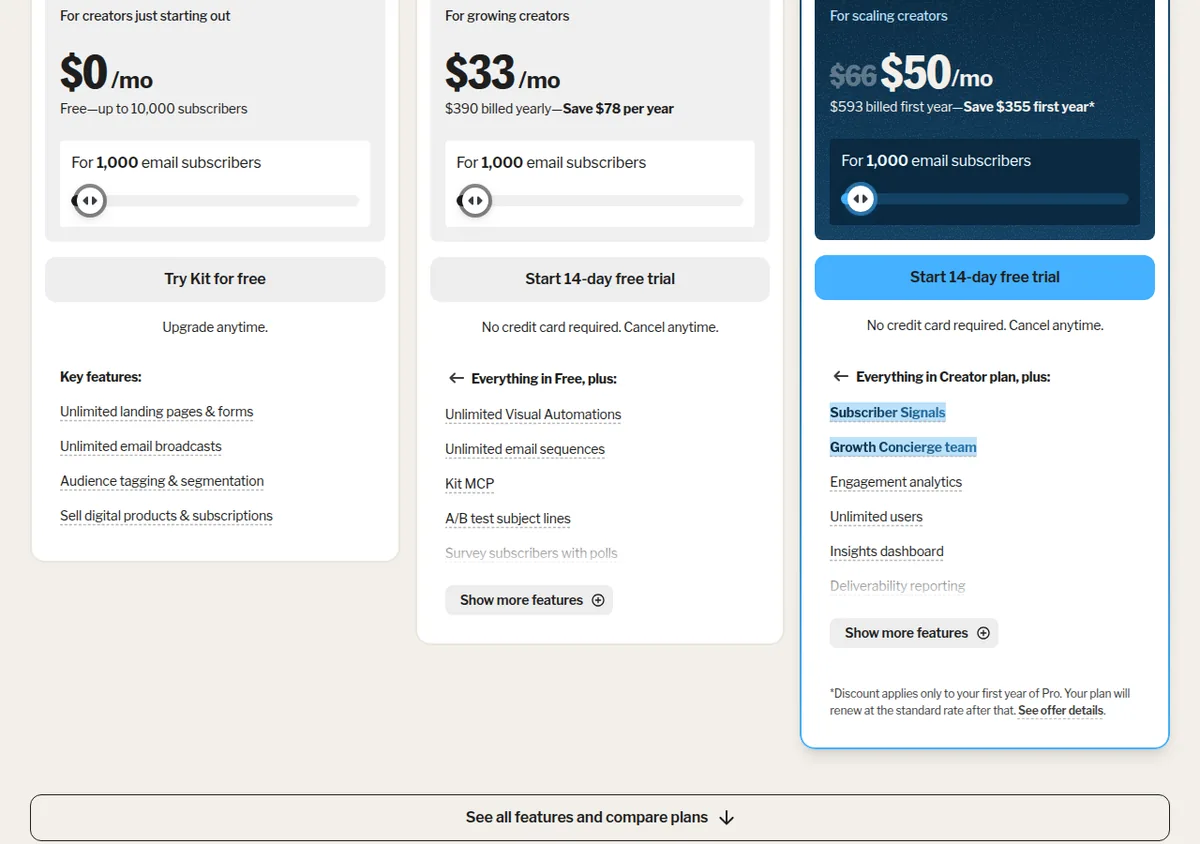
Kit suits an agency that wants tagging, segmentation, landing pages, forms and broadcasts. Free is $0 for up to 10,000 subscribers, with unlimited landing pages and forms, broadcasts, tagging and segmentation, and digital product sales. The supplied evidence does not say how client accounts are separated.
Creator is $33/month billed yearly, or $390/year, for 1,000 subscribers. It includes unlimited visual automations, unlimited sequences, A/B testing, removal of Kit branding, SMS marketing, integrations and 24/7 support. Pro is $66/month billed yearly, with a $50/month promotional price, also for 1,000 subscribers. It adds subscriber signals, engagement analytics, deliverability reporting and unlimited users.
Only Pro is published as including unlimited users. The verified notes say lower tiers should be treated as effectively single-user. Kit does not publish a client sub-account figure, a separate-workspace rule or whether separate client audiences can be priced inside one account. An agency should not infer those capabilities from the subscriber ceiling.
For a five-person studio with one 1,000-subscriber client, Creator is $33/month billed yearly, but the lower tier is effectively single-user. Pro is $66/month billed yearly and is the only published unlimited-user option. Five separate 1,000-subscriber Pro calculations total $330/month billed yearly, although the source does not state that Kit offers five client sub-accounts. One pooled 5,000-subscriber audience remains below Free's ceiling, but the source does not confirm that pooling suits distinct clients.
Kit's weakness for this brief is missing separation information. Pro solves the published team-access question, not the client-isolation question. Confirm the workspace model before putting client lists together.
GetResponse for multiple client accounts
Best for a list-priced 1,000-contact starting point in EUR GetResponse published user caps, but no sub-account figure
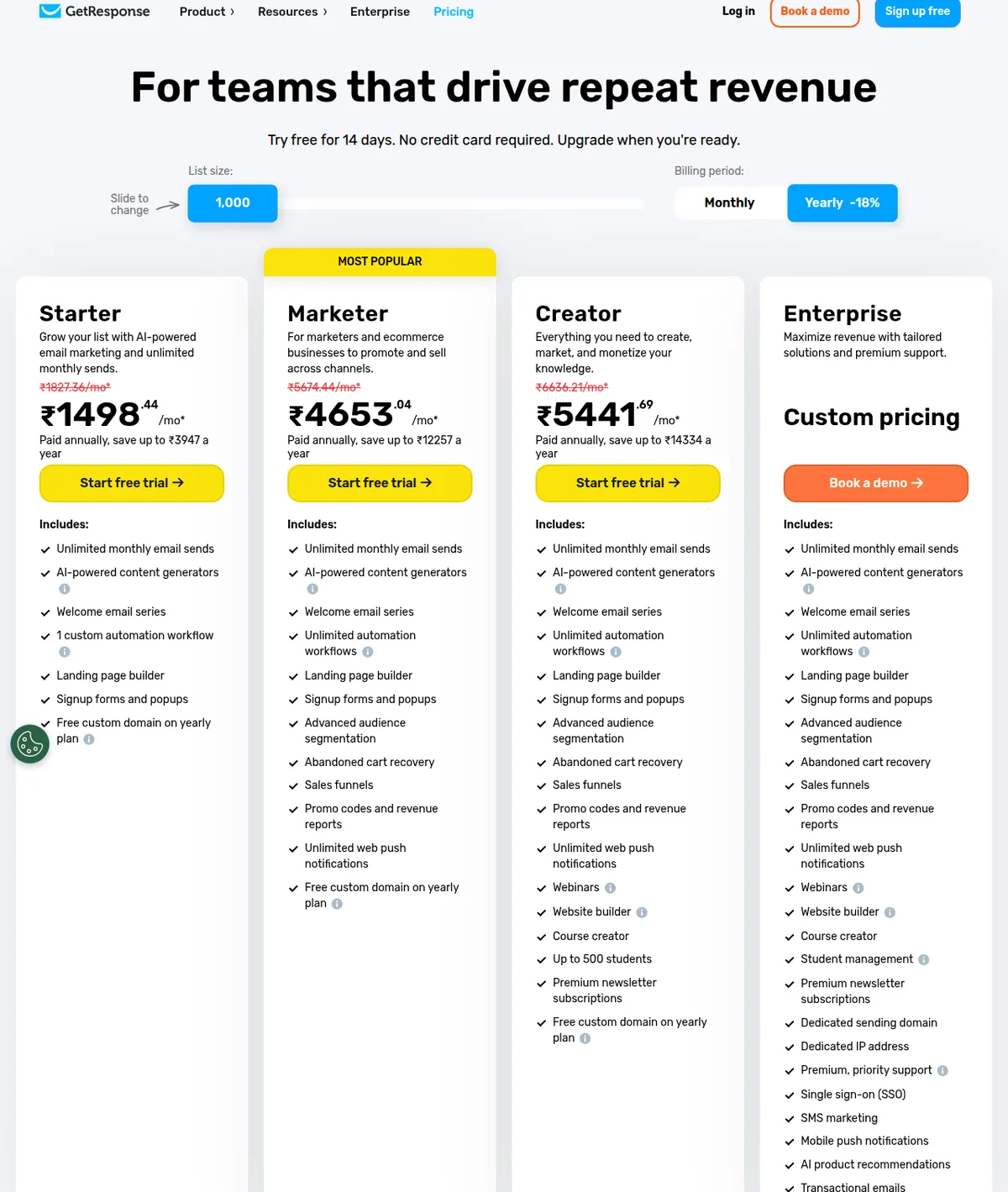
GetResponse is for an agency that wants contact-count pricing, automation, forms and landing pages. The page says prices scale by contact list size and shows local currency. The checked session served EUR, while the FAQ separately quotes $19/month for 1,000 subscribers for US Starter. Those references remain separate.
At 1,000 contacts, Starter costs €16/month monthly or €13.12/month billed yearly and includes 3 users, unlimited monthly sends, one automation workflow, AI tools limited to three uses, landing pages, forms and a free custom domain on yearly plans. Marketer costs €54/month monthly or €44.28/month yearly and allows up to 5 users. It adds unlimited automation workflows, sales funnels and abandoned cart recovery. Creator costs €62/month monthly or €50.84/month yearly, also with up to five users, and adds webinars for up to 100 attendees, a course builder for up to 500 students and paid newsletters. Enterprise is custom.
For a five-person studio with one 1,000-contact client, Marketer is the published five-user option at €54/month monthly or €44.28/month yearly. Starter is cheaper, but its three-user limit is explicit and the additional-user price is not stated. Five separate 1,000-contact Starter calculations total €80/month monthly or €65.60/month yearly. Five separate Marketer calculations total €270/month monthly or €221.40/month yearly.
The pooled 5,000-contact price is not stated, even though the page says pricing scales by list size. GetResponse also does not publish a client sub-account figure here. A lower separate-list calculation therefore does not prove that five clients can have five sub-accounts, and a pooled price cannot be invented. Ask for workspace, permissions and larger-list terms before treating the 1,000-contact price as a multi-client quote.
MailerLite for multiple client accounts
Best for an agency needing unlimited seats MailerLite Power publishes unlimited users and list-size prices
MailerLite is the clearest fit when several staff members need access and the team wants a visible seat rule. Free is $0/month for up to 250 subscribers, 2,500 monthly emails and 2 user seats. It includes campaigns, three automations, one website and landing page, one digital product or booking, three signup forms and community support.
Comfort starts at $12/month and publishes 3 user seats. At 1,000 active subscribers, it is $19/month monthly or $17.10/month as the billed-yearly annual equivalent. It includes 50 automations, up to 10 websites and landing pages combined, 10 signup forms, five digital products or bookings, and sending at 10 times the subscriber-tier ceiling each month. Additional-user pricing is not stated.
Power starts at $25/month and publishes unlimited user seats. At 1,000 active subscribers, it is $39/month monthly or $35.10/month annual equivalent. It includes unlimited monthly emails subject to fair use, unlimited automations, landing pages, signup forms and digital products or bookings, plus multiple automation triggers. Enterprise also publishes unlimited seats, but pricing is custom for 200K+ subscribers and prices at smaller requested sizes are not stated.
For a five-person studio with one 1,000-subscriber client, Power costs $39/month monthly or $35.10/month annual equivalent. Five separate 1,000-subscriber Power calculations total $195/month or $175.50/month annual equivalent. One pooled 5,000-subscriber Power audience is $69/month or $62.10/month annual equivalent. The source does not state that MailerLite offers client sub-accounts, so these are not a promise of account separation.
Comfort at 5,000 subscribers is $49/month monthly or $44.10/month annual equivalent, but its three-seat cap does not fit five staff. MailerLite says exceeding a paid subscriber tier moves the account to the next tier and Comfort's email limit can trigger an upgrade. No separate overage amount is stated. Confirm the workspace model before pooling clients.
Mailchimp for multiple client accounts
Best for established teams with five or unlimited seats Mailchimp Standard has 5 seats, Premium has unlimited seats
Mailchimp gives an agency a clear progression from a small fixed team to an unlimited-seat tier. Free is $0/month for up to 250 contacts, 500 sends per month, a 250-sends-per-day limit, 1 seat and 1 audience. Sending is paused if the contact or sending limit is exceeded, making Free a poor default for several client brands.
Essentials supports up to 50,000 contacts and publishes 3 seats, with a monthly sending cap of 10 times the contact limit. Standard supports up to 100,000 contacts and publishes 5 seats, with a 12-times cap. Standard adds expanded automation flows, advanced segmentation, custom-coded templates and multivariate testing. Premium supports up to 200,000 contacts and publishes unlimited seats, with a 15-times cap, up to 200 marketing automation flows, multivariate and A/B testing, phone and priority support, and personalized onboarding. Above 250,000 contacts, pricing is custom through Sales.
At 5,000 contacts, the calculator shows Standard at $50/mo for 12 months, then $100/month. Essentials is $37.50/mo for 12 months, then $75/month. Premium is $175/mo for 12 months, then $350/month. The “for 12 months” figures are a displayed promotion, not a permanent monthly rate.
For a five-person studio with one pooled 5,000-contact audience, Standard matches the published team size and costs $50/mo for 12 months, then $100/month. Five separate 1,000-contact Standard calculations are $112.50/mo for 12 months or $225/month at the displayed regular price. This shows why separate small plans can cost more, but the verified notes do not state that Mailchimp supplies client sub-accounts. Premium's unlimited seats do not prove client isolation either.
Mailchimp states that exceeding contact or sending limits results in automatically billed overages after the free trial, but no fixed overage amount is stated. Annual-plan availability and pricing are through Sales for Standard and Premium with 10,000 or more contacts. That makes a written quote important for a larger multi-client rollout.
Email pricing compared
The table compares the published prices and seat limits most relevant to a small agency. Prices remain in their source currencies and formats.
| Tool and plan | List size | Published price | Published seats or users |
|---|---|---|---|
| Kit Free | Up to 10,000 subscribers | $0 | Not stated as a seat count; lower paid tiers effectively single-user |
| Kit Pro | 1,000 subscribers | $66/month billed yearly; $50/month promotional | Unlimited users |
| GetResponse Starter | 1,000 contacts | €16/month; €13.12/month yearly | 3 users |
| GetResponse Marketer | 1,000 contacts | €54/month; €44.28/month yearly | Up to 5 users |
| MailerLite Power | 1,000 subscribers | $39/month; $35.10/month annual equivalent | Unlimited user seats |
| Mailchimp Standard | 5,000 contacts | $50/mo for 12 months; then $100/month | 5 seats |
| Mailchimp Premium | 25,000 contacts | $310/mo for 12 months; then $620/month | Unlimited seats |
GetResponse's pooled 5,000-contact price is not stated. Kit's source does not state a sub-account rule, and neither MailerLite nor Mailchimp states a dedicated allowance. This is not a claim that client audiences can share one login safely.
The seat and billing traps
A user seat is not a client account. It says how many people can log in, not how many separate audiences, permissions or billing records a vendor provides. MailerLite Power and Mailchimp Premium can therefore be recommended for unlimited team access while their client sub-account figures remain not stated. Kit Pro has unlimited users, but its sub-account figure is also not stated.
Do not budget the cheapest plan for the wrong headcount. MailerLite Comfort and Mailchimp Essentials publish three seats. GetResponse Starter publishes three users. Mailchimp Standard and GetResponse Marketer and Creator publish up to five, while Kit's lower tiers should be treated as effectively single-user. Additional-user pricing is not stated for MailerLite or Mailchimp in the files, and GetResponse's file does not state one either.
Pooled and separate lists also create different invoices. MailerLite Power at one pooled 5,000-subscriber audience is $69/month, while five separate 1,000-subscriber calculations total $195/month. Mailchimp Standard at 5,000 contacts is $100/month after its displayed promotion, while five separate 1,000-contact calculations total $225/month at the regular displayed price. The cheaper arithmetic may conflict with client ownership or access requirements.
Billing labels matter. GetResponse remains in EUR, and its separately recorded US Starter reference is $19/month, not a conversion. MailerLite's annual figures are annual-equivalent monthly prices, while Mailchimp's “for 12 months” figures are promotional.
Limits can change the invoice. MailerLite says exceeding a paid subscriber tier moves the account to the next tier and Comfort's email limit can trigger an upgrade. Mailchimp states that contact or sending limits create automatically billed overages, but the fixed amount is not stated. A pooled setup can cross a limit faster, while a separate setup can multiply plan charges.
Who should not buy this
Buy nothing yet if the agency cannot identify who owns each audience, approves a send and handles client access. A lower pooled price does not answer those governance questions.
Stay on Kit Free when one audience is under 10,000 subscribers and the team can work with the access terms actually stated. Stay on MailerLite Free or Mailchimp Free only when the small limits genuinely fit. MailerLite Free has 250 subscribers, 2,500 monthly emails and two seats. Mailchimp Free has 250 contacts, 500 monthly sends, one seat and one audience, and pauses sending when limits are exceeded.
Do not choose GetResponse Starter for five staff assuming extra users can be added at a known price. Do not choose MailerLite Comfort or Mailchimp Essentials for five staff when three seats are published. Do not pool client lists solely because the arithmetic is lower. Keep audiences separate, or obtain written confirmation of sub-accounts and permissions, when clients need distinct approvals or ownership.
Our verdict
Choose MailerLite Power when the deciding requirement is a published unlimited-seat tier with visible list-size prices. For 1,000 subscribers it is $39/month monthly or $35.10/month annual equivalent; for one pooled 5,000-subscriber audience it is $69/month or $62.10/month annual equivalent. Confirm client separation because the sub-account figure is not stated.
Choose Mailchimp Standard as runner-up when five seats are enough. At 5,000 contacts it shows $50/mo for 12 months, then $100/month. Choose Premium only when unlimited seats justify its higher contact-tier price. Kit Pro is the better Kit option when unlimited users matter, at $66/month billed yearly for the published 1,000-subscriber price. GetResponse Marketer is the five-user option at 1,000 contacts, at €54/month monthly or €44.28/month yearly, but its sub-account and larger pooled-list prices are not stated. The methodology explains why these gaps remain explicit.
Frequently asked questions
What is the best email tool for multiple client accounts?
MailerLite Power is the strongest published choice when an agency needs unlimited seats and visible list-size prices. Mailchimp Standard is the runner-up for five seats. None of the evidence states a dedicated client sub-account figure.
How much does MailerLite Power cost for several clients?
At 1,000 subscribers, Power is $39/month monthly or $35.10/month annual equivalent. Five separate 1,000-subscriber calculations total $195/month or $175.50/month annual equivalent, while one 5,000-subscriber audience is $69/month or $62.10/month annual equivalent. These are list-price calculations, not proof of the account structure.
Does Mailchimp have client sub-accounts?
The verified pricing evidence does not state a numerical Mailchimp client sub-account allowance. It states that Free has one audience and one seat, while Essentials, Standard and Premium have three, five and unlimited seats. Those figures describe team access, not a confirmed multi-client workspace.
Is pooled email list pricing cheaper than separate client lists?
It can be cheaper on the published arithmetic. MailerLite Power at one pooled 5,000-subscriber audience is $69/month, while five separate 1,000-subscriber calculations total $195/month. A lower pooled price does not establish separate ownership or permissions.
What is the cheapest GetResponse plan for a five-person agency?
At 1,000 contacts, Marketer is the listed plan that publishes up to five users. It costs €54/month monthly or €44.28/month yearly. Starter is €16/month or €13.12/month yearly but publishes three users, and the additional-user price is not stated.
Does Kit publish a client sub-account limit?
No client sub-account figure is stated in the supplied Kit pricing evidence. Kit Pro is $66/month billed yearly for 1,000 subscribers with unlimited users, but that is not a promise of separate client workspaces.
When should an agency keep client audiences separate?
Keep audiences separate when clients need distinct approvals, access, ownership or reporting and the vendor has not documented a shared structure. A pooled account may cost less, but it can combine contact counts and expose the team to a tier change or overage. If the pricing page does not state the sub-account rule, confirm it before migration.