Email Marketing for Agencies
MailerLite Review for Small Agencies
MailerLite review for small agencies with verified 2026 pricing, seat counts, send limits and how the free plan compares with Kit for client work.
Updated Verified against vendor pricing 14 October 2026
The short answer
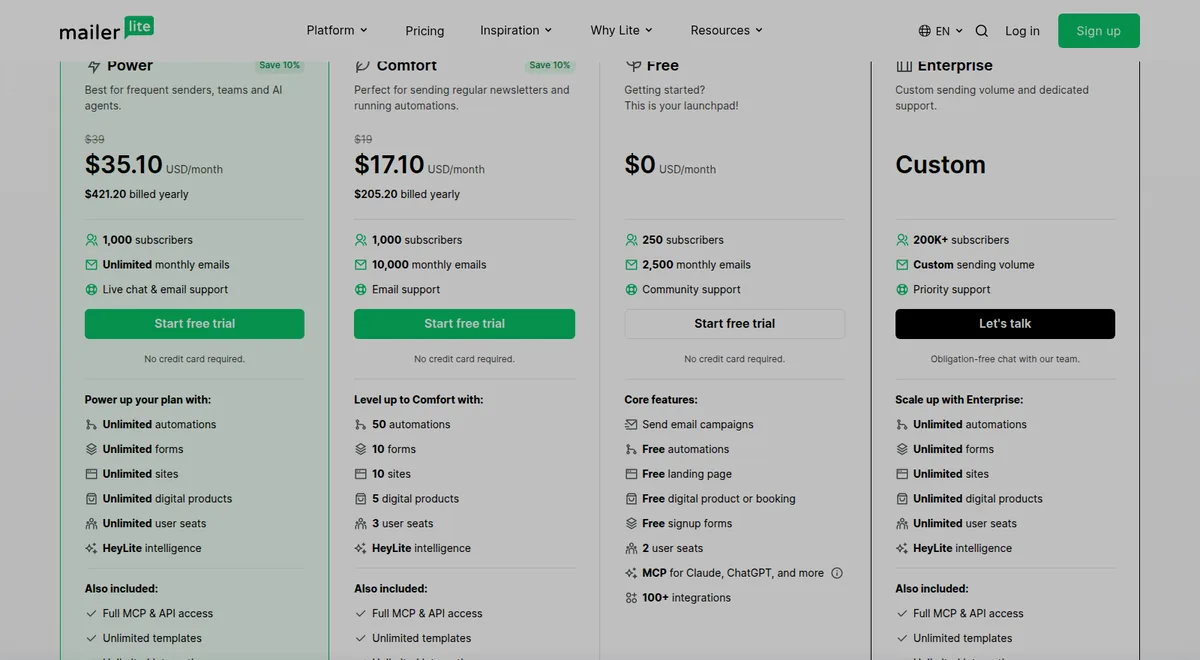
MailerLite is free for up to 250 subscribers with 2 seats. Comfort costs $19 per month on monthly billing or $17.10 on yearly billing at 1,000 subscribers, with 3 seats and 10,000 monthly emails. Power costs $39 monthly or $35.10 yearly and publishes unlimited emails and unlimited seats.
| If you need | Choose |
|---|---|
| A free list for a small newsletter | MailerLite Free, up to 250 subscribers and 2 seats (opens in a new tab) |
| One owned newsletter with automations | Comfort at $17.10 per month billed yearly, with 3 seats |
| A team that needs unlimited seats | Power at $35.10 per month billed yearly |
| Unlimited sending | Power, the only tier with unlimited monthly emails |
| More than 200,000 subscribers | Enterprise, quoted on request |
Start with the tools in this guide
-
Start free with MailerLite (opens in a new tab)
MailerLite
Free plan up to 250 subscribers
These links go to the vendor's own site. We may earn a commission if you sign up, at no extra cost to you. How we fund the site. Every figure in this guide was read from the vendor's pricing page on the date stamped above, so confirm the number before you commit.
- Power (yearly)
- $35.10/mo
- Power user seats
- Unlimited
- Comfort monthly emails
- 10,000
- Free subscriber cap
- 250
Overview
MailerLite is the cheapest paid tier in the email category for a small agency, and Power is the plan that matters. At 1,000 subscribers it costs $35.10 per month on yearly billing and publishes unlimited user seats, which is the single most useful fact for a team of five. The $17.10 Comfort tier is cheaper but caps seats at three and monthly email at 10,000, and those two limits are what push growing agencies upward.
The catch sits at the bottom of the ladder rather than the top. MailerLite Free covers only 250 subscribers, not the 10,000 that Kit gives away. An agency comparing the two free plans is not comparing like with like, and this is the most common mistake in this category.
This MailerLite review is written for small agencies, consultancies and in-house teams. Every price, subscriber limit, send allowance and seat count below was read from MailerLite's own pricing page on 2026-10-14, rendered with JavaScript so the figures are the vendor's live display rather than a static approximation. Comparison figures for Kit come from our Kit review.
For the wider category, see the Email Marketing for Agencies hub, Best email marketing platform for agencies and MailerLite vs Kit for agencies.
What MailerLite is
MailerLite is an email marketing platform covering campaigns, signup forms, landing pages, websites, automation and digital product sales. Its stated pitch is unusual in this category and worth quoting because it changes how the plans work: every paid plan gets the full feature set, and you pay more only for a bigger list or more sending.
That principle is visible in the pricing. Comfort and Power differ in audience capacity, send volume and seats rather than in features, so an agency does not lose functionality by choosing the cheaper tier. It only loses headroom.
Two product details matter for an agency. First, MailerLite publishes MCP access on every plan including Free, which means an AI assistant can work with the account without a paid upgrade. Second, the vendor runs a separate transactional product, MailerSend, for email that is not marketing, so an agency sending password resets or receipts is not forced into a marketing plan to do it.
MailerLite also publishes HeyLite intelligence from Comfort upward, and the vendor states that paid plans include custom user permissions, which is the feature an agency needs before letting a client into a workspace.
MailerLite pricing
All figures below are MailerLite's own display at 1,000 subscribers, which is the tier the vendor shows when the audience selector is set to that level. The Free plan is shown at its own 250-subscriber ceiling. Yearly billing carries a stated saving of 10 per cent, and the vendor's pricing page displays the struck-through monthly price beside the discounted one, so both figures are read directly rather than calculated.
| Plan | Monthly billing | Yearly billing, per month | Yearly total | Subscribers | Monthly emails | Seats |
|---|---|---|---|---|---|---|
| Free | $0 | $0 | $0 | 250 | 2,500 | 2 |
| Comfort | $19 | $17.10 | $205.20 | 1,000 | 10,000 | 3 |
| Power | $39 | $35.10 | $421.20 | 1,000 | Unlimited | Unlimited |
| Enterprise | Custom | Custom | Custom | 200,000+ | Custom | Unlimited |
Three features of this ladder decide the purchase.
Seats are the real dividing line. Free publishes 2 seats, Comfort publishes 3 and Power publishes unlimited. An agency that has grown past three people who need access cannot solve that on Comfort at any price, because the seat count is fixed by the plan rather than sold as an add-on. That single constraint makes Power the default tier for a team.
Comfort caps monthly sending at 10,000 emails. Power is the only tier with unlimited monthly emails. A 1,000-subscriber list receiving a weekly newsletter uses roughly 4,300 emails a month, which sits inside Comfort comfortably, but a weekly campaign plus an automation sequence plus a client-triggered send can approach the ceiling. The cap is generous for one owned newsletter and tight for several.
Every tier except Free includes the full automation allowance for its position. Comfort publishes 50 automations, 10 forms, 10 sites and 5 digital products. Power publishes unlimited automations, forms, sites, digital products and seats. Free publishes free automations, a free landing page, a free signup form allowance and a free digital product or booking, which is enough to test the platform rather than to run a business on.
The three plans that fit most small agencies
Best free starting point MailerLite Free, up to 250 subscribers and 2 seats
Best for one owned newsletter MailerLite Comfort at $17.10/month billed yearly
Best for a team needing unlimited seats MailerLite Power at $35.10/month billed yearly
Cost per client in the five-client scenario
MailerLite is a flat subscription rather than a per-seat charge, so the per-client figure is the plan price divided by five client websites. The scenario is the same one used across this site: five clients, one website each, one operator, yearly billing, no add-ons.
| Plan | Monthly total | Per client monthly |
|---|---|---|
| Free | $0.00 | $0.00 |
| Comfort | $17.10 | $3.42 |
| Power | $35.10 | $7.02 |
At $7.02 per client, Power is the cheapest way in this category to give a team unlimited seats. The comparison that matters is with Kit: Kit Creator is $39 standing monthly with 2 seats and Kit Pro is $79 standing monthly with unlimited seats. MailerLite Power is $35.10 per month on yearly billing for unlimited seats, which undercuts both.
The qualification is that MailerLite and Kit are not the same shape. Kit reaches 10,000 subscribers on its free plan and includes a newsletter referral system on Pro, which suits a publisher growing an owned audience. MailerLite's free plan reaches 250 subscribers and its paid tiers are cheaper with more seats, which suits an agency running a list rather than a publication. The full arithmetic across the category is in our email marketing guide.
Where MailerLite is strong
Unlimited seats at $35.10 per month is the best team price in this category. For an agency where four or five people need campaign access, the seat allowance alone decides the purchase.
The pricing model is unusually honest. The vendor states plainly that paid plans carry the full feature set and that the difference is list size and sending, so an agency comparing tiers is comparing capacity rather than hunting for a missing feature.
MCP access is included on every plan, including Free. An agency experimenting with AI-assisted campaign work does not have to pay to test whether the integration is useful.
The free plan is a real product, not a trial. It publishes 2 seats, free automations, a landing page, signup forms and a digital product allowance. The constraint is the 250-subscriber ceiling, not missing functionality.
Full API and MCP access, unlimited templates and unlimited integrations appear from Comfort upward, which means the cheap paid tier is not artificially hobbled.
Where MailerLite falls short
The free plan's 250-subscriber ceiling is the smallest in the mainstream category. Kit gives away 10,000 subscribers. An agency that wants a free home for a real list will not get one here, and this is the single biggest reason an agency chooses Kit over MailerLite at the start.
Seats cannot be bought individually. Three on Comfort or unlimited on Power is the whole choice, with no middle path. An agency of exactly four people has to pay for unlimited seats it does not yet need.
Comfort's 10,000 monthly email cap is easy to misjudge. It sounds generous until an agency runs a campaign plus an automation sequence plus a list of several thousand. Power removes the cap, so the honest guidance is to move up when sending is heavy rather than when the list is large.
Prices scale with audience, and the published figures are for one tier. MailerLite prices by subscriber count, so the figures above apply at 1,000 subscribers. An agency with 5,000 or 50,000 subscribers should read its own tier rather than scaling these numbers, because we have not verified those levels.
Custom user permissions are a paid feature. An agency that wants per-client permissions cannot get them on Free, which matters if the plan is to give a client visibility without giving it control.
How it compares with the alternatives
Against Kit, covered in our Kit review, the split is audience versus seats. Kit Free reaches 10,000 subscribers and MailerLite Free reaches 250, so Kit wins outright for a publisher starting out. Once the list is paid for, MailerLite Power at $35.10 per month with unlimited seats is cheaper than Kit Pro at $79 standing monthly, so MailerLite wins for a team. A direct comparison is in our MailerLite vs Kit guide.
Against GetResponse, the overlap is widest in automation. GetResponse publishes a Starter tier with a named user allowance and an automation workflow limit, and its free plan is generous in a different way. MailerLite's advantage is the unlimited seat allowance on Power at a lower monthly figure.
Against the wider category, the pattern is consistent. MailerLite is the low-cost option with the strongest team allowance, and it asks the agency to pay for audience capacity rather than for features. An agency that needs a client sub-account model, separate client billing or client-level permissions should check whether any of these platforms publishes it at all, because MailerLite's permitted files name custom user permissions but do not state a client sub-list allowance.
Our verdict
Start on Free only if the list is genuinely under 250 subscribers. It publishes 2 seats and real functionality, so it is a fair test, but it is not a home for a growing list and it should not be chosen by an agency that expects to pass 250 within a year.
Buy Comfort at $17.10 per month billed yearly for one owned newsletter. It publishes 3 seats, 50 automations, 10 forms, 10 sites, 5 digital products and a 10,000 monthly email allowance, which covers a weekly campaign to 1,000 subscribers several times over. At $3.42 per client across five clients it is the cheapest paid tier in the category.
Buy Power at $35.10 per month billed yearly the moment three seats is not enough. Unlimited seats, unlimited monthly emails and unlimited automations make it the correct tier for a team, and $7.02 per client across five clients is still the best team price we have verified in this category.
Do not buy Power for the list size alone. If the agency is a single operator with 1,000 subscribers sending one campaign a week, Comfort does the same job for less. Power solves seats and sending volume, not audience capacity.
Do not assume MailerLite can separate client lists. The vendor publishes custom user permissions from Comfort upward, but its permitted pricing files do not state a client sub-account allowance or separate client billing. An agency planning one workspace per client must confirm that with the vendor before committing.
The figures behind this review are recorded in our pricing research, and the verification standard is in the methodology.
Frequently asked questions
How much does MailerLite cost?
MailerLite publishes a free plan at $0 for up to 250 subscribers and 2 seats, Comfort at $19 per month on monthly billing or $17.10 on yearly billing at 1,000 subscribers, and Power at $39 per month or $35.10 on yearly billing at the same tier. Enterprise is quoted on request. Yearly billing carries a stated saving of 10 per cent.
Is MailerLite free?
Yes, and the free plan is a real product rather than a trial, but its ceiling is 250 subscribers with 2,500 monthly emails and 2 user seats. It includes free automations, a free landing page, free signup forms and a free digital product or booking. An agency with a commercial list will pass 250 subscribers quickly, which is the main reason to compare the free plans in this category carefully.
How many seats does MailerLite include?
Free includes 2 seats, Comfort includes 3 seats and Power includes unlimited seats. Enterprise also publishes unlimited seats. Seats are fixed by the plan rather than sold individually, so a team of four needs Power.
What is the difference between MailerLite Comfort and Power?
Comfort publishes 3 seats, 10,000 monthly emails, 50 automations, 10 forms, 10 sites and 5 digital products. Power publishes unlimited seats, unlimited monthly emails, unlimited automations, unlimited forms, unlimited sites and unlimited digital products, and adds live chat support. The upgrade solves team access and sending volume rather than feature access, because both tiers carry the full feature set.
Does MailerLite have a sending limit?
Yes, and it differs by plan. Free allows 2,500 monthly emails, Comfort allows 10,000 and Power is the only tier with unlimited monthly emails. A weekly campaign to 1,000 subscribers uses roughly 4,300 emails a month, so Comfort is comfortable for one newsletter and tight once automation sequences and additional campaigns are added.
Does MailerLite support AI assistants?
Yes. MailerLite publishes MCP access on every plan including Free, which allows an assistant such as Claude or ChatGPT to work with the account. Paid plans list full MCP and API access, alongside unlimited templates and unlimited integrations.
Is MailerLite good for agencies?
It is strong where a team needs shared access on a low budget. Power at $35.10 per month on yearly billing publishes unlimited seats, unlimited sending and unlimited automations, which is $7.02 per client across five clients and undercuts the equivalent tier at Kit. It is weaker where an agency needs separate client workspaces or client-level billing, because MailerLite publishes custom user permissions but does not state a client sub-account allowance in its pricing files.
Does MailerLite cost more as the list grows?
Yes. MailerLite prices by subscriber count, so the figures in this review apply specifically at 1,000 subscribers. The vendor's pricing page lets an agency set its own audience level and shows the matching price, and its stated model is that paid plans carry the full feature set with the cost rising for a bigger list or more sending. We have verified the 1,000-subscriber tier only, so larger tiers should be read from the vendor directly.
Start with the tools in this guide
-
Start free with MailerLite (opens in a new tab)
MailerLite
Free plan up to 250 subscribers
These links go to the vendor's own site. We may earn a commission if you sign up, at no extra cost to you. How we fund the site. Every figure in this guide was read from the vendor's pricing page on the date stamped above, so confirm the number before you commit.