CRM for Agencies and Consultancies · Updated 19 October 2026
Is CRM Worth It for a Small Agency?
A break-even checklist for agencies of 2 to 20 people, with the arithmetic, the verified seat prices, and the cases where a CRM is genuinely not worth buying.
- 11 min read
- is crm worth it for a small agency
- Verified against vendor pricing
The short answer
A CRM is worth it for a small agency when the cost of one seat is less than the value of the work it stops falling through. The arithmetic is the seat price multiplied by headcount against the hours of rework, missed follow-ups and duplicated admin it prevents. At the cheapest verified seat price of $7 per user a month, a three-person agency pays $252 a year, which is a low bar to clear.
| Your situation | Where to start |
|---|---|
| Two people, fewer than 50 live opportunities | HubSpot free tier (opens in a new tab) |
| Three to five people, work won in conversation | Zoho Bigin Express |
| Five to ten people, more than one person touching a client | Pipedrive Lite (opens in a new tab) |
| Ten to twenty people, several concurrent projects | monday CRM Standard |
| Solo operator with a stable client list | No CRM |
| Agency whose problem is lead generation, not follow-up | No CRM |
| Agency that will not maintain the data | No CRM |
Get started with the tools in this guide
Where a vendor offers a free plan or a free trial, it is stated below, so you can try the tool before you pay for it.
-
Start free with HubSpot (opens in a new tab)
HubSpot
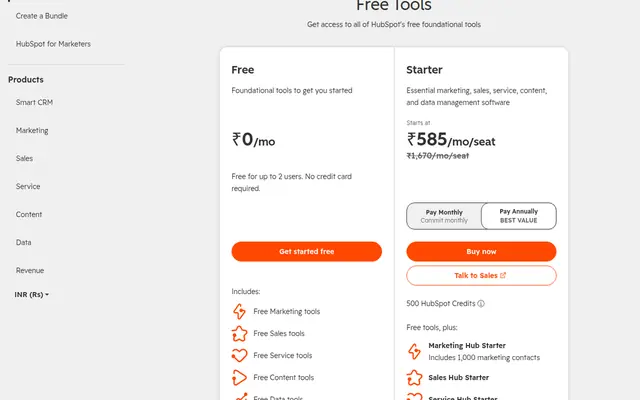
Free CRM for up to 2 users and 1,000 contacts, with no expiry
-
Start a free Pipedrive trial (opens in a new tab)
Pipedrive
14-day free trial, no card required
These links go to the vendor's own site. We may earn a commission if you sign up, at no extra cost to you. How we fund the site. Every figure in this guide was read from the vendor's pricing page on the date stamped above, so confirm the number before you commit.
- Cheapest paid seat
- $7/mo
- 3-person annual cost
- $252/yr
- 10-person annual cost
- $840/yr
- Checked
- 19 October 2026
Overview
The question is usually asked after a bad month. A proposal went unanswered for nine days, a client was surprised by an invoice, or two people chased the same lead. That is when an agency starts looking at CRMs, and that is also when it is most likely to buy the wrong thing for the wrong reason.
The question of is CRM worth it for a small agency has a different answer at three people than at twenty, and the difference is arithmetic rather than features. The honest answer is that a CRM is worth it for most agencies above about three people, and not worth it for reasons that have nothing to do with the software. This guide sets out the break-even arithmetic so an agency can run its own numbers, the four jobs a CRM actually changes, and the cases where the answer is genuinely no.
Every price below was read from the vendor's own pricing page on 19 October 2026. The wider comparison of what each one costs once add-ons are included is in the cheap CRM comparison, and the charges that sit outside the plan price are in CRM software hidden fees.
What a CRM actually changes
A CRM does four jobs for an agency. Only the first is the one people buy it for.
It holds the pipeline in one place. Before a CRM, the pipeline exists in three inboxes and one person's memory. The practical effect is that nobody can answer how much work is genuinely in play this month, which makes hiring, capacity and cash-flow decisions guesswork.
It makes the next action someone's responsibility. A deal with a next action and an owner is a different object from a deal that is "in progress". Most agencies that adopt a CRM report the value arriving here rather than in reporting.
It keeps the client history attached to the client. When one person leaves or goes on holiday, the account does not go dark. For an agency where two or three people touch every client, this is the difference between a handover and a rebuild.
It produces a record of what was agreed. Proposals, calls and change requests sit against the account rather than in a folder. This matters most in disputes, which are rare and expensive.
None of those four is about selling more. A CRM is a record-keeping and accountability tool, and an agency whose problem is that it cannot find enough clients will not solve that by buying one.
The break-even arithmetic
The calculation has two sides and only one of them is a published number.
The cost side is straightforward. Take the seat price, multiply by headcount, multiply by twelve. Then add any add-on the workflow needs, because a CRM bought for pipeline visibility but used for quoting will need the quoting add-on. Verified annual costs at the entry paid tier are below.
The benefit side has to come from the agency's own numbers. The honest way to build it is to estimate two figures: the average value of a piece of work the agency wins, and the number of pieces of work it loses or delays each year for reasons that are administrative rather than commercial. A lost proposal is not lost because the client said no, it is lost because nobody followed up.
| Headcount | Bigin Express at $7 | Freshsales Growth at $9 | monday Basic at $12 | Pipedrive Lite at $14 | Less Annoying at $15 |
|---|---|---|---|---|---|
| 2 | $168 | $216 | $288 | $336 | $360 |
| 3 | $252 | $324 | $432 | $504 | $540 |
| 5 | $420 | $540 | $720 | $840 | $900 |
| 10 | $840 | $1,080 | $1,440 | $1,680 | $1,800 |
| 20 | $1,680 | $2,160 | $2,880 | $3,360 | $3,600 |
Annual cost at the entry paid tier, per seat per month billed annually, at the prices verified on 19 October 2026. Zoho Bigin's free edition is capped at one user and monday CRM requires a minimum of three seats, so the two-person column is indicative for those products.
The comparison that matters is the bottom line against the value of one piece of work. A five-person agency on Pipedrive Lite pays $840 a year. If recovering a single delayed proposal is worth more than that, the CRM pays for itself on one event, and everything after it is margin. That is the test, and it is why the break-even point is usually lower than an agency expects.
Break-even by headcount
Two people. This is the hardest case to justify, because HubSpot's free tier is a real working tool for up to two users at $0. There is no break-even to calculate when the cost is nothing. The decision is not whether a CRM is worth it, it is whether the free tier's limits are tolerable.
Three to five people. This is where paid becomes defensible. A three-person agency on Bigin Express pays $252 a year, or $420 on Pipedrive Lite at five people. Against that, the failure mode is a proposal nobody chased. The arithmetic usually clears comfortably, and the risk is not the subscription, it is choosing a tier that forces an upgrade in month two.
Five to ten people. At this size, more than one person touches every client, and the cost of not having a shared record rises sharply. The bill is under $100 a month on every entry tier in the table. The question stops being whether a CRM is worth it and becomes which one, which is a different problem covered in what an agency should pay for a CRM. If the agency is already on a product it wants to leave, the CRM alternatives guide is the next step.
Ten to twenty people. Here the tier matters more than the vendor. monday CRM Basic allows 1,000 active contacts and deals, which a ten-person agency with a few years of history will exceed, pushing the real cost to Standard at $17 a seat. An agency at this size should price the tier it will be on in twelve months rather than the one it starts on.
The four costs people forget
The break-even calculation is wrong if it uses the advertised seat price alone.
The first is add-ons. Pipedrive prices its add-ons per company, starting at $13.33 a month for Campaigns, $16.66 for Projects and $32.50 for LeadBooster. Freshsales prices its two published add-ons per user, at $19 per user per month and $49 per 100 AI sessions. On a five-person team, one per-user add-on can cost more than the plan.
The second is capacity. Contact and record ceilings are not features, they are a scheduled price increase. monday CRM Basic caps at 1,000 active contacts, Zoho Bigin's free edition at 500 records, and HubSpot's credit allowance expires monthly with top-ups at $10 per 1,000.
The third is the migration and setup effort. Some of that is time rather than money, but not all of it: Insightly publishes a required $3,000 technical setup fee and $1,500 onboarding charge on its All-in-One bundles, which is a reminder to ask what is required before signing.
The fourth is the cost of the data. A CRM returns nothing until it holds something worth reading. The first two months of an adoption are usually unpaid admin, and an agency that has not budgeted for that will judge the software on the period when it was least useful.
When a CRM is not worth it
There are four honest cases for not buying one.
The problem is lead generation. A CRM does not create demand. An agency with a full pipeline and poor follow-up needs a CRM. An agency with an empty pipeline needs marketing, referrals or outbound, and a CRM will only document the emptiness more efficiently.
The client list is small and stable. A solo consultant with eight long-running clients and a calendar can run the entire relationship from a well-organised email account. The CRM would be a second place to maintain the same information.
Nobody will own the data. A CRM is maintained or it is worthless. If the agency cannot name the person who will enter a deal at the point it is agreed, the software will be accurate for three weeks and then become a historical record nobody trusts.
The agency wants reporting before it wants discipline. Dashboards are the least valuable part of a CRM for a small agency, and buying for reporting tends to produce a more expensive plan that fewer people use. Reporting becomes useful after the pipeline is real, not before.
What the free plans actually include
Two of the products in the table publish a permanent free tier, and both are limited in ways that decide the answer for very small agencies.
| Product | Free tier limit | What it allows | Where it stops |
|---|---|---|---|
| HubSpot | Up to 2 users | Full free CRM tools across sales, marketing and service | The third user requires a paid seat at $7 a seat a month annually |
| Zoho Bigin | 1 user only | 500 records, 1 pipeline, 3 automations | A second user requires a paid plan at $7 per user a month |
| Pipedrive | None | 14-day trial, no credit card | The account is not free after the trial |
| Freshsales | None | 21-day trial | No free tier is published |
| monday CRM | None | 14-day trial | Plans start from three users |
| Less Annoying CRM | None | 30-day trial, no credit card | No free tier is published |
| Insightly | None | 14-day trial, no credit card | No free tier is published |
The distinction that decides the two-person case is that HubSpot's free tier is permanent and Bigin's is capped at one user. A two-person agency can therefore run indefinitely at $0 on HubSpot, while a two-person agency on Bigin pays from day one. That is the single largest difference in this table, and it is the reason the two-person verdict above is marginal rather than a clear yes. The wider set of free options is covered in the free CRM options for consultants.
Best break-even at any size Zoho Bigin Express $7 per user a month billed yearly, no user limit on paid plans
Best for a two-person agency HubSpot free tier $0 for up to 2 users, so there is no cost to break even against
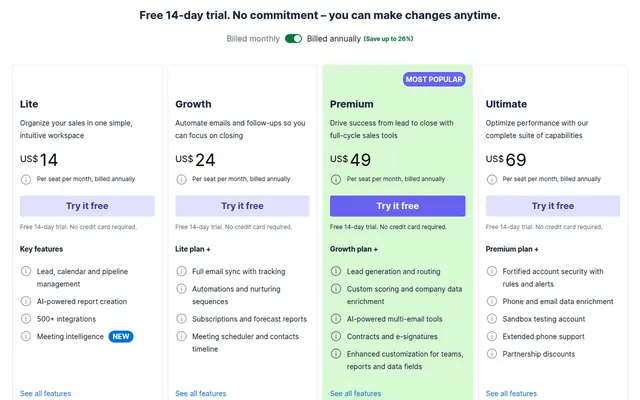
Best if the agency would buy add-ons anyway Pipedrive Lite $14 a seat with add-ons billed per company rather than per seat
Best for cost predictability Less Annoying CRM $15 per user a month includes everything, so the bill cannot grow
Not worth buying if The pipeline is empty A CRM records demand, it does not create it
A checklist before you buy
Work through these in order and the answer usually becomes obvious.
Write down how many live opportunities the agency has today, and where that number currently lives. If it is under twenty and one person holds it in their head, the case for a CRM is weak.
Name the specific failure the CRM is meant to prevent, and the last time it happened. A CRM bought against a named, dated failure gets adopted. One bought against a general feeling does not.
Multiply the seat price by headcount and add every add-on the workflow needs. Then compare that annual figure with the value of one piece of work.
Check the contact or record ceiling and estimate when the agency will hit it. If it is within twelve months, price the tier above.
Decide who owns the data and when they enter it. If the answer is vague, fix that first, because the subscription will not fix it.
Our verdict
A CRM is worth it for most small agencies above three people, and the arithmetic is usually less close than the agency expects. At the cheapest verified seat price of $7 per user a month, a three-person agency commits $252 a year, and the decision turns on whether one recovered piece of work is worth more than that.
It is not worth it for a solo operator with a stable client list, for an agency whose actual problem is finding clients, or for an agency that cannot name who will keep the data accurate. In those cases the free tier is the right answer if any answer is needed at all, and the honest conclusion is that the subscription would be a cost with no return.
The mistake to avoid is treating the decision as settled by the software's feature list. The break-even is decided by the agency's own numbers, and the only figures a vendor can give you are the ones on the cost side.
Frequently asked questions
Is CRM software worth it for a small agency?
For most agencies above three people, yes, because the annual cost at the entry paid tier is between $252 and $1,800 depending on headcount, and the failure it prevents is a piece of work lost to administrative drift. For a solo operator with a stable client list, or an agency whose real problem is lead generation, the answer is usually no.
At what size does an agency need a CRM?
The practical threshold is where more than one person touches the same client. That is usually around three people. Below that, a shared inbox and a calendar can hold the same information. Above it, the cost of not having a shared record rises faster than the subscription.
How do I calculate whether a CRM pays for itself?
Multiply the seat price by headcount and by twelve, then add any required add-ons. Compare that annual figure with the value of one piece of work. If recovering a single delayed proposal is worth more than the annual subscription, the CRM clears its break-even on one event.
Is the free version of a CRM enough for a small agency?
HubSpot's free tier is a working CRM for up to two users and costs nothing, which is enough for a two-person agency. Zoho Bigin's free edition allows a single user with 500 records. Five of the seven products compared here publish no permanent free tier, only a time-limited trial.
What is the cheapest CRM for a three-person agency?
Zoho Bigin Express at $7 per user per month billed yearly costs $252 a year for three users and has no user limit on paid plans. HubSpot's free tier covers two users at no cost but the third user requires a paid seat at $7 a seat per month billed annually.
When is a CRM not worth buying?
Four cases: the agency's problem is finding clients rather than managing them, the client list is small and stable enough for a shared inbox, nobody will own keeping the data accurate, or the agency is buying for reporting before the pipeline is real. In each case the subscription is a cost with no return.
Does a CRM make an agency more profitable?
Not by itself. It changes what the agency can see and who is responsible for the next action. Profitability follows from acting on that, which is why the four jobs a CRM does are all about visibility and accountability rather than selling. An agency that buys one and does not change its habits has bought a record of the old habits.
Should a small agency buy a CRM before or after hiring?
After, in most cases. The value of a CRM comes from coordination between people, so a two-person agency gets less from it than a five-person one at the same price per seat. Buying at three people, when a third person starts touching client records, matches the cost to the point where the benefit appears.
For a one-person business the break-even is faster than it is for a team, because the seat rate is paid once. The bands from $0 to $20 are compared in the freelancer CRM bands.
Get started with the tools in this guide
-
Start free with HubSpot (opens in a new tab)
HubSpot
Free CRM for up to 2 users and 1,000 contacts, with no expiry
-
Start a free Pipedrive trial (opens in a new tab)
Pipedrive
14-day free trial, no card required
These links go to the vendor's own site. We may earn a commission if you sign up, at no extra cost to you. How we fund the site. Every figure in this guide was read from the vendor's pricing page on the date stamped above, so confirm the number before you commit.
Related guides
-
 Best overall
CRM for Small Agencies
Best CRM for Design Studios
CRM options for design studios compared on verified seat pricing and setup effort, including which free tiers actually hold up for a small team.
-
 Free tier
CRM for Small Agencies
Best Free CRM for Consultants
Which free CRM plans hold up for a consultant, what each one actually limits, and the point where a free tier starts costing you time.
-
CRM for Small Agencies
Best CRM for Small Marketing Agencies
A verified comparison of five CRMs for small marketing agencies, focused on proposals, retainers, referrals, adoption speed and the real per-seat bill.