Email Marketing for Agencies
Mailchimp Alternatives for Agencies
Compare Kit, MailerLite and GetResponse for agency access, verified costs, list limits and a safer move away from Mailchimp.
Updated Verified against vendor pricing 11 October 2026
The short answer
MailerLite Power is the best default Mailchimp alternative for an agency that needs several staff in one workspace, while Kit is the better destination for one owned audience and a solo operator. GetResponse is a sensible three-person option at 1,000 contacts, but larger-list pricing is not stated in the verified material.
| If you need | Choose |
|---|---|
| Several staff in one agency workspace | MailerLite Power (opens in a new tab) |
| One owned audience with one operator | Kit Free (opens in a new tab) |
| Two people and paid automation | Kit Creator (opens in a new tab) |
| Three users at 1,000 contacts | GetResponse Starter (opens in a new tab) |
| A cautious move from Mailchimp | Audit access and automation logic first |
Check current pricing at the source
- Check current Kit pricing (opens in a new tab)
- Check current GetResponse pricing (opens in a new tab)
- Check current MailerLite pricing (opens in a new tab)
Every figure in this guide was read from the vendor's own pricing page on the date stamped above. Vendors change plans without notice, so confirm the number before you commit.
- MailerLite Power at 1k
- $39 monthly
- Kit Free subscriber cap
- 10,000
- MailerLite Free subscriber cap
- 250
- GetResponse Starter
- €16 monthly
Overview
MailerLite Power is the best default among these Mailchimp alternatives for an agency that needs several people to work in one account. It publishes unlimited seats and a clear $39 monthly price at 1,000 subscribers. Kit is the runner-up for an agency sending on behalf of its own business: Free reaches 10,000 subscribers at $0, but the verified Free allowance is for 1 user, so it is not a confirmed team workspace.
This guide compares the three destinations by subscriber tiers, real monthly cost, named features, user access and the limits that become expensive after a switch. Mailchimp's free plan is included as a reference point, but its standing paid prices could not be verified. Its own pricing page advertises time-limited introductory offers without displaying a standing price in a form that could be checked, so a headline promotional figure must never be treated as the real cost.
See the Email Marketing for Agencies hub, the best email marketing platform for agencies and Kit vs GetResponse for agencies for adjacent comparisons. The short answer is MailerLite Power for collaborative agency work, Kit for one owned publication, and GetResponse when a named three-user starting plan is the immediate need.
How we chose
Every price was checked against the vendor's own pricing page on 10 October 2026. Prices remain in the currency and billing label shown by the vendor. Where a larger list price, extra-user charge or client-account rule is not stated, it is left open rather than estimated.
Mailchimp is handled more narrowly. The verified free tier is $0 for up to 250 contacts, 1 seat and 500 sends per month, with a 250-sends-per-day limit. No paid Mailchimp price is published because the interactive page exposed promotional offers but not a standing paid price that could be verified.
Kit
Best for an agency's own audience Kit Free reaches 10,000 subscribers, but only Pro is published with unlimited users
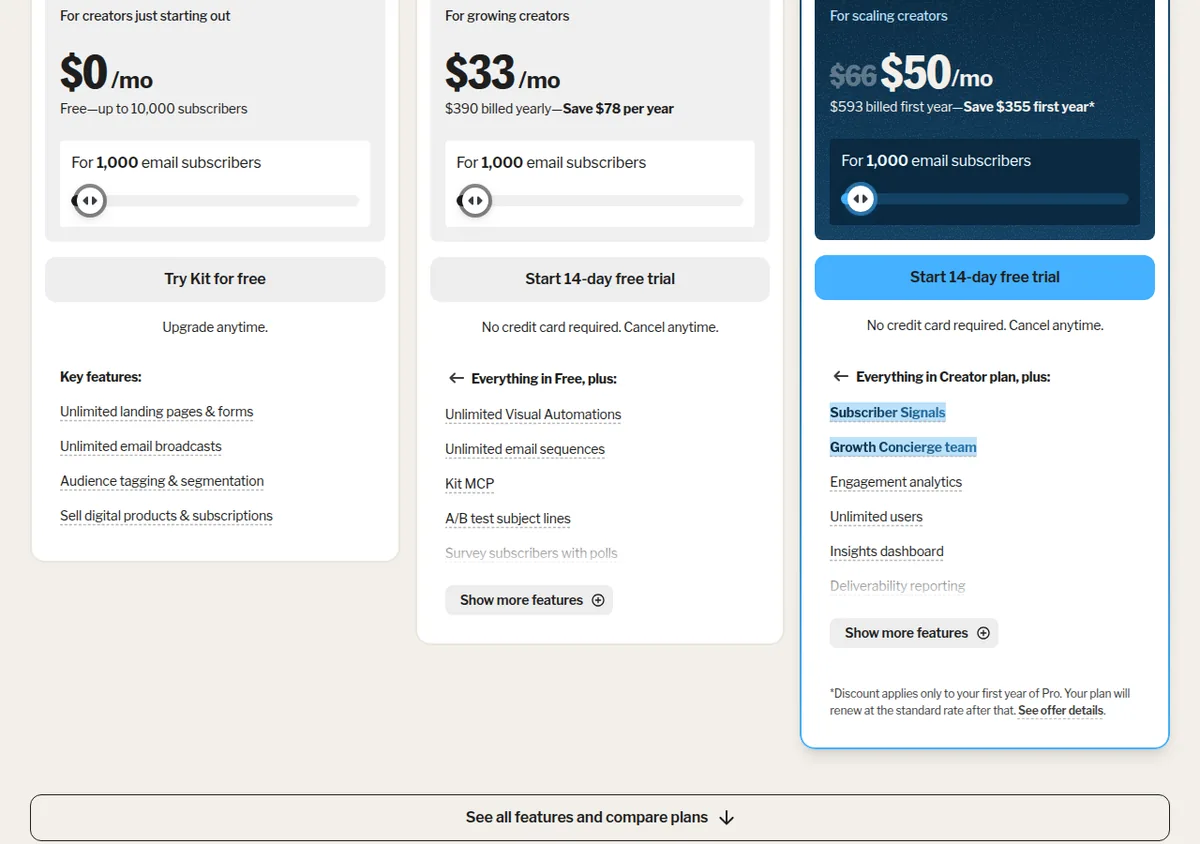
Kit is the strongest destination when the agency owns the audience and one person controls publishing. Free costs $0 per month for up to 10,000 subscribers and includes unlimited landing pages and forms, unlimited email broadcasts, audience tagging and segmentation, and digital-product selling. A consultancy newsletter, studio lead magnet or agency publication can therefore move without an immediate paid subscription.
The access rule changes the answer for a team. Kit Free is stated as 1 user, so the 10,000-subscriber allowance should not be mistaken for a multi-person licence. A solo operator with 1,000 subscribers can remain at $0. A second person cannot be assumed to fit merely because the audience is small. Kit is an especially good Mailchimp alternative for agencies that send on behalf of their own business, not a verified answer for several client-owned workspaces.
Creator is the paid step for a small pair. At up to 1,000 subscribers, it costs $39 per month at the standing monthly price or $390 billed yearly, with the annual display showing $33 per month. Creator includes 2 users, unlimited visual automations, unlimited sequences, A/B testing, removal of Kit branding, SMS marketing, integrations and 24/7 support. A two-person studio with 1,000 subscribers therefore has a named scenario of $39 monthly, or $390 for the year when billed yearly.
Pro is the access and reporting step. At the smallest displayed subscriber tier, its standing price is $79 per month, and the standard annual display is $66 per month equivalent. Kit also shows a $593 first-year promotion, displayed as $50 per month, but that is not the standing price. Pro adds subscriber signals, engagement analytics and deliverability reporting, and it includes unlimited users. A five-person studio at 1,000 subscribers has a standing scenario of $79 monthly. The verified files do not publish Kit paid prices at 2,500, 5,000 or 10,000 subscribers, so do not use the 1,000-subscriber figure as a growth forecast.
MailerLite
Best for several people working together MailerLite Power $39 monthly at 1,000 subscribers with unlimited seats
MailerLite is the clearest destination for a collaborative small agency. Power includes unlimited user seats, unlimited monthly emails subject to fair use, unlimited automations, unlimited landing pages and signup forms, and unlimited digital products and bookings. At up to 1,000 subscribers, it costs $39 per month billed monthly or $35.10 per month billed yearly. A five-person studio with 1,000 subscribers pays $39 monthly, and every person fits within the published access rule.
Power has the most useful published growth ladder of the three alternatives. At 2,500 subscribers it costs $49 per month, at 5,000 it costs $69, and at 10,000 it costs $129 when billed monthly. The annual-equivalent figures are $44.10, $62.10 and $116.10 at those same sizes, and the page states that annual billing saves 10%. Those are forecastable bands, not proof that several client lists become separate workspaces.
Comfort is cheaper at the first tier, but the access trade-off is material. At 1,000 subscribers it costs $19 per month or $17.10 billed yearly, includes 3 seats, 50 automations, up to 10 websites and landing pages combined, 10 signup forms, and 5 digital products or bookings. At 2,500, 5,000 and 10,000 subscribers, Comfort costs $33, $49 and $89 monthly. A five-person team should not choose Comfort just because its list fits; the published 3-seat allowance is the blocker.
MailerLite Free is a useful test, not a direct replacement for a larger Mailchimp account. It costs $0 up to 250 subscribers, with 2 seats, 2,500 emails per month and 3 automations. That makes it more collaborative than a one-seat free allowance at the access level, but it is capped at the same 250-subscriber count stated in the Mailchimp free reference. At 1,000 subscribers, the free option is no longer available.
GetResponse
Best for a defined three-person starting team GetResponse Starter €16 monthly at 1,000 contacts
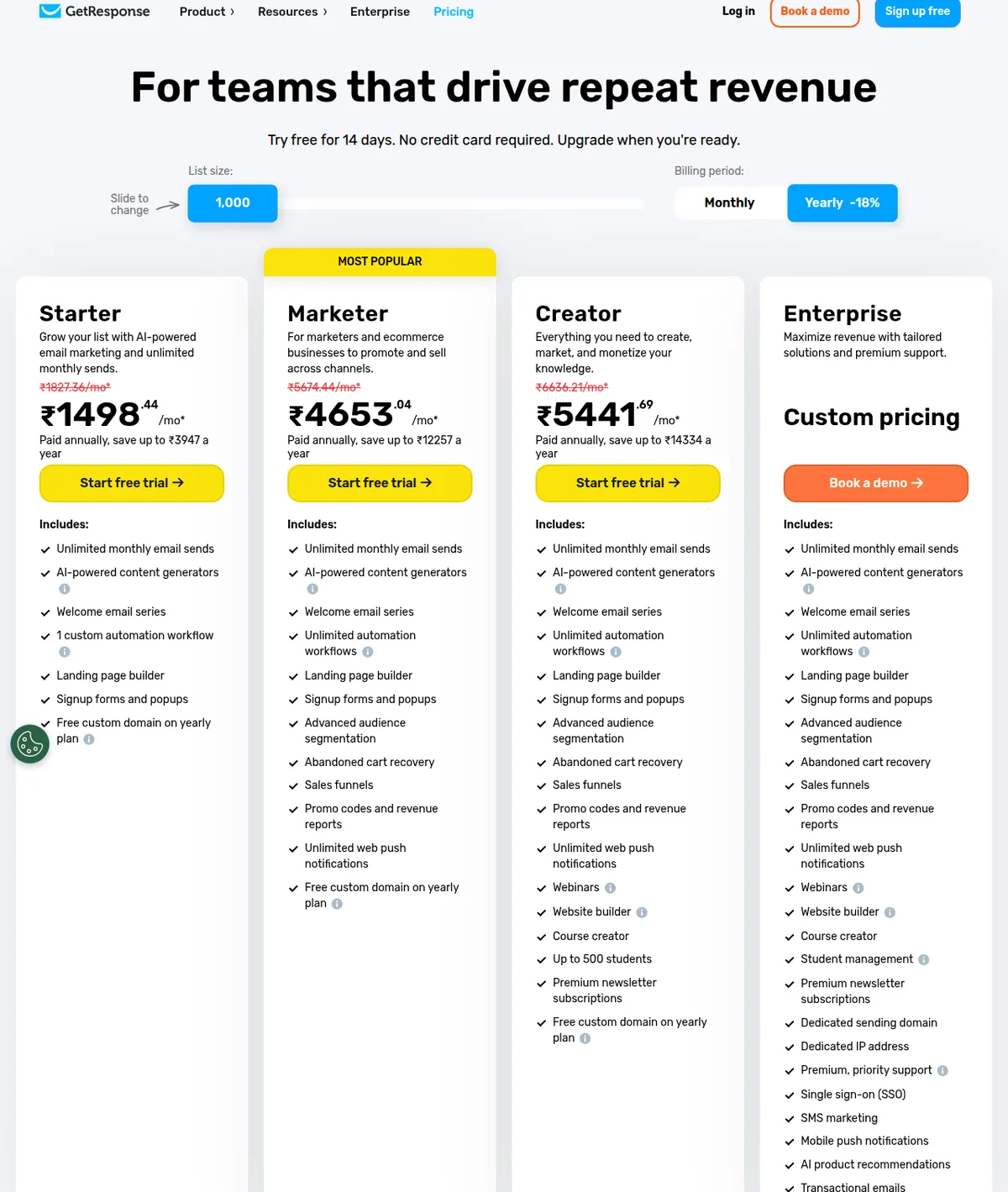
GetResponse suits an agency that wants a named user allowance and an automation path. At 1,000 contacts, Starter costs €16 per month monthly or €13.12 per month billed yearly and includes 3 users, unlimited monthly sends, 1 automation workflow, landing pages and forms, AI tools limited to 3 uses, and a free custom domain on yearly plans. A three-person agency with 1,000 contacts has a clear scenario at €16 monthly.
Marketer at 1,000 contacts costs €54 per month monthly or €44.28 per month billed yearly, with up to 5 users, unlimited automation workflows, sales funnels and abandoned-cart recovery. A five-person studio has a named scenario at €54 monthly. Creator costs €62 per month monthly or €50.84 per month billed yearly, also with up to 5 users, and adds webinars for up to 100 attendees, a course builder up to 500 students and paid newsletters.
The pricing gap is the central weakness. The verified material gives GetResponse figures at 1,000 contacts but does not state prices for 2,500, 5,000 or 10,000 contacts. Do not carry €16 into a larger-list budget. The page served EUR, while its FAQ separately quotes a US Starter price of $19 per month at 1,000 subscribers. Those displays are not converted or merged here.
Kit, MailerLite and GetResponse compared
Caption: verified prices at the smallest published paid subscriber or contact tier, with the relevant free caps and access rules.
| Tool and plan | Named starting cost | Published access | What an agency should notice |
|---|---|---|---|
| Kit Free | $0 up to 10,000 subscribers | 1 user | Forms, broadcasts, tagging, segmentation and digital products |
| Kit Creator | $39 monthly or $390 billed yearly at 1,000 | 2 users | Unlimited visual automations and sequences |
| Kit Pro | $79 monthly at 1,000 | Unlimited users | Reporting and deliverability features; higher-list price not stated |
| MailerLite Free | $0 up to 250 subscribers | 2 seats | 2,500 monthly emails and 3 automations |
| MailerLite Comfort | $19 monthly at 1,000 | 3 seats | 50 automations and 10 signup forms |
| MailerLite Power | $39 monthly at 1,000 | Unlimited seats | Unlimited automations, monthly emails and signup forms |
| GetResponse Starter | €16 monthly at 1,000 contacts | 3 users | 1 automation workflow and unlimited monthly sends |
| GetResponse Marketer | €54 monthly at 1,000 contacts | Up to 5 users | Unlimited automation workflows |
| GetResponse Creator | €62 monthly at 1,000 contacts | Up to 5 users | Webinars, courses and paid newsletters |
MailerLite is the only alternative here with a published paid price ladder through 10,000 subscribers. Kit is the only one with a free subscriber ceiling of 10,000, but its free access is one user. GetResponse is the only one with a three-user starting plan at the verified 1,000-contact price, but the larger bands are not stated.
Mailchimp should be compared on capability and access, not against an invented price row. Its verified free reference is $0 for 250 contacts, 1 seat, 500 sends per month and 250 per day. Its paid standing price could not be verified. The page does advertise time-limited introductory offers, so an agency should record the renewal basis before deciding that a headline offer beats a destination with a published standing price.
The seat and billing traps
Unlimited seats are not client workspaces. Power's unlimited seats mean more agency staff can access the account. Kit Pro's unlimited users mean the same. Neither statement confirms a client sub-account, separate billing, client-owned audience or permission boundary. If each client must approve, own and later retrieve its data, treat account separation as a requirement to verify, not an outcome to infer.
Do not confuse a promotion with a renewal budget. Kit's $593 first-year Pro display is promotional. Mailchimp's paid standing price is not verified, and the page's introductory offers are time-limited. A switching plan should use a published standing figure where one exists and leave an unresolved figure unresolved. The methodology explains why that restraint is part of the price check.
What an agency loses by switching platforms
Form signup history is one of the two items teams most often lose. Export the contact records, tags, segments, consent fields and any available form or source details before cancelling. Preserve the form names, destinations, confirmation language and signup context in a separate internal record. Do not assume that importing a contact list recreates the history of how each person joined.
Automation logic is the second loss. Export or document every trigger, delay, condition, branch, email, exit rule and audience change. Capture the email copy and the order of the steps, then rebuild one representative journey and test it before switching every client. A destination that has unlimited automations is not automatically a destination that imports the old logic.
Save the campaign reports used for client reviews, templates, audience naming conventions and suppression decisions. Switching also changes the operating language: Kit may simplify an owned publication, MailerLite Power changes the budget discipline, and GetResponse Starter's one-workflow limit may force a journey redesign.
Before cancellation, rehearse one audience and one automation. Compare the new form path, consent capture, tags, suppression behavior, email rendering and report fields, and keep the old account available until the export and rebuilt journey pass review. The aim is to preserve ownership, consent, logic and evidence, not every old screen.
Who should not buy this
Do not switch simply because a promotional headline looks cheaper. Mailchimp's paid standing price was not verifiable in the permitted material, so the responsible next step is to record the current renewal terms from the account and compare them with a destination's published standing price. Never replace an unresolved cost with a temporary offer.
Stay on Kit Free when one operator sends for the agency's own business, the audience stays under 10,000 subscribers and the stated 1-user access rule is enough. Do not choose it for a team that needs several logins or for a client-account model that has not been verified.
Stay on MailerLite Free when the audience is no more than 250 subscribers, monthly sending stays within 2,500 emails, 3 automations are enough and 2 seats cover the team. At 1,000 subscribers, choose a named paid tier instead of pretending the free plan is a long-term agency workspace.
Do not buy GetResponse yet when the budget depends on a known 2,500, 5,000 or 10,000-contact price. Those figures are not stated in the verified material. Do not choose Starter when several client journeys need more than its one automation workflow, and do not assume a three-user plan creates three client workspaces.
Buy nothing until the agency has an owner for consent records, list hygiene, approvals, export storage and migration testing. A tool change without that ownership can make reporting and client handover worse, even when the new plan has a lower visible cost.
Our verdict: best Mailchimp alternatives
Choose MailerLite Power as the default destination for a collaborative agency. At 1,000 subscribers it is $39 monthly with unlimited seats, and its published Power ladder reaches $49 at 2,500, $69 at 5,000 and $129 at 10,000. That is the clearest budget for a team carrying growing work in one account, although client sub-accounts still require separate confirmation.
Choose Kit Free when one person sends on behalf of the agency's own business and the list stays within 10,000 subscribers. Choose Creator when two people need unlimited visual automations and sequences at $39 monthly or $390 billed yearly at 1,000 subscribers. Choose Pro when unlimited users and reporting justify its $79 standing monthly price. Kit is not the verified answer for several client-owned lists.
Choose GetResponse Starter when three users, one automation workflow and the 1,000-contact scenario at €16 monthly fit the immediate need. Choose Marketer for up to five users and unlimited automation workflows at €54 monthly at 1,000 contacts. Get a current figure before budgeting a larger list because those prices are not stated above 1,000 contacts.
Frequently asked questions
What are the best Mailchimp alternatives for agencies?
MailerLite Power is the best default for a collaborative team because it publishes unlimited seats and clear prices from 1,000 through 10,000 subscribers. Kit is better for one operator sending for an owned audience, while GetResponse fits a defined three-user need at 1,000 contacts.
What are the Mailchimp free plan limits?
The verified Mailchimp free plan is $0 for up to 250 contacts and 1 seat. It also allows 500 sends per month, with a 250-sends-per-day limit. Those are the only Mailchimp price and free-tier figures used here.
How much does a 1,000-subscriber alternative cost?
Kit is $0 on Free, $39 per month on Creator or $79 per month on Pro at the smallest displayed tier. MailerLite is $19 monthly on Comfort or $39 on Power, while GetResponse is €16 on Starter, €54 on Marketer or €62 on Creator. Billing labels remain distinct, so annual-equivalent figures should not be substituted for monthly prices.
Is Mailchimp cheaper than MailerLite?
A fair standing-price comparison cannot be published because Mailchimp's paid standing prices were not verifiable. Its pricing page displays time-limited introductory offers without a standing price in a form that could be checked, so an agency should never treat a promotional headline as the real renewal cost.
Does GetResponse publish a price above 1,000 contacts?
The verified material publishes GetResponse prices at 1,000 contacts only: €16 monthly for Starter, €54 for Marketer and €62 for Creator. Prices for 2,500, 5,000 and 10,000 contacts are not stated, so obtain a current quote before moving a larger list.
What should an agency export before leaving Mailchimp?
Preserve contact records, tags, segments, consent fields, form context, campaign reports, templates and a written map of every automation trigger, condition, branch, delay, email and exit rule. Form signup history and automation logic are the two losses most likely to make a migration hard to explain, so test one rebuilt journey before cancelling the old account.